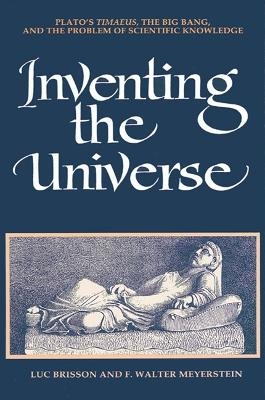
Inventing the Universe
State University of New York Press (Verlag)
978-0-7914-2692-0 (ISBN)
The "irrational gap" between perception and explanation can be appraised historically and identified in three stages: Plato's Timaeus furnishes the first example of a scientific theory dealing with a realm of ideality that cannot be derived from immediate sensible perception; the Big Bang model is constituted on the basis of the purely geometrical notion of symmetry; and in the more recent Algorithmic Theory of Information, the analysis of the purely symbolic language expressing physical reality reveals the level of complexity of any given theory formulated in this language. The result is that the probability of the universe actually conforming with simple mathematics is zero.
In a formal system, a theorem contains more information than can be found in the set of axioms of this system, and it remains undecidable. In Aristotle' s language, the theorems that can be proved within a theoretical model are already potentially contained in the system of axioms underlying these theorems.
Luc Brisson is Director of Research at Centre National de la Recherche Scientifique. He has published several books and articles. F. Walter Meyerstein is in the Philosophy Department at the Universitate Autonoma de Barcelona, and is studying the philosophical implications of modern science.
Acknowledgments Introduction: The Problem of Scientific Knowledge
Situating the problem: our essential presuppositions
The procedure followed in this analysis
The Model of the Universe in Plato's Timaeus
The Big Bang Model of Cosmology
Algorithmic Information Theory
Notes
Part I: The Model of the Universe in the Timaeus
The date of the composition of the Timaeus
The first twelve axioms of the cosmological model advanced in the Timaeus
Plato's theory of matter and the cosmological axioms
Plato's explanation of the complexity of sensible things
Experimental verification in Plato's time
Standards and instruments of measure in Plato's time
The numbering system in Plato's time
Experimentation in the Timaeus
Notes
Part II: Contemporary Big Bang Cosmology
A. The standard Big Bang model: short description
The "philosophical" presuppositions
The geometric axioms
Einstein's gravitation
Einstein's dynamic axioms: matter and energy in the universe
time and causality in the universe
Solving Einstein's field equations
Isotropy and homogeneity of the energy/matter content of the universe: the standard Friendmann-Robertson-Walker model
B. The relation between the model and observation
The Hubble law
Cosmic microwave background radiation
The relative abundance of light elements
Observational limits in cosmology
Problems affecting the FRW model: observations requiring additional axioms
The inflationary scenario
C. Modern theory of matter
The central role of the concept of symmetry
Notes
Part III: What Knowledge is Conveyed by Science?
The symbolic description of reality
Algorithmic Information Theory: some relevant aspects
The Turing machine
A definition of science
The science of the axioms in Aristotle's Posterior Analytics
Final conclusions
Notes
Indices
| Erscheint lt. Verlag | 20.7.1995 |
|---|---|
| Reihe/Serie | SUNY series in Ancient Greek Philosophy |
| Verlagsort | Albany, NY |
| Sprache | englisch |
| Gewicht | 290 g |
| Themenwelt | Geisteswissenschaften ► Philosophie ► Philosophie Altertum / Antike |
| ISBN-10 | 0-7914-2692-0 / 0791426920 |
| ISBN-13 | 978-0-7914-2692-0 / 9780791426920 |
| Zustand | Neuware |
| Informationen gemäß Produktsicherheitsverordnung (GPSR) | |
| Haben Sie eine Frage zum Produkt? |
aus dem Bereich