


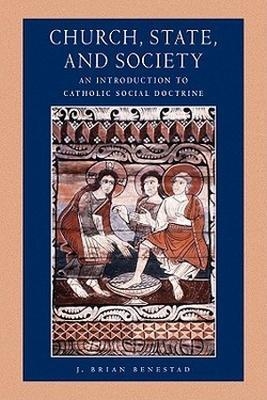
Church, State and Society
An Introduction to Catholic Social Doctrine
Seiten
2011
The Catholic University of America Press (Verlag)
978-0-8132-1801-4 (ISBN)
The Catholic University of America Press (Verlag)
978-0-8132-1801-4 (ISBN)
- Titel erscheint in neuer Auflage
- Artikel merken
Zu diesem Artikel existiert eine Nachauflage
Explains the nuanced understanding of human dignity and the common good found in the Catholic intellectual tradition. It makes the case that liberal-arts education is an essential part of the common good because it helps people understand their dignity and all that justice requires.
How can the Catholic faith help not only Catholics, but all people, build a just and flourishing society?
The Catholic Church contributes first and foremost to the common good by forming the consciences of the faithful. Faith helps reason achieve a proper understanding of the common good and thereby guides what individuals need to do to live justly and harmoniously. In this book, J. Brian Benestad provides a detailed and accessible introduction to Catholic social doctrine (CSD), the Church's teachings concerning the human person, the family, society, political life, charity, justice, and social justice.
Church, State, and Society explains the nuanced understanding of human dignity and the common good found in the Catholic intellectual tradition. It makes the case that liberal-arts education is an essential part of the common good because it helps people understand their dignity and all that justice requires. The author shows the influence of ancient and modern political philosophy on CSD philosophy and examines St. Augustine, St. Thomas Aquinas, papal social encyclicals, Vatican Council II, and postconciliar magisterial teaching. Benestad highlights the teachings of popes John Paul II and Benedict XVI that the attainment of the common good depends on the practice of the virtues by citizens and leaders alike.
The book is divided into four parts. The first treats key themes of social life: the dignity of the human person, human rights, natural law, and the common good. Part two focuses on the three principal mediating institutions of civil society: the family, the Church, and the Catholic university. Part three considers the economy, work, poverty, immigration, and the environment, while part four focuses on the international community and just war principles. The conclusion discusses tension between CSD and liberal democracy.
How can the Catholic faith help not only Catholics, but all people, build a just and flourishing society?
The Catholic Church contributes first and foremost to the common good by forming the consciences of the faithful. Faith helps reason achieve a proper understanding of the common good and thereby guides what individuals need to do to live justly and harmoniously. In this book, J. Brian Benestad provides a detailed and accessible introduction to Catholic social doctrine (CSD), the Church's teachings concerning the human person, the family, society, political life, charity, justice, and social justice.
Church, State, and Society explains the nuanced understanding of human dignity and the common good found in the Catholic intellectual tradition. It makes the case that liberal-arts education is an essential part of the common good because it helps people understand their dignity and all that justice requires. The author shows the influence of ancient and modern political philosophy on CSD philosophy and examines St. Augustine, St. Thomas Aquinas, papal social encyclicals, Vatican Council II, and postconciliar magisterial teaching. Benestad highlights the teachings of popes John Paul II and Benedict XVI that the attainment of the common good depends on the practice of the virtues by citizens and leaders alike.
The book is divided into four parts. The first treats key themes of social life: the dignity of the human person, human rights, natural law, and the common good. Part two focuses on the three principal mediating institutions of civil society: the family, the Church, and the Catholic university. Part three considers the economy, work, poverty, immigration, and the environment, while part four focuses on the international community and just war principles. The conclusion discusses tension between CSD and liberal democracy.
J. Brian Benestad is professor of theology at the University of Scranton and the author of numerous book chapters and journal articles published on Catholic social doctrine. He is editor of Fellowship of Catholic Scholars Quarterly.
| Erscheint lt. Verlag | 30.3.2011 |
|---|---|
| Reihe/Serie | Catholic Moral Thought |
| Verlagsort | Washington |
| Sprache | englisch |
| Maße | 153 x 227 mm |
| Gewicht | 696 g |
| Themenwelt | Religion / Theologie ► Christentum ► Kirchengeschichte |
| ISBN-10 | 0-8132-1801-2 / 0813218012 |
| ISBN-13 | 978-0-8132-1801-4 / 9780813218014 |
| Zustand | Neuware |
| Informationen gemäß Produktsicherheitsverordnung (GPSR) | |
| Haben Sie eine Frage zum Produkt? |
Mehr entdecken
aus dem Bereich


aus dem Bereich
eine andere Geschichte der Papststadt
Buch | Softcover (2024)
C.H.Beck (Verlag)
CHF 25,20
die Macht des Dunklen in unserer Zeit und wie wir ihr entgegentreten
Buch | Hardcover (2025)
Verlag Herder
CHF 27,90


