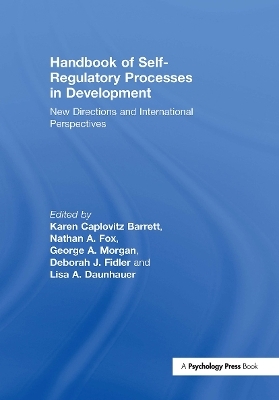
Handbook of Self-Regulatory Processes in Development
Psychology Press Ltd (Verlag)
9781848729193 (ISBN)
Outstanding features include:
Reviews the development of self and emotional regulation from infancy through adolescence.
Contributors from various countries and backgrounds provide an integrative review of the literature to guide the direction of future research.
Features contributions from those who have had a strong impact on self-regulation research.
Reviews research on developmental disorders that have implications for self-regulation.
There are four sections. Section one introduces the development of self- and emotional regulation. This section reviews how self-regulation adapts based on personal and culturally-based goals and how individual differences predispose some to behavior disorders. Socialization influences are examined including a look at when typical regulation processes go awry. Section 2 examines physiological and brain processes as they relate to the development of typical and atypical processes, along with neurocognitive development of performance monitoring and how these processes change over time, cortical activation differences, and behavioral and electrocortical measures of attentional bias. Section 3 reviews the development of self-regulation and mastery motivation including a review of the Dimensions of Mastery Questionnaire (DMQ), cross-national comparisons, and what the DMQ can tell us about self-regulation. The section concludes with a look at the development of self-regulation and mastery motivation in individuals with a developmental disability. Section 4 examines self-regulation in atypical development and evidence-based treatment approaches in children with ADHD, autism, and Down syndrome.
This book is intended for researchers, graduate students, and practitioners in psychology, neuroscience, human development, and education interested in the development of self and emotional regulatory processes.
Karen Caplovitz Barrett, Ph.D., is Professor and Assistant Department Head of Human Development and Family Studies at Colorado State University. Her research takes a functionalist approach to studying emotion processes and their development, with a particular focus on emotion regulation and "social emotions" (such as guilt and shame) during early development, and on cultural and other socialization influences on these processes. Current research projects are in three major areas: (1) the effect of early intervention on early socioemotional competence and school readiness, and on prevention of emotion regulation difficulties; (2) how emotion regulatory and self-regulatory processes develop during early childhood, in typical, atypical, and at-risk populations; and (3) how social emotions develop during early childhood, and how socialization and cultural beliefs impact this development. Nathan A. Fox, Ph.D., is Distinguished University Professor in the Department of Human Development at the University of Maryland College Park. Professor Fox has completed research on the biological bases of social and emotional behavior developing methods for assessing brain activity in infants and young children during tasks designed to elicit a range of emotions. His work is funded by the National Institutes of Health where he was awarded a MERIT award for excellence of his research program examining social and emotional development of young children. Dr. Fox was awarded the Distinguished Scientific Investigator Award from the National Association for Research in Schizophrenia and Depression (NARSAD) and was appointed a Fellow of the American Association for the Advancement of Science in 2008. George A. Morgan, Ph.D., is Emeritus Professor of Education and Human Development at Colorado State University. He received his Ph.D. in child development and psychology from Cornell University in 1965. Over the past 35 years, he has conducted a program of research on children's motivation to master challenging tasks. He has advised many Ph.D. students in education and related fields and also has written text books on SPSS and research methods. Deborah J. Fidler, Ph.D., is Professor of Human Development and Family Studies at Colorado State University. Her research expertise is in the area of early atypical development, with a particular focus on the emerging behavioral phenotype in Down syndrome. She has published over 30 articles on cognition and behavioral development in children with various neurogenetic disorders, with the goal of identifying potential targets for early intervention and improving educational practice in these populations. Lisa A. Daunhauer, Sc.D., is Associate Professor in the Department of Human Development and Family Studies at Colorado State University. Her research has focused on bridging the divide between research in behavioral phenotypes and cutting-edge practice in intervention science, particularly occupational therapy. Her current projects are designed to examine executive functioning and its relationship to participation in everyday life and academic achievement in children with Down syndrome and other developmental disabilities.
Section One: Development of Emotion Regulation & Self-Regulation.K. C. Barret, Introduction to Section I. Overview and Analysis. R.A. Thompson, E. A. Virmani, S. F. Waters, H. A. Raikes, S. Meyer, The Development of Emotion Self-Regulation: The Whole and the Sum of the Parts. M. Holodynski, D. Seeger, P. Kortas-Hartmann, V. Wörmann, Placing Emotion Regulation in a Developmental Framework of Self-Regulation. K. C. Barrett, Adaptive and Maladaptive Regulation of and by Emotion: Process, Context, and Relation to Self-regulation. J. Zeman, M. Cassano, M. Adrian, Socialization Influences on Children’s and Adolescents’ Emotional Self-Regulation Processes: A Developmental Psychopathology Perspective. Section Two: Development of Self Regulation: Physiological and Brain Processes.N. A. Fox, Introduction to Section II. Overview and Analysis. H. A. Henderson, P. C. Mundy, The Integration of Self and Other in the Development of Self-regulation: Typical and Atypical Processes. T. A. Dennis, L. J. O’Toole, J. M. DeCicco, Emotion Regulation from the Perspective of Developmental Neuroscience: What, Where, When, and Why. K. Hum, M. D. Lewis, Neural Mechanisms of Emotion Regulation in Children: Implications for Normative Development and Emotion-related Disorders. P. Cédric, M. P. Koolschijn, E. A. Crone, The Neurocognitive Development of Performance Monitoring. A. MacNamara, E. S. Kappenman, S. R. Black, J. N. Bress, G. Hajcak, Integrating Behavioral and Electrocortical Measures of Attentional Bias Toward Threat. Section Three: Development of Self Regulation and Mastery Motivation.N. A. Busch-Rossnagel, G. A. Morgan, Introduction to Section III: Mastery Motivation and Self-Regulation. K. Józsa, D. E. Molnár, The Relationship between Mastery Motivation, Self-Regulated Learning and School Success: a Hungarian and European Perspective. G. A. Morgan, J. Wang, H. F. Liao, Q. Xu, Using the Dimensions of Mastery Questionnaire (DMQ) to Assess Mastery Motivation of English- and Chinese- Speaking Children: Psychometrics and Implications for Self-Regulation. J. Wang, K. C. Barrett, Mastery Motivation and Self-regulation during Early Childhood. M. Cuskelly, L. Gilmore, A. Carroll, Self-regulation and Mastery Motivation in Individuals with Developmental Disabilities: Barriers, Supports and Strategies. Section Four: Self Regulation In A Typical Development.L. A. Daunhauer, D. J. Fidler, Self-Regulation in Atypical Development: An Overview of the Section. C. M. Walcott, Current Perspectives on Preschool Attention-Deficit/Hyperactivity Disorder. S. L. Hepburn, B. C. Wolff, Self-Regulation in Persons with Autism Spectrum Disorders. L. A. Daunhauer, D. J. Fidler, Executive Functioning in Individuals with Down syndrome.
| Erscheint lt. Verlag | 8.2.2013 |
|---|---|
| Zusatzinfo | 33 Tables, black and white; 18 Line drawings, black and white; 12 Halftones, black and white; 30 Illustrations, black and white |
| Verlagsort | Hove |
| Sprache | englisch |
| Maße | 178 x 254 mm |
| Gewicht | 1086 g |
| Themenwelt | Geisteswissenschaften ► Psychologie ► Allgemeine Psychologie |
| Geisteswissenschaften ► Psychologie ► Entwicklungspsychologie | |
| Geisteswissenschaften ► Psychologie ► Pädagogische Psychologie | |
| Geisteswissenschaften ► Psychologie ► Verhaltenstherapie | |
| ISBN-13 | 9781848729193 / 9781848729193 |
| Zustand | Neuware |
| Informationen gemäß Produktsicherheitsverordnung (GPSR) | |
| Haben Sie eine Frage zum Produkt? |
aus dem Bereich