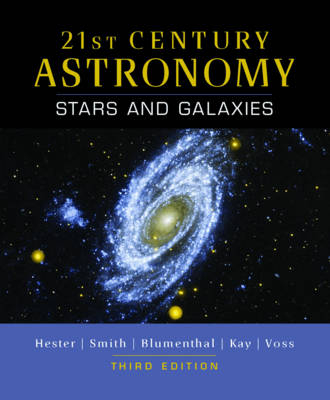
21St Century Astronomy
WW Norton & Co (Verlag)
978-0-393-93285-0 (ISBN)
- Titel ist leider vergriffen;
keine Neuauflage - Artikel merken
through the eyes of a scientist.
21st Century Astronomy?s distinctive writing style,
superior art, and supporting media package all work together to
teach students how science works, help students visualize basic
concepts and physical processes, and keep students focused on the
?big picture.?
For the Third Edition, the entire text has been reread from a
student?s perspective and rewritten to eliminate jargon and
ensure that the book?s hallmark tone resounds throughout
every chapter. New Visual Analogy icons help students connect the
textual analogies used to describe physical processes with the
figures that illustrate them, and new AstroTour animations and
simulations developed at the University of Nebraska provide
students with opportunities for interactive learning.
Jeff Hester is professor of physics and astronomy at Arizona State University. He studies the interstellar medium in the Milky Way and external galaxies, the structure of the diffuse ISM, and supernova remnants. Brad Smith is a retired professor of planetary science. He has served as an associate professor of astronomy at New Mexico State University, a professor of planetary sciences and astronomy at the University of Arizona, and as a research astronomer at the University of Hawaii. Through his interest in Solar System astronomy, he has participated as a team member or imaging team leader on several U.S. and international space missions, including Mars Mariners 6, 7, and 9; Viking; Voyagers 1 and 2; and the Soviet Vega and Phobos missions. He later turned his interest to extrasolar planetary systems, investigating circumstellar debris disks as a member of the Hubble Space Telescope NICMOS experiment team. Brad has four times been awarded the NASA Medal for Exceptional Scientific Achievement. He is a member of the IAU Working Group for Planetary System Nomenclature and is Chair of the Task Group for Mars Nomenclature. George Blumenthal is chancellor at the University of California-Santa Cruz, where he has been a professor of astronomy and astrophysics since 1972. Chancellor Blumenthal received his BS degree from the University of Wisconsin-Milwaukee and his PhD in physics from the University of California-San Diego. As a theoretical astrophysicist, Chancellor Blumenthal's research encompasses several broad areas, including the nature of the dark matter that constitutes most of the mass in the universe, the origin of galaxies and other large structures in the universe, the earliest moments in the universe, astrophysical radiation processes, and the structure of active galactic nuclei such as quasars. Laura Kay is Ann Whitney Olin professor and Chair of the Department of Physics and Astronomy at Barnard College, where she has taught since 1991. She received a BS degree in physics and an AB degree in feminist studies from Stanford University, and MS and PhD degrees in astronomy and astrophysics from the University of California-Santa Cruz. As a graduate student she spent 13 months at the Amundsen Scott station at the South Pole in Antarctica, and has had fellowships in Chile and Brazil. She studies active galactic nuclei using optical and X-ray telescopes. At Barnard she teaches courses on astronomy, astrobiology, women and science, and polar exploration. Howard Voss is professor of physics emeritus at Arizona State University and has been active in the American Association of Physics Teachers and the American Institute of Physics.
Part I: Introduction to Astronomy
Chapter 1: Why Learn Astronomy?
Chapter 2: Patterns in the Sky-Motions of Earth
Chapter 3: Gravity and Orbits-A Celestial Ballet
Chapter 4: Light
Chapter 5: The Tools of the Astronomer
Part II: The Solar System
Chapter 6: The Birth and Evolution of Planetary Systems
Chapter 7: The Terrestrial Planets and Earth's Moon
Chapter 8: Atmospheres of the Terrestrial Planets
Chapter 9: Worlds of Gas and Liquid-The Giant Planets
Chapter 10: Gravity Is More Than Kepler's Laws
Chapter 11: Planetary Adornments-Moons and Rings
Chapter 12: Dwarf Planets and Small Solar System Bodies
Part III: Stars and Stellar Evolution
Chapter 13: Taking the Measure Of Stars
Chapter 14: A Run-of-the-Mill G Type Star-Our Sun
Chapter 15: Star Formation and the Interstellar Medium
Chapter 16: Stars in the Slow Lane: Low-Mass Stellar Evolution
Chapter 17: Live Fast, Die Young: High Mass Stellar Evolution
Part IV: Galaxies, the Universe, and Cosmology
Chapter 18: Our Expanding Universe
Chapter 19: Galaxies
Chapter 20: The Milky Way-A Normal Spiral Galaxy
Chapter 21: Modern Cosmology
Chapter 22: Structure in the Universe
Chapter 23: Life
| Erscheint lt. Verlag | 11.1.2010 |
|---|---|
| Zusatzinfo | Figures; Illustrations, color; Illustrations, black and white |
| Verlagsort | New York |
| Sprache | englisch |
| Gewicht | 1195 g |
| Themenwelt | Geisteswissenschaften ► Psychologie |
| Naturwissenschaften ► Physik / Astronomie ► Astronomie / Astrophysik | |
| ISBN-10 | 0-393-93285-0 / 0393932850 |
| ISBN-13 | 978-0-393-93285-0 / 9780393932850 |
| Zustand | Neuware |
| Informationen gemäß Produktsicherheitsverordnung (GPSR) | |
| Haben Sie eine Frage zum Produkt? |
aus dem Bereich