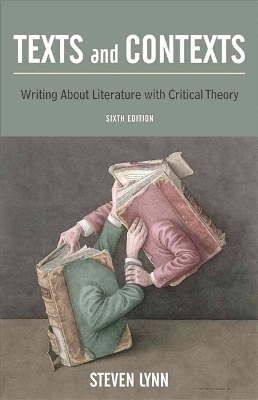
Texts and Contexts
Pearson (Verlag)
9780205716746 (ISBN)
- Titel erscheint in neuer Auflage
- Artikel merken

Texts and Contexts: Writing about Literature presents a user-friendly introduction to contemporary critical theories—from new criticism to cultural studies—as part of the practice of analyzing and writing about literature. Some of the changes to the new edition include enhanced coverage of film and other genres reflecting the growing interest in film as an academic field and engaging students. New sample texts and projects, all classroom-tested, appear at the end of every theory chapter, along with guiding questions to offer more practice for students in applying critical theory to literary texts. There is more on current approaches to literature, including the relationship between rhetoric and reader-response criticism, Marxism, postcolonialism, queer theory, feminist theory, and African-American studies.
Preface
1 An Introduction, Theoretically
Textual Tours
Checking Some Baggage
Anything to Declare?
Recommended Further Reading
2 Critical Worlds: A Selective Tour
Brendan Gill, from Here at “The New Yorker”
New Criticism
Reader-Response Criticism
Deconstructive Criticism
Historical Approaches
Psychological Criticism
Feminist Criticism
Other Approaches
Works Cited
Recommended Further Reading
3 Unifying the Work: New Criticism
The Purpose of New Criticism
Basic Principles Reflected
Archibald MacLeish, “Ars Poetica”
Radicals in Tweed Jackets
How to Do New Criticism
The Writing Process: A Sample Essay
Gwendolyn Brooks, “The Mother” 48
Preparing to Write
Shaping
Drafting
Practicing New Criticism
Lucille Clifton, “forgiving my father”
Stephen Shu-ning Liu, “My Father’s Martial Art”
Ben Jonson, “On My First Son”
“The Prodigal Son” (Luke 15: 11—32, King James Version)
Useful Terms
Checklist
Works Cited and Recommended Reading
4 Creating the Text: Reader-Response Criticism
The Purpose of Reader-Response Criticism
New Criticism as the Old Criticism
The Reader Emerges
Hypertextual Readers
How to Do Reader-Response Criticism
Preparing to Respond
Sandra Cisneros, “Love Poem #1”
Making Sense
Subjective Response
Receptive Response
The Writing Process: A Sample Essay
Preparing to Respond
Ernest Hemingway, “A Very Short Story”
Preparing to Write
Shaping
Drafting
Practicing Reader-Response Criticism
Michael Drayton, “Since There’s No Help”
Judith Minty, “Killing the Bear”
Caroline Fraser, “All Bears”
Emily Dickinson, “Through the Dark Sod”
Useful Terms
Works Cited and Recommended
Further Reading
5 Opening Up the Text: Deconstructive Criticism
The Purpose of Deconstruction
How to Do Deconstruction
William Butler Yeats, Sailing to Byzantium
The Writing Process: A Sample Essay
Amy Clampitt, “Discovery”
Preparing to Write
Shaping
Drafting
Practicing Deconstructive Criticism
Continuing Education, Cut Through the Anxiety...
William Blake, “London”
Linda Pastan, “Ethics”
John Donne, “Death Be Not Proud”
Useful Terms
Checklist
Works Cited and Recommended Further Reading
6 Connecting the Text: Varieties of Historical Criticism
The Purposes of Biographical, Historical, Postcolonial, Ethnic, Marxist, and Cultural
Studies
Biographical and Historical Criticism
John Milton, When I Consider How My Light Is Spent
Cultural Studies
New Historicism
History as Text
Marxist Criticism
Postcolonial Studies
How to Do Historical, Postcolonial, and Cultural Studies
The Writing Process: Sample Essays
John Cheever, Reunion
A Biographical Essay
Preparing to Write
Shaping
Drafting
A New Historical Essay
Preparing to Write
Shaping
Drafting
Practicing Historical, Postcolonial, and Cultural Studies
Useful Terms
Checklist
Works Cited and Recommended Further Reading
7 Minding the Work: Psychological Criticism
The Purpose of Psychological Criticism
How to Do Psychological Criticism
William Wordsworth, “A Slumber Did My Spirit Seal”
The Writing Process: A Sample Essay
William Shakespeare, from Hamlet
Preparing to Write
Shaping
Drafting
Practicing Psychological Criticism
Emily Dickinson, “A Narrow Fellow in the Grass”
Marianne Moore, “O to Be a Dragon”
Matthew Arnold, “Dover Beach”
Your Dream Here
Useful Terms
Checklist
Works Cited and Recommended Further Reading
8 Gendering the Text: Feminist Criticism, Post-Feminism, and Queer Theory
The Purposes of Feminist Criticism, Post-Feminism, and
Queer Theory
How to Do Feminist Criticism, Post-Feminism, and Queer Theory
Mary Astell, from A Serious Proposal
The Writing Process: A Sample Essay
Samuel Johnson, To Miss _____ On Her Playing upon the Harpsichord...
Preparing to Respond
Shaping
Drafting
Revision: Gay and Lesbian Criticism
Practicing Feminist, Post-Feminist and Queer Theory Criticism
William Shakespeare, Shall I Compare Thee...
Emily Dickinson, My Life had stood...
Tobias Wolff, “Say Yes”
Gender in the Movies
Useful Terms
Checklist
Works Cited
Recommended Further Reading
Appendix 1: John Donne, The Canonization
Appendix 2: How Theories Relate
Credits
Index
| Erscheint lt. Verlag | 1.7.2010 |
|---|---|
| Sprache | englisch |
| Maße | 140 x 216 mm |
| Gewicht | 331 g |
| Themenwelt | Geisteswissenschaften ► Sprach- / Literaturwissenschaft ► Anglistik / Amerikanistik |
| Geisteswissenschaften ► Sprach- / Literaturwissenschaft ► Literaturwissenschaft | |
| ISBN-13 | 9780205716746 / 9780205716746 |
| Zustand | Neuware |
| Informationen gemäß Produktsicherheitsverordnung (GPSR) | |
| Haben Sie eine Frage zum Produkt? |
aus dem Bereich