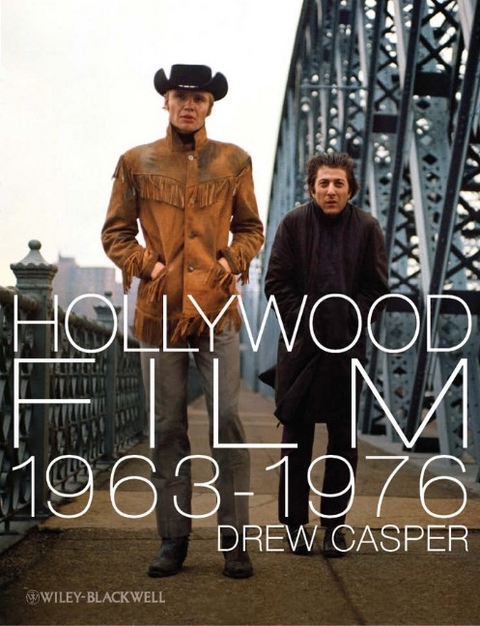
Hollywood Film 1963-1976
Wiley-Blackwell (Verlag)
9781405188289 (ISBN)
Hollywood 1963-1976 chronicles the upheaval and innovation that took place in the American film industry during an era of pervasive cultural tumult. Exploring the many ideologies embraced by an increasingly diverse Hollywood, Casper offers a comprehensive canon, covering the period's classics as well as its brilliant but overlooked masterpieces.
A broad overview and analysis of one of American film's most important and innovative periods
Offers a new, more expansive take on the accepted canon of the era
Includes films expressing ideologies contrary to the misremembered leftist slant
Explores and fully contextualizes the dominant genres of the 60s and 70s
Drew Casper is the Alma and Alfred Hitchcock Chair of American Film at the University of Southern California's School of Cinematic Arts. He is the author of Postwar Hollywood, 1946-1962 (Blackwell, 2007), Introduction to Film Reader (2007), Stanley Donen (1983), and Vincente Minnelli and the Film Musical (1977). He has contributed on many DVD commentaries for documentaries of classic and contemporary Hollywood films.
Acknowledgments. List of Illustrations.
Foreword.
Part I: Cultural Overview: The Years of Revolution and Reaction, 1963–76:
1. Major Historical Events.
Civil Rights Legislation and Protests.
The Vietnam War.
Law and Order.
Realpolitik.
2. Economic Situation.
Expanse and Contraction.
Downturn.
3. Societal Issues.
The New Left, the Counterculture, Neo-Conservatism, and the Silent Majority.
Ecology, Good Health, and Fitness.
Scientific/Technological Advances.
Conglomerate Ascendancy.
Media Society.
Crime.
Religion.
A Sense of Confusion, Impotence, and Cynicism, and a Wave of Nostalgia.
Part II: Business:
4. Production–Distribution.
Showmen, Caretakers, and Conglomerates.
The Practices of the Seven Major Studios: Lesser Movies, Higher Costs, Independent/Runaway Production, Sources, Stars, Sequels/Series, Mainstreaming Exploitation, “The Big Kill,” “The Youth Movie,” “A Film By,” Diversification.
Competition: Minor and New Studios.
The Financial Bloodbath.
Additional Practices: Downsizing, Negative Pickup, Co-Production/Distribution, Tax Breaks/Shelters.
Still Other Gambits: The Nostalgic Wave and The “Special Event” Movie.
Distribution.
Black Groundswell.
Academy Awards.
5. Exhibition and the New Audience.
Exhibition.
The New Audience.
Part III: Technology:
6. Color, Screen Shapes, Sound, Special Effects, and Production Refinements.
Color.
Screen Shapes.
Sound.
Special Effects.
Production Refinements.
Part IV: Style:.
7. Documentary and Documentary Realism.
8. TV and TV Theatrical.
9. Modernism, TV Programming/Commercials, the Avant-Garde, and Expressive Stylization.
Literary Design.
Performance.
Visual Design.
Composition.
Temporal Design.
Sound Design.
Part V: Censorship:.
10. Issues, Solutions, and Problems.
Subsidiary Syndrome.
Two-Version Ploy.
Dilemma: The Pawnbroker (AA, 1965).
Turning Point: Who’s Afraid of Virginia Woolf? (WB, 1966).
The 1966 Production Code Guidelines and the “SMA” Category.
Ratings System.
Enlightenment of the Legion of Decency.
Divorce: Hollywood and the Church.
City/State Censorship and the Liberalization of the Supreme Court.
City/State Censorship vs. Hollywood.
Part VI: Genre:.
11. Adventure.
12. Biography.
13. Historical Spectacle.
14. Comedy.
Black Comedy.
Farce.
Parody.
Social Satire.
Romantic Comedy.
Family Comedy.
Fantasy Comedy.
15. Horror and Science Fiction.
Horror.
Science Fiction.
16. Melodrama.
Family Melodrama.
Road Film and Biker Film.
Female Melodrama.
Male Melodrama.
Romance Melodrama.
Buddy Film.
17. Musical.
Musical Comedy and Musical Drama.
Musical Biography.
18. Social Problem Film and Courtroom Drama.
Social Problem Film.
Courtroom Drama
19. Suspense Thriller.
Spy Thriller: WWII/Cold War.
Crime.
Vigilante.
Caper.
Conspiracy.
20. War
21. Western.
Coda: Postmodern Hollywood, 1977.
Appendix: Hierarchical Order of Ten Box-Office Stars, 1963–76.
Bibliography.
Index.
| Erscheint lt. Verlag | 25.3.2011 |
|---|---|
| Verlagsort | Hoboken |
| Sprache | englisch |
| Maße | 191 x 247 mm |
| Gewicht | 866 g |
| Themenwelt | Kunst / Musik / Theater ► Film / TV |
| Geschichte ► Teilgebiete der Geschichte ► Kulturgeschichte | |
| Sozialwissenschaften ► Kommunikation / Medien ► Medienwissenschaft | |
| Sozialwissenschaften ► Soziologie | |
| ISBN-13 | 9781405188289 / 9781405188289 |
| Zustand | Neuware |
| Informationen gemäß Produktsicherheitsverordnung (GPSR) | |
| Haben Sie eine Frage zum Produkt? |
aus dem Bereich