


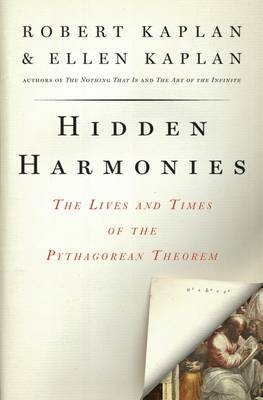
Hidden Harmonies
The Lives and Times of the Pythagorean Theorem
Seiten
2011
Bloomsbury Press (Verlag)
978-1-59691-522-0 (ISBN)
Bloomsbury Press (Verlag)
978-1-59691-522-0 (ISBN)
- Titel ist leider vergriffen;
keine Neuauflage - Artikel merken
The untold history of the most famous relation in mathematics and what it illustrates about the nature of human reasoning.
A squared plus b squared equals c squared. It sounds simple, doesn't it? Yet this familiar expression is a gateway into the riotous garden of mathematics, and sends us on a journey of exploration in the company of two inspired guides, acclaimed authors Robert and Ellen Kaplan. With wit, verve, and clarity, they trace the life of the Pythagorean theorem, from ancient Babylon to the present, visiting along the way Leonardo da Vinci, Albert Einstein, President James Garfield, and the Freemasons-not to mention the elusive Pythagoras himself, who almost certainly did not make the statement that bears his name.
How can a theorem have more than one proof? Why does this one have more than two hundred-or is it four thousand? The Pythagorean theorem has even more applications than proofs: Ancient Egyptians used it for surveying property lines, and today astronomers call on it to measure the distance between stars. Its generalizations are stunning-the theorem works even with shapes on the sides that aren't squares, and not just in two dimensions, but any number you like, up to infinity. And perhaps its most intriguing feature of all, this tidy expression opened the door to the world of irrational numbers, an untidy discovery that deeply troubled Pythagoras's disciples.
Like the authors' bestselling The Nothing That Is and Chances Are . . .-hailed as "erudite and witty," "magnificent," and "exhilarating"-Hidden Harmonies makes the excitement of mathematics palpable.
A squared plus b squared equals c squared. It sounds simple, doesn't it? Yet this familiar expression is a gateway into the riotous garden of mathematics, and sends us on a journey of exploration in the company of two inspired guides, acclaimed authors Robert and Ellen Kaplan. With wit, verve, and clarity, they trace the life of the Pythagorean theorem, from ancient Babylon to the present, visiting along the way Leonardo da Vinci, Albert Einstein, President James Garfield, and the Freemasons-not to mention the elusive Pythagoras himself, who almost certainly did not make the statement that bears his name.
How can a theorem have more than one proof? Why does this one have more than two hundred-or is it four thousand? The Pythagorean theorem has even more applications than proofs: Ancient Egyptians used it for surveying property lines, and today astronomers call on it to measure the distance between stars. Its generalizations are stunning-the theorem works even with shapes on the sides that aren't squares, and not just in two dimensions, but any number you like, up to infinity. And perhaps its most intriguing feature of all, this tidy expression opened the door to the world of irrational numbers, an untidy discovery that deeply troubled Pythagoras's disciples.
Like the authors' bestselling The Nothing That Is and Chances Are . . .-hailed as "erudite and witty," "magnificent," and "exhilarating"-Hidden Harmonies makes the excitement of mathematics palpable.
Robert and Ellen Kaplan have taught mathematics to people from six to sixty, at leading independent schools and most recently at Harvard University. Robert Kaplan is the author of the best-selling The Nothing That Is: A Natural History of Zero, which has been translated into 10 languages, and together they wrote The Art of the Infinite. Ellen Kaplan is also co-author of Chances Are: Adventures in Probability and Bozo Sapiens: Why to Err is Human, co-written with her son Michael Kaplan.
| Erscheint lt. Verlag | 7.3.2011 |
|---|---|
| Zusatzinfo | B&W |
| Verlagsort | New York |
| Sprache | englisch |
| Maße | 156 x 235 mm |
| Gewicht | 493 g |
| Themenwelt | Geisteswissenschaften ► Geschichte ► Allgemeine Geschichte |
| Mathematik / Informatik ► Mathematik ► Geschichte der Mathematik | |
| ISBN-10 | 1-59691-522-6 / 1596915226 |
| ISBN-13 | 978-1-59691-522-0 / 9781596915220 |
| Zustand | Neuware |
| Informationen gemäß Produktsicherheitsverordnung (GPSR) | |
| Haben Sie eine Frage zum Produkt? |
Mehr entdecken
aus dem Bereich



aus dem Bereich
Eine wahre Geschichte von Schiffbruch, Mord und Meuterei
Buch | Hardcover (2024)
C.Bertelsmann (Verlag)
CHF 34,95
Siedler, Händler, Philosophen : eine globale Geschichte vom …
Buch | Hardcover (2024)
DVA (Verlag)
CHF 58,75


