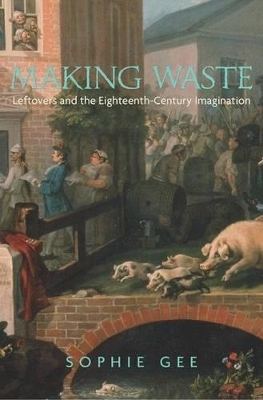
Making Waste
Princeton University Press (Verlag)
978-0-691-13984-5 (ISBN)
Why was eighteenth-century English culture so fascinated with the things its society discarded? Why did Restoration and Augustan writers such as Milton, Dryden, Swift, and Pope describe, catalog, and memorialize the waste matter that their social and political worlds wanted to get rid of--from the theological dregs in Paradise Lost to the excrements in "The Lady's Dressing Room" and the corpses of A Journal of the Plague Year? In Making Waste, the first book about refuse and its place in Enlightenment literature and culture, Sophie Gee examines the meaning of waste at the moment when the early modern world was turning modern. Gee explains how English writers used contemporary theological and philosophical texts about unwanted and leftover matter to explore secular, literary relationships between waste and value. She finds that, in the eighteenth century, waste was as culturally valuable as it was practically worthless--and that waste paradoxically revealed the things that the culture cherished most. The surprising central insight of Making Waste is that the creation of value always generates waste.
Waste is therefore a sign--though a perverse one--that value and meaning have been made. Even when it appears to symbolize civic, economic, and political failure, waste is in fact restorative, a sign of cultural invigoration and imaginative abundance. Challenging the conventional association of Enlightenment culture with political and social improvement, and scientific and commercial progress, Making Waste has important insights for cultural and intellectual history as well as literary studies.
Sophie Gee is assistant professor of English at Princeton University and the author of "The Scandal of the Season" (Scribner), a novel based on the story behind Alexander "Pope's Rape of the Lock". She writes regularly for the "New York Times Book Review", the "Washington Post", and the "Financial Times".
ACKNOWLEDGMENTS vii Introduction: Making Waste 1 Chapter 1: The Invention of the Wasteland: Civic Narrative and Dryden's Annus Mirabilis 18 Chapter 2: Wastelands, Paradise Lost, and Popular Polemic at the Restoration 41 Chapter 3: Milton's Chaos in Pope's London: Material Philosophy and the Book Trade 67 Chapter 4: The Man on the Dump: Swift, Ireland, and the Problem of Waste 91 Chapter 5: Holding On to the Corpse: Fleshly Remains in A Journal of the Plague Year 112 Afterword: Mr. Spectator's Tears and Sophia Western's Muff 137 NOTES 145 BIBLIOGRAPHY 169 INDEX 187
| Erscheint lt. Verlag | 17.1.2010 |
|---|---|
| Verlagsort | New Jersey |
| Sprache | englisch |
| Maße | 152 x 235 mm |
| Gewicht | 425 g |
| Themenwelt | Geisteswissenschaften ► Geschichte ► Regional- / Ländergeschichte |
| Geschichte ► Teilgebiete der Geschichte ► Kulturgeschichte | |
| Geisteswissenschaften ► Sprach- / Literaturwissenschaft ► Anglistik / Amerikanistik | |
| Geisteswissenschaften ► Sprach- / Literaturwissenschaft ► Literaturwissenschaft | |
| ISBN-10 | 0-691-13984-9 / 0691139849 |
| ISBN-13 | 978-0-691-13984-5 / 9780691139845 |
| Zustand | Neuware |
| Informationen gemäß Produktsicherheitsverordnung (GPSR) | |
| Haben Sie eine Frage zum Produkt? |
aus dem Bereich