


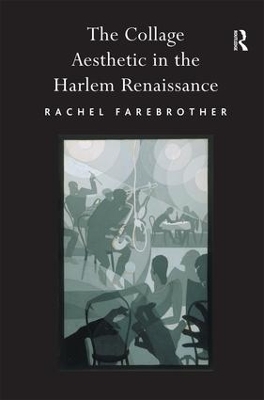
The Collage Aesthetic in the Harlem Renaissance
Seiten
2009
Routledge (Verlag)
978-0-7546-6198-6 (ISBN)
Routledge (Verlag)
978-0-7546-6198-6 (ISBN)
Beginning with an analysis of the cultural context, this book examines collage in modernist and Harlem Renaissance figurative art, and reveals the collage sensibility attendant in Franz Boas' anthropology. It offers an exploration of neglected connections between Euro-American modernism and the Harlem Renaissance.
Beginning with a subtle and persuasive analysis of the cultural context, Farebrother examines collage in modernist and Harlem Renaissance figurative art and unearths the collage sensibility attendant in Franz Boas's anthropology. This strategy makes explicit the formal choices of Harlem Renaissance writers by examining them in light of African American vernacular culture and early twentieth-century discourses of anthropology, cultural nationalism and international modernism. At the same time, attention to the politics of form in such texts as Toomer's Cane, Locke's The New Negro and selected works by Hurston reveals that the production of analogies, juxtapositions, frictions and distinctions on the page has aesthetic, historical and political implications. Why did these African American writers adopt collage form during the Harlem Renaissance? What did it allow them to articulate? These are among the questions Farebrother poses as she strives for a middle ground between critics who view the Harlem Renaissance as a distinctive, and necessarily subversive, kind of modernism and those who foreground the cooperative nature of interracial creative work during the period. A key feature of her project is her exploration of neglected connections between Euro-American modernism and the Harlem Renaissance, a journey she negotiates while never losing sight of the particularity of African American experience. Ambitious and wide-ranging, Rachel Farebrother's book offers us a fresh lens through which to view this crucial moment in American culture.
Beginning with a subtle and persuasive analysis of the cultural context, Farebrother examines collage in modernist and Harlem Renaissance figurative art and unearths the collage sensibility attendant in Franz Boas's anthropology. This strategy makes explicit the formal choices of Harlem Renaissance writers by examining them in light of African American vernacular culture and early twentieth-century discourses of anthropology, cultural nationalism and international modernism. At the same time, attention to the politics of form in such texts as Toomer's Cane, Locke's The New Negro and selected works by Hurston reveals that the production of analogies, juxtapositions, frictions and distinctions on the page has aesthetic, historical and political implications. Why did these African American writers adopt collage form during the Harlem Renaissance? What did it allow them to articulate? These are among the questions Farebrother poses as she strives for a middle ground between critics who view the Harlem Renaissance as a distinctive, and necessarily subversive, kind of modernism and those who foreground the cooperative nature of interracial creative work during the period. A key feature of her project is her exploration of neglected connections between Euro-American modernism and the Harlem Renaissance, a journey she negotiates while never losing sight of the particularity of African American experience. Ambitious and wide-ranging, Rachel Farebrother's book offers us a fresh lens through which to view this crucial moment in American culture.
Rachel Farebrother is lecturer in American Studies at the University of Swansea, UK.
Contents: Introduction; Boasian anthropolgy and the Harlem renaissance; '[F]lung out in a jagged, uneven but progressive pattern': 'culture citizenship' in The New Negro; '[A]dventuring through the pieces of a still unorganized mosaic': Jean Toomer's collage aesthetic in Cane; 'Think[ing] in hieroglyphics': Zora Neale Hurston's cross-cultural aesthetic; Reading Zora Neale Hurston's textual synthesis in Jonah's Gourd Vine and Moses, Man of the Mountain; Conclusion; Bibliography; Index.
| Erscheint lt. Verlag | 28.10.2009 |
|---|---|
| Verlagsort | London |
| Sprache | englisch |
| Maße | 156 x 234 mm |
| Gewicht | 566 g |
| Themenwelt | Geisteswissenschaften ► Sprach- / Literaturwissenschaft ► Anglistik / Amerikanistik |
| Geisteswissenschaften ► Sprach- / Literaturwissenschaft ► Literaturwissenschaft | |
| ISBN-10 | 0-7546-6198-9 / 0754661989 |
| ISBN-13 | 978-0-7546-6198-6 / 9780754661986 |
| Zustand | Neuware |
| Informationen gemäß Produktsicherheitsverordnung (GPSR) | |
| Haben Sie eine Frage zum Produkt? |
Mehr entdecken
aus dem Bereich

aus dem Bereich
Poetik eines sozialen Urteils
Buch | Hardcover (2023)
De Gruyter (Verlag)
CHF 83,90


