


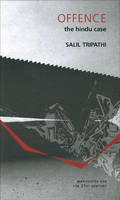
Offence: The Hindu Case
Seiten
2009
Seagull Books London Ltd (Verlag)
978-1-906497-38-5 (ISBN)
Seagull Books London Ltd (Verlag)
978-1-906497-38-5 (ISBN)
To many outside India, Hinduism is envisioned as the foundation of an ideal, all-embracing society. Yet this is far from the truth. This work documents how Hindu fundamentalists have succeeded in censoring and banning many cultural works, tampered with university teaching, and prevented academics from continuing in their jobs.
To many outside India, Hinduism is envisioned as the foundation of an ideal, all-embracing society. Yet this is far from the truth. Though historically the practice of Hinduism does promote the idea of an inclusive and tolerant way of life, in the past decade Hindu extremists have captured the religion and perverted it to their own ideological ends. In "The Hindu Case", Indian journalist Salil Tripathi meticulously documents how Hindu fundamentalists have succeeded in censoring and banning many cultural works, tampered with university teaching, and prevented academics from continuing in their jobs. In addition, Tripathi shows that these extremists are in the process of rewriting the ancient Hindu scriptures. This title in the "Manifestos for the 21st Century" series, published in collaboration with "Index on Censorship", the only international magazine dedicated to promoting and protecting free expression, focuses on rights, tolerance, censorship, and dissent within India's complex society, and it is an essential read for those interested in the struggle between religious fundamentalism and free expression.
To many outside India, Hinduism is envisioned as the foundation of an ideal, all-embracing society. Yet this is far from the truth. Though historically the practice of Hinduism does promote the idea of an inclusive and tolerant way of life, in the past decade Hindu extremists have captured the religion and perverted it to their own ideological ends. In "The Hindu Case", Indian journalist Salil Tripathi meticulously documents how Hindu fundamentalists have succeeded in censoring and banning many cultural works, tampered with university teaching, and prevented academics from continuing in their jobs. In addition, Tripathi shows that these extremists are in the process of rewriting the ancient Hindu scriptures. This title in the "Manifestos for the 21st Century" series, published in collaboration with "Index on Censorship", the only international magazine dedicated to promoting and protecting free expression, focuses on rights, tolerance, censorship, and dissent within India's complex society, and it is an essential read for those interested in the struggle between religious fundamentalism and free expression.
Salil Tripathi was born in Bombay. He moved to London in 1999 and has written frequently for numerous publications, including the Wall Street Journal, Guardian, Independent, New Statesman, Spectator, Prospect, Index on Censorship, Philadelphia Inquirer, Washington Post, and Salon. He is also senior visiting fellow for business and human rights at the Kennedy School of Government, Harvard University.
| Reihe/Serie | Manifestos for the 21st Century |
|---|---|
| Verlagsort | Greenford |
| Sprache | englisch |
| Maße | 12 x 18 mm |
| Gewicht | 198 g |
| Themenwelt | Geschichte ► Teilgebiete der Geschichte ► Religionsgeschichte |
| Geisteswissenschaften ► Religion / Theologie ► Hinduismus | |
| ISBN-10 | 1-906497-38-9 / 1906497389 |
| ISBN-13 | 978-1-906497-38-5 / 9781906497385 |
| Zustand | Neuware |
| Informationen gemäß Produktsicherheitsverordnung (GPSR) | |
| Haben Sie eine Frage zum Produkt? |
Mehr entdecken
aus dem Bereich


aus dem Bereich
von der Antike bis zur Gegenwart
Buch | Softcover (2025)
C.H.Beck (Verlag)
CHF 16,80


