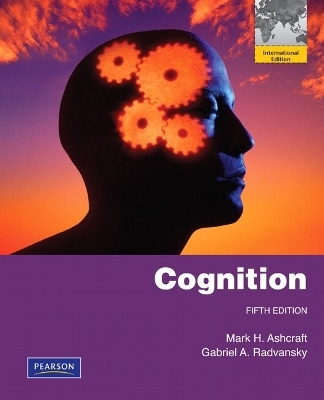
Cognition
Pearson (Verlag)
978-0-13-508168-6 (ISBN)
- Titel erscheint in neuer Auflage
- Artikel merken

The psychology of human memory and cognition is fascinating, dealing with questions and ideas that are inherently interesting, such as how we think, reason, remember, and use language. Using a first person narrative, posing direct questions to the reader, and balancing classic research with cutting edge topics, the author draws in the reader and conveys the excitement of the field.
Reflecting the increasing use of new technologies to study memory and cognition, Ashcraft and the new co-author, Gabriel Radvansky, continue to integrate sections on neurosciences within individual chapter topics.
1. Cognitive Psychology : An Introduction
Thinking About Thinking
Memory and Cognition Defined
An Introductory History of Cognitive Psychology
Anticipations of Psychology
Early Psychology
Behaviorism and Neobehaviorism
Dissatifaction with Behaviorism: The Winds of Change
Cognitive Psychology and Information Processing
The New Direction
The Assumptions of Cognitive Psychology
2. The Cognitive Science Approach
Guiding Principles
Themes
Measuring Information Processes
Getting Started
Time and Accuracy Measures
Guiding Analogies
The Information-Processing Approach
The Standard Theory
A Process Model
The Strict Information Processing Approach
Some Difficulties
The Modern Cognitive Approach: Cognitive Science
Updating the Standard Theory
Fixing the Narrowness
Neurocognition: The Brain and Cognition Together
Basic Neurology
Brain Anatomy
Principles of Functioning
Split Brain Research and Lateralization
Methods of Investigation
Neural Net Models: Connectionism
3. Perception and Pattern Recognition
Visual Perception
Gathering Visual Information
Visual Sensory Memory
The Early parts of a Fixation
A Summary for Visual Sensory Memory
Trans-saccadic Memory
Pattern Recognition: Written Language
Gestalt Grouping Principles
The Template Approach
Visual Feature Detection
Beyond Features: Conceptually Driven Pattern Recognition
Connectionist Modeling
Object Recognition and Agnosia
Recognition by Components
Agnosia
Implications for Cognitive Science
Auditory Perception
Auditory Sensory Memory
Auditory Pattern Recognition
4. Attention
Multiple Meaning of Attention
Basics of Attention
Basic Input Attentional Processes
Alertness and Arousal
Orienting Response and Attention Capture
Spotlight Attention and Visual Search
Contrasting Input and Controlled Attention
Hemineglect: An Attention Deficit
Controlled, Voluntary Attention
Selective Attention and the Cocktail Party Effect
Selection Models
Attention as a Mental Resource
Automatic and Conscious Processing Theories
A Synthesis for Attention and Automaticity
Disadvantages of Automaticity
5. Short-Term Working Memory
Short-Term Memory: A Limited Capacity Bottleneck
The Magical Number Seven, Plus or Minus Two
Forgetting from Short-Term Memory
Short-Term Memory Retrieval
Serial Position Effects
Short-Term Memory Scanning: The Sternberg Task
Working Memory
The Components of Working Memory
The Central Executive
The Phonological Loop
The Visuo-Spatial Sketchpad
The Episodic Buffer
Assessing Working Memory
The Dual Task Method
Working Memory Span
The Role of Working Memory in Cognition
Working Memory and Attention
Working Memory and Long-Term Memory
Working Memory and Reasoning
Sometimes Small Working Memory Spans are Better
6. Learning and Remembering
Preliminary Issues
Mnemonic Devices
The Ebbinghaus Tradition of Memory Research
Metamemory
Storing Information in Episodic Memory
Rehearsal
Frequency of Rehearsal
Two Kinds of Rehearsal
Depth of Processing
Challenges to Depth of Processing
Generation and Enactment
Organization in Storage
Imagery
Emotion and Survival Value
Context and Encoding Specificity
Retrieving Episodic Information
Decay
Interference
Retrieval Failure
Retrieval Cues
Amnesia and Implicit Memory
Dissociation of Episodic and Semantic Memory
Anterograde Amnesia
Implicit and Explicit Memory
7. Knowing
Semantic Memory
The Collins and Quillian ( and Loftus) Model
Smith's Feature Comparison Model
Empirical Tests of Semantic Memory Models
Semantic Relatedness
Priming in Semantic Memory
Nuts and Bolts of Priming Tasks
Empirical Demonstrations of Priming
Priming in Other Tasks
Automatic and Controlled Priming
Priming Is an Implicit Process
Schemata and Scripts
Bartlett’s Research
Schemata
Scripts
Evidence of Scripts
< Context, Connectionism, and the Brain
Connectionism
Connectionism and the Brain
8. Using Knowledge in the Real World
The Seven Sins of Memory
Facts About the World
The Nature of Propositions
Rules for Deriving Propositions
Are Propositions Real?
Situation Models and Embodied Cognition
Levels of Representation
Remembering Facts
Metamemory
Source Monitoring
Prospective Memory
Knowing What You Know
False Memories, Eyewitness Memory. and "Forgotten Memories"
False Memories
Integration
Leading Questions and Memory Distortion
The Misinformation Effect
Source Misattribution and Misinformation Acceptance
Stronger Memory Distortion Effects
Repressed and Recovered Memories
Autobiographical Memories
The Bahrick Work
Phenomena of Autobiographical Memory
The Irony of Memory
9. Language
Linguistic Universals and Functions
Defining Language
Language Universals
Animal Communication
Levels of Analysis, a Critical Distinction, and the Sapir-Whorf Hypothesis
Phonology: The Sounds of Language
Sounds in Isolation
Combining Phonemes into Words
Embodiment in Speech Perception
Speech Perception and Context
A Final Puzzle
Syntax: The Ordering of Words and Phrases
Chomsky's Transformational Grammar
Limitations of the Transformational Grammar Approach
The Cognitive Role of Syntax
Lexical and Semantic Factors: The Meaning in Language
Morphemes
The Lexical Representation
Case Grammar
Interaction of Syntax and Semantics
Evidence for the Semantic Grammar Approaches
Brain and Language
Language in the Intact Brain
Aphasia
Generalizing from Aphasia
10. Comprehension: Written and Spoken Language
Getting Started: An Overview
Conceptual and Rule Knowledge
Traditional Comprehension Research
Online Comprehension Tasks
Metacomprehension
Comprehension as Mental Structure Building
Levels of Comprehension
Reading
Gaze Duration
Basic Online Reading Effects
A Model of Reading
Summary
Reference, Situation Models, and Events
Reference
Situation Models
Events
Conversation and Gesture
The Structure of Conversations
Cognitive Conversational Characteristics
Empirical Effects in Conversation
Gesture
11. Decisions, Judgments, and Reasoning
Formal Logic and Reasoning
Syllogisms
Conditional Reasoning: If P Then Q
Hypothesis Testing
Decisions
Decisions About Physical Differences
Decisions About Symbolic Differences
Decisions About Geographic Distances
Decisions and Reasoning Under Uncertainty
Algorithms and Heuristics
Heuristics, Biases, and Fallacies
The Representativeness Heuristic
The Availability Heuristics
The Simulation Heuristics
The Undoing Heuristics: Counterfactual Reasoning
Adaptive Thinking and " Fast, Frugal" Heuristics
The Ongoing Debate
Limitations in Reasoning
Limited Domain Knowledge
Limitations in Processing Resources
Appendix: Algorithms for Coin Tosses and Hospital Births
Coin Tosses
Hospital Births
12. Problem Solving
The Status of Problem-Solving Area
Gestalt Psychology and Problem Solving
Early Gestalt Research
Difficulties in Problem Solving
Insight and Analogy
Insight
Analogy
Neurocognition in Analogy and Insight
Basics of Problem Solving
Characteristics of Problem Solving
A Vocabulary of Problem Solving
Means-End Analysis: A Fundamental Heuristic
The Basics of Means-End Analysis
The Tower of Hanoi
General Problem Solver
Improving Your Problem Solving
Increase Your Domain Knowledge
Automate Some Components of the Problem-Solving Solution
Follow a Systematic Plan
Draw Inferences
Develop Subgoals
Work Backward
Search for Contradictions
Search for Relations Among Problems
Find a Different Problem Representation
Stay Calm
If All Else Fails, Try Practice
Glossary
References
Photo Credits
Name Index
Subjet Index
| Erscheint lt. Verlag | 3.8.2009 |
|---|---|
| Sprache | englisch |
| Maße | 188 x 228 mm |
| Gewicht | 790 g |
| Themenwelt | Geisteswissenschaften ► Psychologie ► Allgemeine Psychologie |
| Geisteswissenschaften ► Psychologie ► Verhaltenstherapie | |
| ISBN-10 | 0-13-508168-8 / 0135081688 |
| ISBN-13 | 978-0-13-508168-6 / 9780135081686 |
| Zustand | Neuware |
| Informationen gemäß Produktsicherheitsverordnung (GPSR) | |
| Haben Sie eine Frage zum Produkt? |
aus dem Bereich