


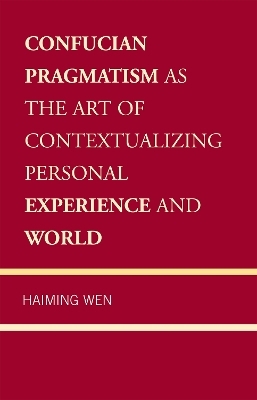
Confucian Pragmatism as the Art of Contextualizing Personal Experience and World
Seiten
2009
Lexington Books (Verlag)
978-0-7391-3644-7 (ISBN)
Lexington Books (Verlag)
978-0-7391-3644-7 (ISBN)
This engaging work of comparative philosophy puts the Chinese and American philosophical traditions into a mutually informative and transformative philosophical dialogue on the way to developing a new form of Confucian pragmatism.
This engaging work of comparative philosophy brings together American pragmatism and Chinese philosophy in a way that generates new interpretations of Chinese philosophy and a fresh perspective on issues in process philosophy. Through an analysis of key terms, Haiming Wen argues that Chinese philosophical terminology is not simply a retrospective language that through a process of stipulation promises us knowledge of an existing world, but is also an open, prospective vocabulary that through productive associations allows philosophers to realize a desired world. Relying on this productive power of Chinese terminology, Wen introduces a new term: 'Confucian pragmatism.' Wen convincingly shows that although there is much that distinguishes American pragmatism from Confucian philosophy, there is enough conceptual overlap to make Confucian pragmatism a viable and exciting field of study.
This engaging work of comparative philosophy brings together American pragmatism and Chinese philosophy in a way that generates new interpretations of Chinese philosophy and a fresh perspective on issues in process philosophy. Through an analysis of key terms, Haiming Wen argues that Chinese philosophical terminology is not simply a retrospective language that through a process of stipulation promises us knowledge of an existing world, but is also an open, prospective vocabulary that through productive associations allows philosophers to realize a desired world. Relying on this productive power of Chinese terminology, Wen introduces a new term: 'Confucian pragmatism.' Wen convincingly shows that although there is much that distinguishes American pragmatism from Confucian philosophy, there is enough conceptual overlap to make Confucian pragmatism a viable and exciting field of study.
Haiming Wen is assistant professor of philosophy at Renmin University of China
Chapter 1 1. The Crisis of Creativity
Chapter 2 2. Getting Past the Eclipse of Creativity: Acknowledging the Philosophical Fallacy
Chapter 3 3. Intentionality/Meaning (yi) and Confucian Contextual Creativity
Chapter 4 4. Feelings (qing) and the Importance of History, Particularity, and Emergence in Context
Chapter 5 5. The Contextual Creativity of Key Philosophical Terms
Chapter 6 6. Chinese Philosophical Sensibility
Chapter 7 7. Chinese Metaphysical Creativity
Chapter 8 8. Chinese Epistemological Creativity: Thinking-and-Feeling (Mind) and Experience
Chapter 9 9. Confucian Pragmatism as a Post-Modern Comparative Philosophy
| Erscheint lt. Verlag | 16.6.2009 |
|---|---|
| Sprache | englisch |
| Maße | 162 x 241 mm |
| Gewicht | 655 g |
| Themenwelt | Sonstiges ► Geschenkbücher |
| Geisteswissenschaften ► Philosophie ► Östliche Philosophie | |
| Geisteswissenschaften ► Philosophie ► Philosophie Altertum / Antike | |
| Geisteswissenschaften ► Philosophie ► Philosophie der Neuzeit | |
| ISBN-10 | 0-7391-3644-5 / 0739136445 |
| ISBN-13 | 978-0-7391-3644-7 / 9780739136447 |
| Zustand | Neuware |
| Informationen gemäß Produktsicherheitsverordnung (GPSR) | |
| Haben Sie eine Frage zum Produkt? |
Mehr entdecken
aus dem Bereich
aus dem Bereich
christliches Yoga für Anfängerinnen und Fortgeschrittene
Buch (2025)
Patmos Verlag
CHF 34,90


