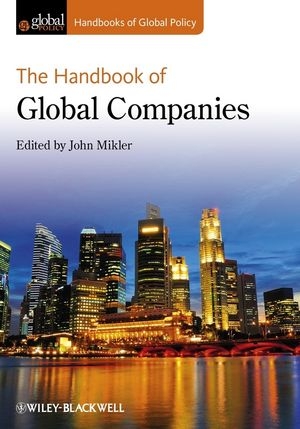
The Handbook of Global Companies brings together original research addressing the latest theories and empirical analysis surrounding the role of global companies in local, national, and international governance.
- Offers new insights into the role of global companies in relation to policy and governance at local, national, and international levels
- Brings together newly-commissioned research by a global team of established and up-and-coming scholars from the fields of international relations, political science, public policy, and beyond
- Considers the environmental and societal responsibilities of global corporations.
- Covers topics including the spatial locations of global companies; debate about the power they wield and their role as catalysts in new forms of governance; and the ways in which global companies share authority with the state and international organizations to drive policy processes
- Speculates on the broader potential and limitations of global governance
John Mikler is a Senior Lecturer in the Department of Government and International Relations at the University of Sydney. His research interests are primarily focused on the role of transnational economic actors, particularly multinational corporations, and the interaction between them and states, international organizations and civil society. He is the author of Greening the Car Industry: Varieties of Capitalism and Climate Change (2009), and has published widely in journals including Business and Politics, Regulation and Governance, Global Society, Policy and Society, Cambridge Journal of Regions, Economy and Society, and New Political Economy.
The Handbook of Global Companies brings together original research addressing the latest theories and empirical analysis surrounding the role of global companies in local, national, and international governance. Offers new insights into the role of global companies in relation to policy and governance at local, national, and international levels Brings together newly-commissioned research by a global team of established and up-and-coming scholars from the fields of international relations, political science, public policy, and beyond Considers the environmental and societal responsibilities of global corporations. Covers topics including the spatial locations of global companies; debate about the power they wield and their role as catalysts in new forms of governance; and the ways in which global companies share authority with the state and international organizations to drive policy processes Speculates on the broader potential and limitations of global governance
John Mikler is a Senior Lecturer in the Department of Government and International Relations at the University of Sydney. His research interests are primarily focused on the role of transnational economic actors, particularly multinational corporations, and the interaction between them and states, international organizations and civil society. He is the author of Greening the Car Industry: Varieties of Capitalism and Climate Change (2009), and has published widely in journals including Business and Politics, Regulation and Governance, Global Society, Policy and Society, Cambridge Journal of Regions, Economy and Society, and New Political Economy.
List of Illustrations xi
Notes on Contributors xiii
Preface xxi
1 Global Companies as Actors in Global Policy and Governance
1
John Mikler
Part I Locating Global Companies 17
2 The Global Company 19
Hinrich Voss
3 The National Identity of Global Companies 35
Stephen Wilks
4 Big Business in the BRICs 53
Andrea Goldstein
Part II Global Companies and Power 75
5 Theorizing the Power of Global Companies 77
Doris Fuchs
6 Why, When, and How Global Companies Get Organized 96
Tony Porter and Sherri Brown
7 How Governments Mediate the Structural Power of International
Business 113
Stephen Bell
8 How Global Companies Wield Their Power: The Discursive Shaping
of Sustainable Development 134
Nina Kolleck
Part III Global Companies and the State 153
9 How Global Companies Make National Regulations 155
Terry O'Callaghan and Vlado Vivoda
10 Making Government More "Business-Like":
Management Consultants as Agents of Isomorphism in Modern Political
Economies 173
Denis Saint-Martin
11 East Asian Development States and Global Companies as
Partners of Techno-Industrial Competitiveness 193
Sung-Young Kim
12 Varieties of the Regulatory State and Global Companies: The
Case of China 209
Shiufai Wong
13 Global Companies and Emerging Market Countries 227
Caner Bakir and Cantay Caliskan
Part IV Global Companies and International Organizations
239
14 Regulating Global Corporate Capitalism 241
Sarianna M. Lundan
15 Global Companies as Agenda Setters in the World Trade
Organization 257
Cornelia Woll
16 Business Interests Shaping International Institutions:
Negotiating the Trans-Pacific Partnership Agreement 272
Deborah Elms
17 Global Companies and the Environment: The Triumph of TNCs in
Global Environmental Governance 285
Matthias Finger
18 Global Companies, the Bretton Woods Institutions, and Global
Inequality 300
Pamela Blackmon
19 Outsourcing Global Governance: Public-Private Voluntary
Initiatives 316
Marianne Thissen-Smits and Patrick Bernhagen
Part V Global Companies and Society 333
20 Global Companies and Global Society: The Evolving Social
Contract 335
Ann Florini
21 Global Companies as Social Actors: Constructing Private
Business in Global Governance 351
Tanja Bru¨hl and Matthias Hofferberth
22 The Socially Embedded Corporation 371
Kate Macdonald
23 Ecological Modernization and Industrial Ecology 388
Frank Boons
Part VI The Exercise and Limitations of Private Global
Governance 403
24 Global Companies as Agents of Globalization 405
Shana M. Starobin
25 The Greening of Capitalism 421
John A. Mathews
26 Global Companies and the Private Regulation of Global Labor
Standards 437
Luc Fransen
27 Global Private Governance: Explaining Initiatives in the
Global Mining Sector 456
Hevina S. Dashwood
28 Will Business Save the World? 474
Simon Zadek
Index 493
"Summing Up: Recommended. Upper-division
undergraduate through professional collections."
(Choice, 1 February 2014)
"Global companies represent challenges of governance which
need to be studied comprehensively and systematically. This
handbook tackles this challenge successfully and represents both
the scholarly progress and the maturity of this field of
study. It is a must in any social sciences library and will
be highly useful for scholars, graduate students and undergraduates
alike." David Levi-Faur, Hebrew University of
Jerusalem
"This is an excellent volume examining the role
multinational corporations play in global public policy processes.
The contributors recognize that motivations and strategies of these
firms cannot be reduced to profit maximization. To understand how
corporations influence policy, one must explore the complex nature
of the modern global firm. The Handbook of Global Companies will
enlighten the on-going debates on globalization and public
policy." Aseem Prakash, University of
Washington
"For all their impact on the global policy environment,
multinational companies remain relatively understudied outside the
management and international business framework. This Handbook,
deftly edited by John Mikler, identifies how global companies are
political and social, as well as economic, actors that drive
globalization, and in turn are shaped by it. The chapters, written
by both distinguished and rising scholars, provide a welcome
breadth of coverage, ranging from theoretical and political issues
of power to social issues of sustainability and the role of
corporations in safeguarding (or destroying) the planet. This
impressive handbook is destined to become a standard reference for
anyone interested in global companies as policy actors."
Linda Weiss, Professor Emeritus, University of Sydney
| Erscheint lt. Verlag | 19.3.2013 |
|---|---|
| Reihe/Serie | Handbooks of Global Policy | HGP - Handbooks of Global Policy |
| Sprache | englisch |
| Themenwelt | Sozialwissenschaften ► Politik / Verwaltung ► Staat / Verwaltung |
| Wirtschaft ► Betriebswirtschaft / Management ► Unternehmensführung / Management | |
| Schlagworte | Ãffentliche Ordnung u. Verwaltung • Analysis • companies • corporations • Debate • Essays • established • Experts • Global • global companies • Handbook • Influence • Lack • Latest • Level • Öffentliche Ordnung u. Verwaltung • Original • Planet • Policy • Political Science • Politikwissenschaft • powerful institutions • Public Policy & Administration • scholars • series • sophisticated • Surprising • Terms • Weltpolitik • widely |
| ISBN-10 | 1-118-32614-8 / 1118326148 |
| ISBN-13 | 978-1-118-32614-5 / 9781118326145 |
| Informationen gemäß Produktsicherheitsverordnung (GPSR) | |
| Haben Sie eine Frage zum Produkt? |
 PDF (Adobe DRM)
Kopierschutz: Adobe-DRM
Adobe-DRM ist ein Kopierschutz, der das eBook vor Mißbrauch schützen soll. Dabei wird das eBook bereits beim Download auf Ihre persönliche Adobe-ID autorisiert. Lesen können Sie das eBook dann nur auf den Geräten, welche ebenfalls auf Ihre Adobe-ID registriert sind.
Details zum Adobe-DRM
Dateiformat: PDF (Portable Document Format)
Mit einem festen Seitenlayout eignet sich die PDF besonders für Fachbücher mit Spalten, Tabellen und Abbildungen. Eine PDF kann auf fast allen Geräten angezeigt werden, ist aber für kleine Displays (Smartphone, eReader) nur eingeschränkt geeignet.
Systemvoraussetzungen:
PC/Mac: Mit einem PC oder Mac können Sie dieses eBook lesen. Sie benötigen eine
eReader: Dieses eBook kann mit (fast) allen eBook-Readern gelesen werden. Mit dem amazon-Kindle ist es aber nicht kompatibel.
Smartphone/Tablet: Egal ob Apple oder Android, dieses eBook können Sie lesen. Sie benötigen eine
Geräteliste und zusätzliche Hinweise
Buying eBooks from abroad
For tax law reasons we can sell eBooks just within Germany and Switzerland. Regrettably we cannot fulfill eBook-orders from other countries.
aus dem Bereich