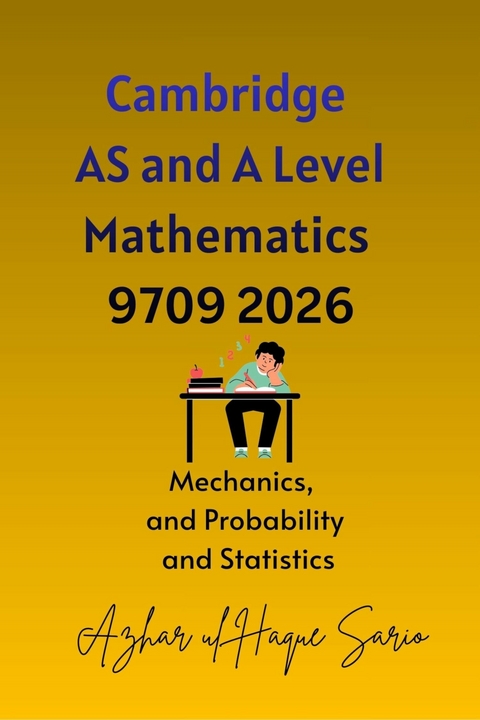
Cambridge AS and A Level Mathematics 9709 2026 (eBook)
188 Seiten
Azhar Sario Hungary (Verlag)
978-3-384-79215-0 (ISBN)
Master the mathematical language of the future with a guide that turns abstract numbers into 2026 reality.
This book is a complete, all-in-one resource for the Cambridge AS and A Level Mathematics 9709 syllabus, specifically targeting Mechanics (Paper 4) and Probability & Statistics (Papers 5 and 6). It breaks down complex syllabus requirements into clear, manageable lessons. You will start with the fundamentals of forces and equilibrium. You will learn to draw perfect force diagrams. It covers the kinematics of motion in a straight line. You will master the SUVAT equations. It explains Newton's laws of motion with precision. It simplifies the concepts of energy, work, and power. You will also dive deep into data representation. It teaches you how to handle permutations and combinations. You will understand the logic of probability. It explores discrete random variables. It demystifies the Normal and Poisson distributions. It guides you through linear combinations of random variables. Finally, it gives you a robust framework for hypothesis testing. Every topic is aligned with the 2026 syllabus.
What sets this book apart is its refusal to treat mathematics as a dead subject; instead, it contextualizes every equation within the technological landscape of 2026. While other textbooks rely on outdated examples of pulling blocks up slopes, this guide applies Newtonian mechanics to autonomous drone flight, maglev trains, and electric vehicle regenerative braking. It explains statistical concepts through the lens of modern data science, such as analyzing latency in 6G networks or predicting errors in quantum processors. It acknowledges that you are not just a student taking an exam, but a future engineer or data scientist who needs to understand why these laws matter. It provides 'Deep Dive' sections that connect classroom theory to real-world engineering, such as soft robotics and algorithmic trading. It highlights common student pitfalls-like the 'distance trap' in kinematics or the 'multiple of one' error in variance-and provides specific strategies to avoid them. This is not just a list of formulas; it is a handbook for quantifying the modern world.
The book is structured to build your confidence systematically. In the Mechanics module, you move from the basics of identifying forces to solving complex connected particle problems. You will learn to resolve forces on inclined planes without getting tangled in trigonometry. The Energy, Work, and Power section transitions you from simple calculations to understanding the conservation of energy in non-linear motion.
In the Probability and Statistics modules, the book transitions from simple counting to complex predictive modeling. You will learn to distinguish between mutually exclusive and independent events using rigorous mathematical tests. The section on Continuous Random Variables uses calculus to model uncertainty, preparing you for advanced fields like machine learning. The sampling and estimation chapters explain the Central Limit Theorem in plain English, ensuring you understand how to derive truth from limited data. Whether you are calculating the flight path of a projectile or determining the risk of a Type I error in a medical trial, this book ensures you have the tools to solve the problem correctly.
Disclaimer: This book is an independently produced educational resource by Azhar ul Haque Sario. It is not affiliated with, endorsed by, or connected to the Cambridge Assessment International Education board. All use of the Cambridge name and syllabus codes is for nominative fair use purposes only, to indicate the intended scope and compatibility of the material.
Probability
We will cover four primary learning objectives:
Enumeration and Counting: Using permutations and combinations to handle equiprobable events.
Basic Operations: Mastering the addition and multiplication of probabilities.
Event Relationships: distinguishing between exclusive and independent events.
Conditional Probability: calculating the likelihood of an event given that another has already occurred.
Let us begin our deep dive.
Part 1: Evaluating Probabilities by Enumeration and Counting
1.1 The Concept of Equiprobable Events
At its core, probability is a fraction. It is the number of "successful" outcomes divided by the total number of possible outcomes. This simple definition relies on a crucial assumption: every elementary event must be "equiprobable," or equally likely to happen.
Think of a "fair" die. The word "fair" is a mathematical contract. It guarantees that the physical properties of the die—its weight, shape, and balance—do not favor any single face. If the die is fair, rolling a 6 is just as likely as rolling a 1.
The Basic Formula:
P(E)=n(S)n(E)
Where:
P(E) is the probability of Event E.
n(E) is the number of ways Event E can happen.
n(S) is the total number of items in the Sample Space (S).
1.2 Enumeration: The Art of Listing
Before we use complex formulas, we must learn to count. Enumeration is the process of listing all possible outcomes. While this is inefficient for large numbers, it is vital for understanding the structure of a problem.
Example: The Two-Dice Problem Imagine you throw two fair dice, one red and one blue. You want to find the probability that the sum of the scores is exactly 8.
First, we determine the sample space (n(S)). Since each die has 6 faces, and they are independent, the total combinations are 6×6=36.
Now, we enumerate the "success" cases where the sum is 8:
Red 2, Blue 6
Red 3, Blue 5
Red 4, Blue 4
Red 5, Blue 3
Red 6, Blue 2
There are 5 successful outcomes. Therefore:
P(Sum is 8)=365
This is enumeration. It is transparent and verifiable. However, in 2026, we deal with massive datasets. We cannot list every outcome when dealing with encryption keys or gene sequences. This is where Permutations and Combinations come into play.
1.3 Permutations: When Order Matters
Permutations are used when the arrangement of items is important. Think of a PIN code. The digits "1-2-3-4" are distinctly different from "4-3-2-1," even though the numbers are the same.
Formula for Permutation (nPr):
nPr=(n−r)!n!
n is the total number of items.
r is the number of items we are choosing to arrange.
Real-World Example: The Server Rack A data center technician needs to arrange 5 distinct servers into 3 empty slots in a rack. The top slot has better cooling than the bottom slot, so the position (order) matters.
Here, n=5 and r=3. Calculation:
5P3=(5−3)!5!=2120=60
There are 60 distinct ways to arrange the servers. If we wanted to know the probability that a specific server ends up in the top slot, we would count the favorable arrangements and divide by 60.
1.4 Combinations: When Order Is Irrelevant
Combinations are used when the order of selection does not change the outcome. Think of a fruit salad. A bowl containing "Apple, Banana, and Cherry" is identical to a bowl containing "Cherry, Apple, and Banana."
Formula for Combination (nCr):
nCr=r!(n−r)!n!
Real-World Example: The Security Team A cybersecurity firm has 10 equivalent analysts. They need to form a specialized "Red Team" of 4 analysts to test a firewall. The role of each person on the team is the same; you are either on the team or you are not.
Here, n=10 and r=4. Calculation:
10C4=4!(10−4)!10!=24×7203,628,800=210
There are 210 different teams possible.
Application in Probability: Question: What is the probability that a specific analyst, let's call her "Sarah," is on the team?
Step 1: Fix Sarah on the team. Now we need to choose 3 more people from the remaining 9.
Step 2: Calculate favorable outcomes: 9C3=84.
Step 3: Divide by total outcomes: 84/210=0.4.
Result: There is a 40% chance Sarah makes the team.
Part 2: Addition and Multiplication of Probabilities
In the Cambridge A Level syllabus, you are not required to mechanically memorize the general addition formula (P(A∪B)=P(A)+P(B)−P(A∩B)), but you must understand the logic behind it. This logic boils down to two words: "OR" and "AND".
2.1 The Addition Law (The "OR" Rule)
When we ask for the probability of Event A OR Event B happening, we are looking at the union of two sets.
Case A: Mutually Exclusive Events Two events are mutually exclusive if they cannot happen at the same time. A coin cannot land on Heads and Tails simultaneously. A student cannot be in Year 12 and Year 13 at the exact same moment.
Rule: If A and B are mutually exclusive, P(A or B)=P(A)+P(B).
Example: In a bag of sweets, 30% are red, 20% are blue, and 50% are green. What is the probability of picking a sweet that is Red OR Blue? Since a sweet cannot be both red and blue (assuming solid colors):
P(Red∪Blue)=0.30+0.20=0.50
Case B: Non-Mutually Exclusive Events This is where students often make mistakes. If events can happen together, simply adding their probabilities results in "double counting."
Example: In a group of 2026 tech students, 60% learn Python and 50% learn Java. 20% learn both. What is the probability a student learns Python OR Java?
If we just add 0.60+0.50, we get 1.10, which is impossible (probability cannot exceed 1). We must subtract the overlap (the students counted twice).
P(Python or Java)=0.60+0.50−0.20=0.90
2.2 The Multiplication Law (The "AND" Rule)
When we ask for the probability of Event A AND Event B happening, we are looking for the intersection.
Case A: Independent Events Events are independent if the outcome of one does not affect the outcome of the other. Rolling a die and flipping a coin are independent. The die does not care what the coin did.
Rule: If A and B are independent, P(A and B)=P(A)×P(B).
Example: You have a 0.8 probability of waking up on time. Your bus has a 0.9 probability of arriving on time. Assuming these are independent:
P(You act on time AND Bus is on time)=0.8×0.9=0.72
Case B: Dependent Events If the first event changes the conditions for the second event, they are dependent. This often happens when sampling "without replacement."
Example: A drawer has 2 black socks and 2 white socks.
Probability of first sock being black: 2/4 or 0.5.
If you take that black sock out, there are now 3 socks left (1 black, 2 white).
Probability of second sock being black: 1/3.
Probability of drawing Black AND then Black:
P(Black then Black)=21×31=61
Part 3: Exclusive vs. Independent Events
This is a critical distinction in the Cambridge syllabus. Students often confuse "Mutually Exclusive" with "Independent," but they are conceptually opposite.
3.1 Defining the Difference
Mutually Exclusive:
Definition: They cannot happen together. The intersection is zero.
Visual: In a Venn diagram, the two circles do not touch.
Test: If P(A∩B)=0, they are mutually exclusive.
Independent:
Definition: They happen together, but they don't influence each other.
Visual: In a Venn diagram, the circles overlap. The size of the overlap is exactly the product of the individual probabilities.
Test: If P(A∩B)=P(A)×P(B), they are independent.
3.2 The Paradox of Independence
It is usually impossible for two events (with non-zero probabilities)...
| Erscheint lt. Verlag | 3.1.2026 |
|---|---|
| Reihe/Serie | Cambridge A Level Courses |
| Sprache | englisch |
| Themenwelt | Schulbuch / Wörterbuch ► Schulbuch / Allgemeinbildende Schulen |
| Sozialwissenschaften ► Pädagogik | |
| Schlagworte | Cambridge A Level Mathematics 9709 • Cambridge Maths 2026 Exam Syllabus • Forces and Equilibrium • hypothesis testing • Mechanics Paper 4 • Normal and Poisson Distributions • Probability and Statistics Paper 5 and 6 |
| ISBN-10 | 3-384-79215-7 / 3384792157 |
| ISBN-13 | 978-3-384-79215-0 / 9783384792150 |
| Informationen gemäß Produktsicherheitsverordnung (GPSR) | |
| Haben Sie eine Frage zum Produkt? |
 EPUB (Ohne DRM)
Digital Rights Management: ohne DRM
Dieses eBook enthält kein DRM oder Kopierschutz. Eine Weitergabe an Dritte ist jedoch rechtlich nicht zulässig, weil Sie beim Kauf nur die Rechte an der persönlichen Nutzung erwerben.
Dateiformat: EPUB (Electronic Publication)
EPUB ist ein offener Standard für eBooks und eignet sich besonders zur Darstellung von Belletristik und Sachbüchern. Der Fließtext wird dynamisch an die Display- und Schriftgröße angepasst. Auch für mobile Lesegeräte ist EPUB daher gut geeignet.
Systemvoraussetzungen:
PC/Mac: Mit einem PC oder Mac können Sie dieses eBook lesen. Sie benötigen dafür die kostenlose Software Adobe Digital Editions.
eReader: Dieses eBook kann mit (fast) allen eBook-Readern gelesen werden. Mit dem amazon-Kindle ist es aber nicht kompatibel.
Smartphone/Tablet: Egal ob Apple oder Android, dieses eBook können Sie lesen. Sie benötigen dafür eine kostenlose App.
Geräteliste und zusätzliche Hinweise
Buying eBooks from abroad
For tax law reasons we can sell eBooks just within Germany and Switzerland. Regrettably we cannot fulfill eBook-orders from other countries.
aus dem Bereich