


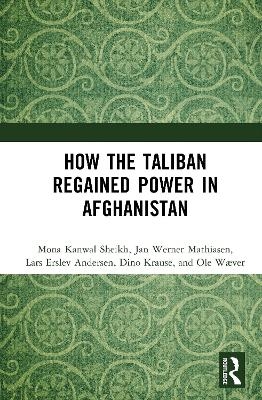
How the Taliban Regained Power in Afghanistan
Routledge (Verlag)
9781041100188 (ISBN)
- Noch nicht erschienen (ca. März 2026)
- Versandkostenfrei
- Auch auf Rechnung
- Artikel merken
The volume presents an analysis of the factors that contributed to the Taliban’s ability to seize power following the withdrawal of the international coalition in August 2021, marking the end of 20 years of international engagement in the country. It is the result of a thorough review of research and policy publications over the course of 20 years, and is based on open-source data, including threat assessments of the Danish intelligence services. There are multiple explanations in academic and policy reports as to why the Taliban were able to take power despite the efforts expected to prevent this from happening. Based on existing research literature, analyses, studies and reports, the book identifies five factors that are central to understanding the outcome. These factors offer overarching explanations for why the Taliban was able to regain power, with each encompassing different clusters of challenges that constituted central conditions for the Taliban takeover. Although the book is not about assigning blame, the explanations provided here can contribute to further discussion about how to ensure the necessary knowledge base for future decisions when confronted with new emergencies calling for possible international intervention.
This book will be of interest to students of security studies, conflict resolution, Asian security, military interventions, peace building, and International Relations.
Mona Kanwal Sheikh is a Senior Researcher and Head of Global Security and Worldview at DIIS. She is an expert on Islamist and jihadist movements and has particularly studied the Taliban movement in Pakistan and Afghanistan since 2007. Jan Werner Mathiasen is an officer in the Danish Armed Forces Defence with extensive knowledge of the War in Afghanistan, gained in part through his deployment to Afghanistan in 2010. He is employed as a military analyst at the Royal Danish Defence College, where he lectures in military strategy and international politics. Lars Erslev Andersen is an historian of ideas and a senior researcher at DIIS. He has extensive expertise in the Middle East and has published several books on Afghanistan and the War on Terror. His expertise also encompasses American Middle East policy and security thinking. Dino Krause is a postdoctoral researcher affiliated with a project on transnational jihadism at DIIS. He is an expert on al-Qaeda and the Islamic State and has worked extensively with analyses of quantitative conflict data. Ole Wæver is a professor of international relations at the Department of Political Science at the University of Copenhagen, where he also directs the Centre on Resolution of International Conflicts. He has authored and edited many books on international security, including key contributions to the field of security studies.
Preface 1. Introduction 2. The Taliban: Their Strength and Strategy 3. Negotiations with the Taliban 4. The US War in Afghanistan 5. Military Capacity Building: The Main Problems 6. The Civilian Capacity Building: The Main Problems 7. Conclusion: What Can We Learn from the War in Afghanistan? Appendix A: On Learning
| Erscheint lt. Verlag | 31.3.2026 |
|---|---|
| Zusatzinfo | 2 Tables, black and white; 3 Line drawings, black and white; 3 Illustrations, black and white |
| Verlagsort | London |
| Sprache | englisch |
| Maße | 156 x 234 mm |
| Themenwelt | Geisteswissenschaften ► Geschichte ► Regional- / Ländergeschichte |
| Sozialwissenschaften ► Politik / Verwaltung ► Europäische / Internationale Politik | |
| Sozialwissenschaften ► Soziologie ► Spezielle Soziologien | |
| ISBN-13 | 9781041100188 / 9781041100188 |
| Zustand | Neuware |
| Informationen gemäß Produktsicherheitsverordnung (GPSR) | |
| Haben Sie eine Frage zum Produkt? |
aus dem Bereich


