


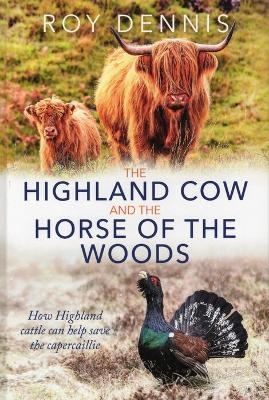
Highland Cow & the Horse of the Woods
How Highland cattle can help save the capercaillie
Seiten
2025
|
Hertfordshire
Whittles Publishing (Verlag)
978-1-84995-608-6 (ISBN)
Whittles Publishing (Verlag)
978-1-84995-608-6 (ISBN)
This book highlights the catastrophic decline of the capercaillie (once a common and widespread bird in Scotland) and how the Highland cow could come to the rescue.
Appalled by the catastrophic decline of the capercaillie in Scotland author Roy Dennis argues a dysfunctional forest habitat is to blame and that Highland cattle can be the solution.
The name 'capercaillie' is derived from Gaelic 'capallcoille', or 'horse of the woods'. Capercaillie numbers in Scotland’s pine forests have tumbled from 20,000 in the 1960s to about 400 today. The species is now facing extinction without a major conservation effort.
Roy argues that the capercaillie’s living space has become dysfunctional and the key to recovery is to mimic the behaviour of ancient oxen, which had a profound beneficial impact on the ecology of the woodlands.
Ancient oxen are long gone but their distant relative, the Highland cow, was part of the woodland scene right through until the middle of the last century. Roy explains why they are now the key to restoring the forest ecosystem, creating path networks, increasing biodiversity and invertebrate populations - not only to the benefit of capercaillies, but nature as a whole.
Appalled by the catastrophic decline of the capercaillie in Scotland author Roy Dennis argues a dysfunctional forest habitat is to blame and that Highland cattle can be the solution.
The name 'capercaillie' is derived from Gaelic 'capallcoille', or 'horse of the woods'. Capercaillie numbers in Scotland’s pine forests have tumbled from 20,000 in the 1960s to about 400 today. The species is now facing extinction without a major conservation effort.
Roy argues that the capercaillie’s living space has become dysfunctional and the key to recovery is to mimic the behaviour of ancient oxen, which had a profound beneficial impact on the ecology of the woodlands.
Ancient oxen are long gone but their distant relative, the Highland cow, was part of the woodland scene right through until the middle of the last century. Roy explains why they are now the key to restoring the forest ecosystem, creating path networks, increasing biodiversity and invertebrate populations - not only to the benefit of capercaillies, but nature as a whole.
Roy Dennis, OBE, DSc (hon) is one of the world’s foremost conservationists, best known for his work on the restoration of species such as the osprey, white-tailed sea eagle and red kite but who has spent a lifetime restoring natural lands and biodiversity.
| Erscheinungsdatum | 30.08.2025 |
|---|---|
| Zusatzinfo | 125 Halftones, color |
| Sprache | englisch |
| Maße | 156 x 234 mm |
| Gewicht | 562 g |
| Themenwelt | Sachbuch/Ratgeber ► Natur / Technik ► Naturführer |
| Naturwissenschaften ► Biologie ► Ökologie / Naturschutz | |
| ISBN-10 | 1-84995-608-1 / 1849956081 |
| ISBN-13 | 978-1-84995-608-6 / 9781849956086 |
| Zustand | Neuware |
| Informationen gemäß Produktsicherheitsverordnung (GPSR) | |
| Haben Sie eine Frage zum Produkt? |
Mehr entdecken
aus dem Bereich


aus dem Bereich
Buch | Hardcover (2019)
Quelle & Meyer (Verlag)
CHF 55,90
so fühlen sie sich rundum wohl
Buch | Softcover (2025)
Gräfe und Unzer (Verlag)
CHF 19,90


