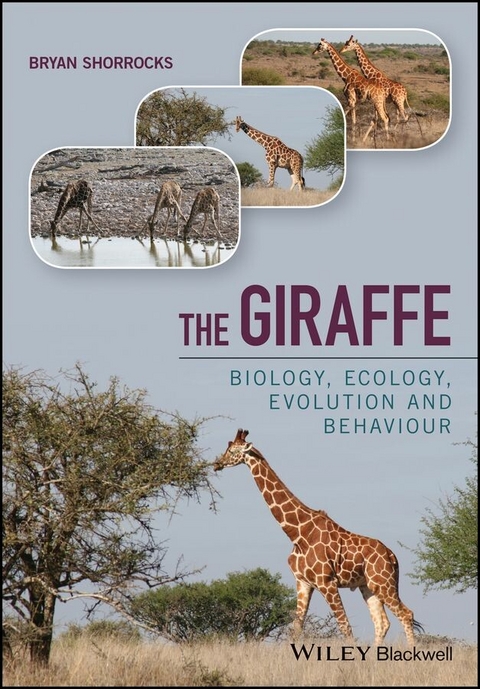
- Covers fossil history, taxonomy, genetics, physiology, biomechanics, behavior, ecology, and conservation
- Includes genetic analysis of five of the six subspecies of modern giraffes
- Includes giraffe network studies from Laikipia Kenya, Etosha National Park, Namibia andSamburu National Reserve, Kenya
Professor Bryan Shorrocks, Environment Department, University of York, York, UK.
Provides a comprehensive overview of one of nature's most engaging mammals Covers fossil history, taxonomy, genetics, physiology, biomechanics, behavior, ecology, and conservation Includes genetic analysis of five of the six subspecies of modern giraffes Includes giraffe network studies from Laikipia Kenya, Etosha National Park, Namibia andSamburu National Reserve, Kenya
Professor Bryan Shorrocks, Environment Department, University of York, York, UK.
Preface vi
1 Introduction to the giraffe 1
2 Origins 13
3 Present distribution and geographical races 26
4 Anatomy 42
5 Physiology 60
6 Individual behaviour 76
7 Individual ecology 100
8 Social networks, movement and population regulation 134
9 Conservation status and wildlife reserves 166
References 187
Index 217
CHAPTER 1
Introduction to the giraffe
In the prehistoric rocky landscape of the Sahara, native people drew pictures of this amazing animal, and in the Egyptian Bronze Age it decorated the tombs of kings. It may even have been the god the Egyptians called ‘Set’ (Spinage 1968a). In ancient Greece and Rome it was called the ‘camelopard’, in East Africa today it is twiga, and in the English language we now call it ‘giraffe’. The name ‘giraffe’ has its earliest known origins in the Arabic word zarafa (zarāfah) (), perhaps from some African language. The name can be translated as ‘fast walker’ (Kingdon 1997), although some linguistic authorities believe it stems from a source meaning an ‘assemblage of animals’. Clearly, the Greeks took this latter view. They contributed part of its scientific name, camelopardalis, which literally describes a camel’s body wearing a leopard’s coat. The Italian form giraffa arose in the 1590s and the modern English form developed around 1600 from the French girafe. The old and the new now combine to form the giraffe’s scientific name, Giraffa camelopardalis, although interestingly, the form ‘kameelperd’ survives in Afrikaan.
In one form or another, giraffes have been around for a very long time. And so has Homo sapiens. The interaction between giraffes and humans starts way back in prehistory, and rock art (paintings and engravings) is found all over Africa from Morocco, Algeria and Libya in the north, through Ethiopia, Somalia, Kenya and Tanzania in the east, to Botswana, Zimbabwe, Namibia and Mozambique in the south (Le Quellec 1993, 2004; Muzzolini 1995). Wherever, in fact, there has been savannah. However, the most extensive and remarkable rock art is found in areas of the Sahara (Coulson & Campbell 2001). Today these are found in remote, inhospitable regions of the desert, so arid that any form of sustained human or animal existence is untenable today. They document prehistoric cultures that apparently thrived in these regions, hunting wild animals and herding domesticated cattle, that have subsequently vanished, leaving little trace of their presence or of the richness of their cultures.
The Sahara has not always been the desert it is today. Over the last 2 million years, it has fluctuated several times between even greater aridity and plentiful rain. Where there are now dry gullies, rivers once flowed. In what are now empty sandy plains, there were lakes surrounded by grasslands and trees, rather like the savannahs of sub‐Saharan Africa today. The earliest rock art, much of which represents large wild animals such as giraffe, hippo, elephant, rhinoceros and the extinct long‐horned buffalo (Buffalus antiquus), is believed to have been created by hunter‐gatherers more than 7000 years ago and possibly as early as 10,000 BP (before present).
The Wadi al‐Hayat is one of three wadis (dry rivers where the underground water is near enough to the surface to support vegetation and to be accessed through wells) in the modern region of the Fezzan, situated in south‐west Libya. Since about 7000 years ago, possibly earlier, human groups living in the wadi, or perhaps using it periodically, were creating rock engravings of the animals found in their savannah environment. These animals seem to have been chosen deliberately, and presumably had great cultural value and meaning. Precisely what they symbolised to these Stone Age people, and the message that they conveyed, is of course not known for certain. However, they may have been created to give early hunters mastery over their prey. Of course, these early hunters may well have just enjoyed painting and engraving the animals they saw around them. What is noticeable in these prehistoric depictions of, for example, giraffes is the artists’ familiarity with their subject. They knew these animals, their graceful bodies and how they moved. In contrast, later medieval depictions are a poor reflection of the real animal, presumably because the artists had never seen a giraffe.
The first significant collection of prehistoric and historic engravings was identified in the Wadi al‐Hayat in 2000 and 2002, during the Fazzan Archaeological Project, directed by Professor David Mattingly. These preliminary studies indicated that this was an exciting area to explore further (Mattingley 2003), and after a systematic survey of over 80 km of the wadi, over 900 engraved rocks and several thousand individual carved images have been recorded. Interestingly, many of the paintings and engravings of giraffe show what appear to be human hunters, nets (often called plate nets) and ropes attached to neck collars (Fig. 1.1). Other sites in Libya include Wadi Methkandoush and Karkur‐Talh which have pictures of elephants, hippos, giraffes, cattle, crocodiles and birds. In Karkur‐Talh, the only large African animal represented is the giraffe. The absence of elephants and rhinoceros seems to indicate that these engravings are younger than the earliest ones in the central Saharan massifs. Most of the engravings are small, 30–50 cm; there is a single example of a giraffe exceeding 1 metre in dimension. Frequently the animals (giraffe and ostrich) are shown tethered, probably caught in some kind of a trap, or held at the neck by a leash.
Fig. 1.1 Line drawing of rock art from the Fezzan, Libya. Notice the leash around the neck of one of the giraffes.
In the heart of the Sahara, in what is now Niger, lies the Tenere Desert. Tenere means ‘where there is nothing’. It is a barren desert landscape stretching for thousands of miles, but this part of the Sahara lay across an ancient caravan route. For over two millennia the Tuareg operated this trans‐Saharan caravan trade route, connecting the great cities on the southern edge of the Sahara, via five desert trade routes, to the northern coast of Africa. Here in the heart of Niger lies Dabous, home to one of the finest examples of ancient rock art in the world, two life‐size giraffes carved in stone, possibly at least 8000 years old (Dupuy 1988). They adorn an outcrop of rock and, curiously, the carvings cannot be seen from the ground, but only by climbing onto the outcrop. What is also interesting is that the rock surface used, the stone canvas if you like, had been prepared beforehand for the carvings. There are two giraffes, one large male in front of a smaller female, engraved side by side on the sandstone’s surface. The larger of the two is over 18 feet tall (5.40 m), combining several techniques including scraping, smoothing and deep engraving of the outlines (Fig. 1.2). This giraffe has a leash on its neck, perhaps implying some level of taming the animals.
Fig. 1.2 The Niger giraffes.
Reproduced by kind permission of Rudy A. Photography: www.rudyaphotography.com/.
Whatever the reasons for these prehistoric depictions of giraffes, what is certain is that they have had a significant place in these African prehistoric cultures for thousands of years, perhaps even being kept as ‘pets’ or ‘status symbols’. Yet despite this, giraffes are hardly mentioned in African folklore today. Only the Tugen (Kamasia) tribe of Kenya retains the giraffe’s image in the face of their god Mda (Spinage 1968a). Intriguingly, the Tugen are a Kalenjin people and they believe that although their ancestors’ aboriginal home was in Kenya, they migrated to Misiri or Egypt, where they stayed for thousands of years, and then migrated back again to Kenya. It is to Egypt that we now turn for images of giraffe.
The early Egyptians used images and symbols of giraffes quite frequently. In predynastic times (before about 3050 BC), the Egyptian climate was much less arid than it is today. Large regions of Egypt were covered in savannah and would have been home to herds of grazing ungulates, including giraffes. In southern Egypt, the Naqada culture began to expand along the Nile by about 4000 BC and manufactured a diverse selection of material goods, which included combs. Figure 1.3 shows an early ivory comb, ca.3900–3500 BC, what is called the Naqada I and early Naqada ll periods, with the handle of the comb depicted as a giraffe. More detailed is the giraffe on a carved schist palette, again from Naqada (Fig. 1.4). These cosmetic palettes, of middle to late predynastic Egypt, were thought to have been used to grind and apply ingredients for facial or body cosmetics. Later they became commemorative, ornamental and possibly ceremonial. Many of the palettes (like Fig. 1.4) were found at Hierakonpolis, a centre of power in predynastic Upper Egypt. After the gradual unification of the country (from around 3100 BC), the palettes ceased to be included in tomb assemblages.
Fig. 1.3 Ivory giraffe comb from Naqada graves. Ashmolean Museum, Oxford.
Photograph by Jo Shorrocks.
Fig. 1.4 Carved schist cosmetic palette, showing a nice giraffe at the bottom. Late predynastic (Nagada Iic/d or IIIa) from the main deposit at Hierakonpolis. Ashmolean Museum, Oxford.
Photograph by Jo Shorrocks.
We next see giraffes in hunting scenes from the pyramid complex of King Unas (2375–2345 BC), at Saqqara. Unas was the last of the kings of the Fifth Dynasty. A covered causeway (720 m long) links Unas’s mortuary temple to his valley temple and is...
| Erscheint lt. Verlag | 9.8.2016 |
|---|---|
| Sprache | englisch |
| Themenwelt | Naturwissenschaften ► Biologie ► Ökologie / Naturschutz |
| Naturwissenschaften ► Biologie ► Zoologie | |
| Technik | |
| Schlagworte | Africa • Ãkologie • Ãkologie / Tiere • Animal ecology • Animal Science & Zoology • Behavior & Behavioral Ecology • Behaviour • Biowissenschaften • Browsers • conservation • Evolution • Giraffe • Life Sciences • Ökologie • Ökologie / Tiere • Population Studies • Savannah • Social Networks • Taxonomy • Verhalten • Verhalten, Verhaltensökologie • Verhalten, Verhaltensökologie • Zoologie |
| ISBN-13 | 9781118587461 / 9781118587461 |
| Informationen gemäß Produktsicherheitsverordnung (GPSR) | |
| Haben Sie eine Frage zum Produkt? |
 EPUB (Adobe DRM)
Kopierschutz: Adobe-DRM
Adobe-DRM ist ein Kopierschutz, der das eBook vor Mißbrauch schützen soll. Dabei wird das eBook bereits beim Download auf Ihre persönliche Adobe-ID autorisiert. Lesen können Sie das eBook dann nur auf den Geräten, welche ebenfalls auf Ihre Adobe-ID registriert sind.
Details zum Adobe-DRM
Dateiformat: EPUB (Electronic Publication)
EPUB ist ein offener Standard für eBooks und eignet sich besonders zur Darstellung von Belletristik und Sachbüchern. Der Fließtext wird dynamisch an die Display- und Schriftgröße angepasst. Auch für mobile Lesegeräte ist EPUB daher gut geeignet.
Systemvoraussetzungen:
PC/Mac: Mit einem PC oder Mac können Sie dieses eBook lesen. Sie benötigen eine
eReader: Dieses eBook kann mit (fast) allen eBook-Readern gelesen werden. Mit dem amazon-Kindle ist es aber nicht kompatibel.
Smartphone/Tablet: Egal ob Apple oder Android, dieses eBook können Sie lesen. Sie benötigen eine
Geräteliste und zusätzliche Hinweise
Buying eBooks from abroad
For tax law reasons we can sell eBooks just within Germany and Switzerland. Regrettably we cannot fulfill eBook-orders from other countries.
aus dem Bereich