


Automate Excel with Python
No Starch Press,US (Verlag)
978-1-7185-0464-6 (ISBN)
- Noch nicht erschienen (ca. Mai 2026)
- Versandkostenfrei
- Auch auf Rechnung
- Artikel merken
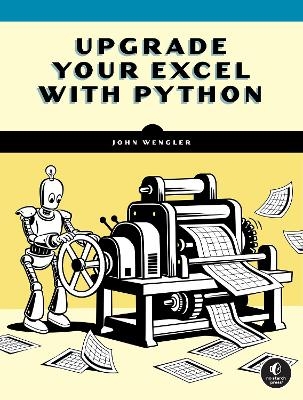
Automate Excel with Python bridges the gap between Excel expertise and Python programming without forcing you to start from scratch. Unlike other programming guides, it’s specifically designed for Excel users who need more power and automation, not for professional programmers.
This book focuses on enhancing your existing Excel skills rather than replacing them. You’ll learn how Python’s dataframes work like virtual spreadsheets, extending what you already know while automating repetitive tasks. You’ll be able to import and export data seamlessly between Excel and Python to integrate coding into your current workflow.
Concise, practical examples throughout will get you up and running quickly. Each topic addresses real problems Excel users face, with solutions you can implement immediately. The structure is deliberately flexible. Chapters progress logically but stand independently, so you can jump to exactly what you need without reading everything that came before. This makes it perfect for solving urgent problems or learning at your own pace.
You’ll apply the techniques you learn to automate reports, clean messy data, perform complex calculations, and handle large datasets that would overwhelm Excel alone—all while leveraging your existing spreadsheet knowledge.
John Wengler enjoys a Mark Twain–like career spanning journalism, community planning, risk management, and compliance. He taught himself Python to upgrade a spreadsheet process to help an employer save millions on a third-party system. He wrote the 2001 book Managing Energy Risk as well as dozens of industry articles on corporate governance. A distinguished public speaker, John has taught courses at the Illinois Institute of Technology (IIT) and Tulane University. He also helped create and write the Energy Risk Professional (ERP) certification program for the Global Association of Risk Professionals (GARP). Prior to learning Python, John previously attempted coding as an undergrad at the University of Wisconsin, using punch cards in the basement mainframe neon dungeon of the Civil Engineering building. He somehow managed to avoid any and all programming when achieving a master’s in urban planning at the University of Illinois at Chicago (UIC) and an MBA from Northwestern University’s Kellogg School. John’s hobbies include writing, history, and the outdoors. Unlike Mark Twain, however, he has yet to captain a riverboat.
Introduction
Part I: From Spreadsheets to Dataframes
Chapter 1: Getting Started with Python
Chapter 2: Displaying Data and Understanding Data Types
Chapter 3: Creating and Manipulating Dataframes and Lists
Chapter 4: Adding, Modifying, and Calculating Column Data
Chapter 5: Accessing and Transforming Individual Cell Values
Chapter 6: Filtering and Displaying Dataframes
Part II: Tools to Replicate Excel Functionality
Chapter 7: Counting and Summing Values
Chapter 8: Combining Dataframes
Chapter 9: Formatting and Calculating Dates and Times
Part III: Workflow Techniques
Chapter 10: Reading Excel Files into Dataframes
Chapter 11: Saving Dataframes to Excel
Chapter 12: There and Back Again: An Excel–Python–Excel Workflow
Appendix A: Working with Folders, Files, and Pathnames
Appendix B: Cleaning Up a Messy Spreadsheet
Appendix C: The Ducks Module
Appendix D: Python Quick Reference
Index
| Erscheint lt. Verlag | 19.5.2026 |
|---|---|
| Verlagsort | San Francisco |
| Sprache | englisch |
| Maße | 178 x 235 mm |
| Gewicht | 369 g |
| Themenwelt | Mathematik / Informatik ► Informatik ► Datenbanken |
| Informatik ► Office Programme ► Excel | |
| Mathematik / Informatik ► Informatik ► Programmiersprachen / -werkzeuge | |
| ISBN-10 | 1-7185-0464-0 / 1718504640 |
| ISBN-13 | 978-1-7185-0464-6 / 9781718504646 |
| Zustand | Neuware |
| Informationen gemäß Produktsicherheitsverordnung (GPSR) | |
| Haben Sie eine Frage zum Produkt? |
aus dem Bereich


