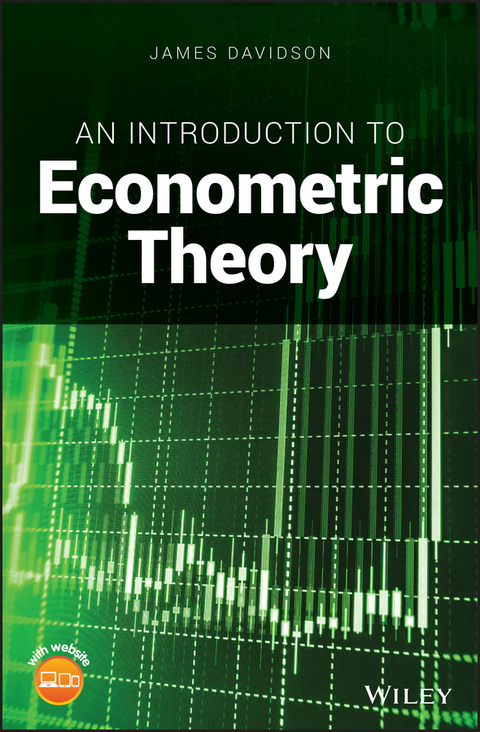
An Introduction to Econometric Theory (eBook)
John Wiley & Sons (Verlag)
978-1-119-48493-6 (ISBN)
A guide to economics, statistics and finance that explores the mathematical foundations underling econometric methods
An Introduction to Econometric Theory offers a text to help in the mastery of the mathematics that underlie econometric methods and includes a detailed study of matrix algebra and distribution theory. Designed to be an accessible resource, the text explains in clear language why things are being done, and how previous material informs a current argument. The style is deliberately informal with numbered theorems and lemmas avoided. However, very few technical results are quoted without some form of explanation, demonstration or proof.
The author - a noted expert in the field - covers a wealth of topics including: simple regression, basic matrix algebra, the general linear model, distribution theory, the normal distribution, properties of least squares, unbiasedness and efficiency, eigenvalues, statistical inference in regression, t and F tests, the partitioned regression, specification analysis, random regressor theory, introduction to asymptotics and maximum likelihood. Each of the chapters is supplied with a collection of exercises, some of which are straightforward and others more challenging. This important text:
- Presents a guide for teaching econometric methods to undergraduate and graduate students of economics, statistics or finance
- Offers proven classroom-tested material
- Contains sets of exercises that accompany each chapter
- Includes a companion website that hosts additional materials, solution manual and lecture slides
Written for undergraduates and graduate students of economics, statistics or finance, An Introduction to Econometric Theory is an essential beginner's guide to the underpinnings of econometrics.
JAMES DAVIDSON is Professor of Econometrics at the University of Exeter. He has also held teaching posts at the University of Warwick, the London School of Economics, the University of Wales Aberystwyth and Cardiff University, as well as visiting positions at the University of California, Berkeley, the University of California, San Diego, and Central European University, Budapest.
A GUIDE TO ECONOMICS, STATISTICS AND FINANCE THAT EXPLORES THE MATHEMATICAL FOUNDATIONS UNDERLING ECONOMETRIC METHODS An Introduction to Econometric Theory offers a text to help in the mastery of the mathematics that underlie econometric methods and includes a detailed study of matrix algebra and distribution theory. Designed to be an accessible resource, the text explains in clear language why things are being done, and how previous material informs a current argument. The style is deliberately informal with numbered theorems and lemmas avoided. However, very few technical results are quoted without some form of explanation, demonstration or proof. The author a noted expert in the field covers a wealth of topics including: simple regression, basic matrix algebra, the general linear model, distribution theory, the normal distribution, properties of least squares, unbiasedness and efficiency, eigenvalues, statistical inference in regression, t and F tests, the partitioned regression, specification analysis, random regressor theory, introduction to asymptotics and maximum likelihood. Each of the chapters is supplied with a collection of exercises, some of which are straightforward and others more challenging. This important text: Presents a guide for teaching econometric methods to undergraduate and graduate students of economics, statistics or finance Offers proven classroom-tested material Contains sets of exercises that accompany each chapter Includes a companion website that hosts additional materials, a solution manual and lecture slides Written for undergraduates and graduate students of economics, statistics or finance, An Introduction to Econometric Theory is an essential beginner's guide to the underpinnings of econometrics.
JAMES DAVIDSON is Professor of Econometrics at the University of Exeter. He has also held teaching posts at the University of Warwick, the London School of Economics, the University of Wales Aberystwyth and Cardiff University, as well as visiting positions at the University of California, Berkeley, the University of California, San Diego, and Central European University, Budapest.
| Erscheint lt. Verlag | 18.7.2018 |
|---|---|
| Sprache | englisch |
| Themenwelt | Mathematik / Informatik ► Mathematik ► Angewandte Mathematik |
| Naturwissenschaften ► Chemie | |
| Wirtschaft ► Volkswirtschaftslehre ► Ökonometrie | |
| Schlagworte | Angewandte Mathematik • A Note on Computation • Applied mathematics • A Random Experiment • Computing the Regression Line • Conditional distributions • Correlation • Cramer's Rule • Definite Matrices • Determinant and Adjoint • Discrete Random Variables • Econometrics • Economics • Elementary Data Analysis • Expected values • Finanz- u. Wirtschaftsstatistik • Linear Dependence and Rank • Mathematics • Mathematik • Matrix Algebra Basics • Matrix Calculus • Matrix Inversion • matrix representation • multiple regression • Ökonometrie • Other Continuous Distributions • Partitioned • Partitioning and Inversion • probability distributions • Properties of the Normal Distribution • random vectors • Regression • Rules of Matrix Algebra • Solving the Matrix Equation • Statistics • Statistics for Finance, Business & Economics • Statistik • summary statistics • Systems of Equations • The Classical Assumptions • The Classical Regression Model • The General Linear Regression • The Least Squares Solution • The Multivariate Normal Distribution • Transposes and Products • Variables and Observations • Volkswirtschaftslehre |
| ISBN-10 | 1-119-48493-6 / 1119484936 |
| ISBN-13 | 978-1-119-48493-6 / 9781119484936 |
| Informationen gemäß Produktsicherheitsverordnung (GPSR) | |
| Haben Sie eine Frage zum Produkt? |
 PDF (Adobe DRM)
Kopierschutz: Adobe-DRM
Adobe-DRM ist ein Kopierschutz, der das eBook vor Mißbrauch schützen soll. Dabei wird das eBook bereits beim Download auf Ihre persönliche Adobe-ID autorisiert. Lesen können Sie das eBook dann nur auf den Geräten, welche ebenfalls auf Ihre Adobe-ID registriert sind.
Details zum Adobe-DRM
Dateiformat: PDF (Portable Document Format)
Mit einem festen Seitenlayout eignet sich die PDF besonders für Fachbücher mit Spalten, Tabellen und Abbildungen. Eine PDF kann auf fast allen Geräten angezeigt werden, ist aber für kleine Displays (Smartphone, eReader) nur eingeschränkt geeignet.
Systemvoraussetzungen:
PC/Mac: Mit einem PC oder Mac können Sie dieses eBook lesen. Sie benötigen eine
eReader: Dieses eBook kann mit (fast) allen eBook-Readern gelesen werden. Mit dem amazon-Kindle ist es aber nicht kompatibel.
Smartphone/Tablet: Egal ob Apple oder Android, dieses eBook können Sie lesen. Sie benötigen eine
Geräteliste und zusätzliche Hinweise
Buying eBooks from abroad
For tax law reasons we can sell eBooks just within Germany and Switzerland. Regrettably we cannot fulfill eBook-orders from other countries.
aus dem Bereich