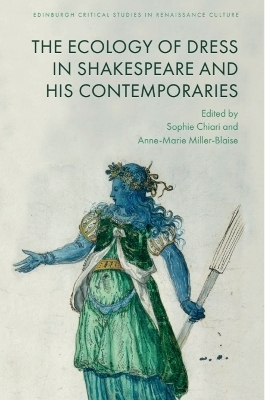
The Ecology of Dress in Shakespeare and His Contemporaries
Edinburgh University Press (Verlag)
978-1-3995-2214-4 (ISBN)
This volume posits that clothing in the early modern period was conceived of as the prime interface between the human body and its multiple environments. Both a second skin and a human-made artefact, dress can indeed be considered as the most immediate site for the elaboration of any sort of ecology, in its etymological sense of a ‘discourse’ of the oikos, or of the place we inhabit. This collection shows how early modern English literature, and drama in particular, interrogates the crucial relationship between humans and the world that surrounds them in its staging of dress. It also argues that the theatrical productions of the time derived much of their creative energy from this process, by which climates and their effects were translated and embodied through dress on the mediating stage. Its various chapters study early modern clothes in their ecosystems and challenge the inside/outside, natural/artificial and body/environment binaries.
Sophie Chiari is Professor of Early Modern English Literature at Université Clermont Auvergne, France, where she is also the Director of the ‘Maison des Sciences de l’Homme de Clermont-Ferrand’, a research institute encompassing the humanities and social sciences. A member of the IHRIM research team, she has edited or coedited various collections of essays including Performances at Court in the Age of Shakespeare (coedited with John Mucciolo, 2019) and The Experience of Disaster in Early Modern English Literature (2022). Her current research focuses on ecocritical issues in Shakespeare and his contemporaries. Her most recent works are Shakespeare’s Representation of Weather, Climate and Environment (2019) and Shakespeare and the Environment. A Dictionary (2022). Anne-Marie Miller-Blaise is Professor of Early Modern English Literature and Cultural Studies at the Université Sorbonne Nouvelle (Paris, France), where she also directs the Epistémè research group within the PRISMES research centre. She was awarded a Research Fellowship by the Institut Universitaire for a project on the interconnectedness of poetic and material circulations within Early Modern Europe (2016–2021). Originally a specialist of poetry and religious history, she was the 2011 recipient of the SAES (French Society for English Studies) special research prize for her monograph on George Herbert, Le Verbe fait image (2010). She currently serves as the vice-president of the Société Française Shakespeare (the French Shakespeare association). Her research profile is interdisciplinary, publishing across genres and adopting a trans-regional perspective as well as a material approach to her analysis of Elizabethan and Jacobean poetry and drama, which are the centre of gravity of her work. She co-edited the volume of Shakespeare’s poetry in French translation for the Pléiade, Gallimard (2021), is currently working on a new French edition of Twelfth Night for Gallimard, and has recently translated Marlowe’s Massacre at Paris with Christine Sukic (forthcoming with Garnier Classiques).
List of Figures
Acknowledgements
Series Editors' Preface
Introduction
Sophie Chiari and Anne-Marie Miller-Blaise
Part I. Fashioning Nativeness and Foreignness
1. Without a National Dress but with a Climate of Their Own: The Invention of the English Climate and ‘Constitution’
Margaret Tudeau-Clayton
2. The Clothes of Insularity in Browne’s Inner Temple Masque
Elisabeth Lacombe
Part II. The Humours of Dress
3. Fabrics, Fashion and the Environment: Representing Venice in Early Modern England
Anne Geoffroy
4. ‘Come and see our frippery’: Brainworm’s Humour of Necessity and Clothes Trafficking in Ben Jonson’s Every Man in His Humour
Anna Demoux
Part III. Clothing the Seasons of Life
5. Clad in Rags: Eco-psychology and Trans-textuality in the Lear stories
Danièle Berton-Charrière
6. ‘O that I were a glove upon that hand’: Love and Gloves in Shakespeare
François Laroque
7. Shakespeare’s Gaudy
Dympna Callaghan
Part IV. The Stuff That Gender Is Made Of
8. ‘That quiff and pinner that hath the gillyflower’: Flowers, Clothes and Female Identities in Jane Cavendish and Elizabeth Brackley’s The Concealed Fancies
Lisa Hopkins
9. Fashioning Falstaff: Dress and Disguise in Shakespeare’s Henry the Fourth and The Merry Wives of Windsor
Valentina Finger
10. Middleton’s Ambivalent Fashions
Chantal Schütz
Part V. The Wealth of Nature's Wardrobe: Playing With The Elements
11. Water and Costume: Wetness on the Early Modern Stage
Sophie Chiari
12. ‘Diana’s Shrouds’ and ‘Black Tempests’: Rites of Passage in Christopher Marlowe’s Dido Queen of Carthage
Sélima Lejri
13. Changing Habits: The Politics and Theatricality of Clothing in Early Modern English Voyages
Sophie Lemercier-Goddard
Notes on Contributors
Bibliography
Index
| Erscheinungsdatum | 09.11.2024 |
|---|---|
| Reihe/Serie | Edinburgh Critical Studies in Renaissance Culture |
| Zusatzinfo | 11 black and white illustrations, 5 colour illustrations |
| Verlagsort | Edinburgh |
| Sprache | englisch |
| Maße | 156 x 234 mm |
| Themenwelt | Literatur ► Lyrik / Dramatik ► Dramatik / Theater |
| Sachbuch/Ratgeber ► Natur / Technik ► Natur / Ökologie | |
| Geisteswissenschaften ► Sprach- / Literaturwissenschaft ► Anglistik / Amerikanistik | |
| Geisteswissenschaften ► Sprach- / Literaturwissenschaft ► Literaturgeschichte | |
| Geisteswissenschaften ► Sprach- / Literaturwissenschaft ► Literaturwissenschaft | |
| ISBN-10 | 1-3995-2214-0 / 1399522140 |
| ISBN-13 | 978-1-3995-2214-4 / 9781399522144 |
| Zustand | Neuware |
| Informationen gemäß Produktsicherheitsverordnung (GPSR) | |
| Haben Sie eine Frage zum Produkt? |
aus dem Bereich