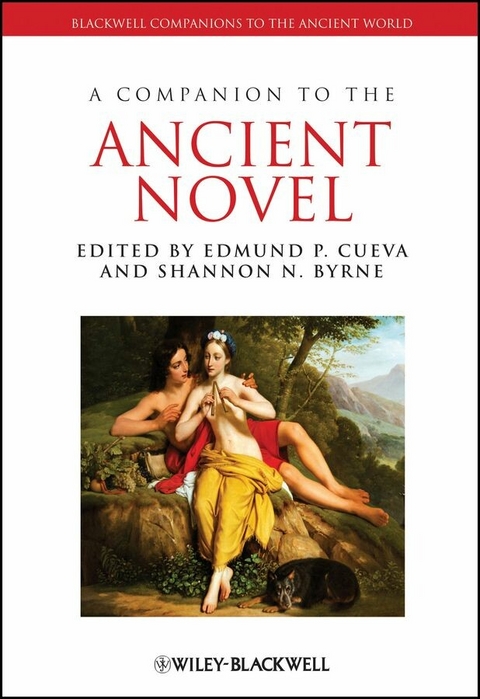
This companion addresses a topic of continuing contemporary relevance, both cultural and literary.
- Offers both a wide-ranging exploration of the classical novel of antiquity and a wealth of close literary analysis
- Brings together the most up-to-date international scholarship on the ancient novel, including fresh new academic voices
- Includes focused chapters on individual classical authors, such as Petronius, Xenophon and Apuleius, as well as a wide-ranging thematic analysis
- Addresses perplexing questions concerning authorial expression and readership of the ancient novel form
- Provides an accomplished introduction to a genre with a rising profile
Shannon N. Byrne is Professor of Classics at Xavier University.
Edmund P. Cueva is Professor of Classics and Humanities at the University of Houston-Downtown. Together, they have coedited several books, including of Authors, Authority and Interpreters in the Ancient Novel: Essays in Honor of Gareth L. Schmeling (with J. Alvares, 2006), Longus: Text, Commentary and Vocabulary (2005), and Humor and Classical Literature (2002).
This companion addresses a topic of continuing contemporary relevance, both cultural and literary. Offers both a wide-ranging exploration of the classical novel of antiquity and a wealth of close literary analysis Brings together the most up-to-date international scholarship on the ancient novel, including fresh new academic voices Includes focused chapters on individual classical authors, such as Petronius, Xenophon and Apuleius, as well as a wide-ranging thematic analysis Addresses perplexing questions concerning authorial expression and readership of the ancient novel form Provides an accomplished introduction to a genre with a rising profile
Shannon N. Byrne is Professor of Classics at Xavier University. Edmund P. Cueva is Professor of Classics and Humanities at the University of Houston-Downtown. Together, they have coedited several books, including of Authors, Authority and Interpreters in the Ancient Novel: Essays in Honor of Gareth L. Schmeling (with J. Alvares, 2006), Longus: Text, Commentary and Vocabulary (2005), and Humor and Classical Literature (2002).
Notes on Contributors viii
Introduction 1
Edmund P. Cueva and Shannon N. Byrne
Part I Novels and Authors 11
a. Greek 12
1 Chariton: Individuality and Stereotype 13
Graham Anderson
2 Daphnis and Chloe: Innocence and Experience, Archetypes andArt 26
Jean Alvares
3 Xenophon, The Ephesian Tales 43
James N. O'Sullivan
4 Achilles Tatius, Sophistic Master of Novelistic Conventions62
Kathryn S. Chew
5 Heliodorus, the Ethiopian Story 76
Marília P. Futre Pinheiro
b. Roman 95
6 Petronius, Satyrica 96
Heinz Hofmann
7 Apuleius' The Golden Ass: The Nature of the Beast119
Paula James
8 Historia Apollonii Regis Tyri 133
Giovanni Garbugino
c. Related 146
9 The Other Greek Novels 147
Susan Stephens
10 Hell-bent, Heaven-sent: From Skyman to Pumpkin 159
Barry Baldwin
11 The Novel and Christian Narrative 180
David Konstan and Ilaria Ramelli
Part II Genre and Approaches 199
12 The Genre of the Novel: A Theoretical Approach 201
Marília P. Futre Pinheiro
13 The Management of Dialogue in Ancient Fiction 217
Graham Anderson
14 Characterization in the Ancient Novel 231
Koen De Temmerman
15 Liaisons Dangereuses: Epistolary Novels in Antiquity244
Timo Glaser
16 The Life of Aesop (rec.G): The Composition of the Text257
Consuelo Ruiz-Montero
Part III Influences and Intertextuality 273
17 Reception of Strangers in Apuleius' Metamorphoses: TheExamples of Hypata and Cenchreae 275
Stavros Frangoulidis
18 From the Epic to the Novelistic Hero: Some Patterns of aMetamorphosis 288
Luca Graverini
19 Roman Elegy and the Roman Novel 300
Judith P. Hallett and Judith Hindermann
20 Apuleius' Metamorphoses: A Hybrid Text? 317
Paula James
21 The Magnetic Stone of Love: Greek Novel and Poetry 330
Françoise Létoublon
22 "Respect these Breasts and Pity Me": Greek Noveland Theater 352
Françoise Létoublon and Marco Genre
23 Poems in Petronius' Satyrica 371
Aldo Setaioli
24 Various Asses 384
Niall W. Slater
25 Greek Novel and Greek Archaic Literature 400
Giuseppe Zanetto
26 Ekphrasis in the Ancient Novel 411
Angela Holzmeister
Part IV Themes and Topics 425
27 Miscellanea Petroniana: A Petronian Enthusiast'sThoughts and Reviews 427
Barry Baldwin
28 Love, Myth, and Ritual: The Mythic Dimension and Adolescencein Longus' Daphnis and Chloe 441
Anton Bierl
29 Gender in the Ancient Novel 456
Ellen D. Finkelpearl
30 Education as Construction of Gender Roles in the Greek Novels473
Sophie Lalanne
31 Greek Love in the Greek Novel 490
John F. Makowski
32 Latin Culture in the Second Century ad 502
Claudio Moreschini
33 Mimet(h)ic Paideia in Lucian's True History 522
Peter von Möllendorff
34 Reimagining Community in Christian Fictions 535
Judith Perkins
35 The Poetics of Old Wives' Tales, or Apuleius and thePhilosophical Novel 552
Stefan Tilg
36 Achilles Tatius and Heliodorus: Between Aristotle andHitchcock 570
Martin M. Winkler
37 Longus' Daphnis and Chloe: Literary Transmission andReception 584
Maria Pia Pattoni
Index 598
"It offers a nice mixture of new discussions, including some that will be useful for students and the uninitiated, some that will provoke further research, and a number that will stand as important contributions to the field in their own right." (Bryn Mawr Classical Review, 19 June 2015)
"Ending with a chapter looking at the influence of the ancient novel on modern film, the Companionforms a full circle in its assessment of forms of entertainment, while also demonstrating, in spite of its apparent rarity, that the ancient novel continues to exert a strong influence on modern storytellers, their means of, and inspirations for, storytelling." (Reference Reviews, 1 December 2014
Notes on Contributors
Jean Alvares is Associate Professor and Chair at Montclair State University and works on the Greco-Roman novel as well as teaching with technology.
Graham Anderson is Emeritus Professor of Classics in the University of Kent. His work on ancient fiction includes Eros Sophistes (1982) and Folktale as a Source of Graeco-Roman Fiction (2007). He is currently involved in a study of kingship legend in antiquity.
Barry Baldwin is Emeritus Professor of Classics at the University of Calgary and Fellow of the Royal Society of Canada. His publications include Studies in Lucian (Hakkert, 1973), Studies in Aulus Gellius (Coronado Press, 1975), and Suetonius (A.M. Hakkert, 1983); anthologies of Byzantine poetry and later Latin literature (J.C. Gieben, 1985, 1987); three volumes of collected Greek, Roman, and Byzantine papers (J.C. Gieben, 1984, 1985, 1989); translations of the Philogelos (J.C. Gieben, 1983) and the Timarion (Wayne State Press, 1984); The Roman Emperors (Harvest House, 1980); and The Latin & Greek Poems of Samuel Johnson (Duckworth, 1995). He writes a monthly classical column for the Fortean Times (UK/USA), and contributes regularly to the Petronian Society Newsletter and to Vates (electronic journal of neo-Latin poetry).
Anton Bierl is Professor Ordinarius for Greek Literature at the University of Basel. He is the co-editor of the Gesamtkommentar zu Homers Ilias and the series editor for MythosEikonPoiesis. His main research interests include Homeric epic, drama, song and performance culture, and the ancient novel.
Kathryn S. Chew is Professor of Classics in the Department of Comparative Literature and Classics at California State University, Long Beach. Her research interests include ancient novels, early Christian literature, and Late Antique history. She has an article “Eyeing Epiphanies in Greek, Latin, and Sanskrit Texts” forthcoming from Phoenix.
Ellen D. Finkelpearl is Professor of Classics and the Helen Chandler Garland Chair in Ancient Studies at Scripps College. Her research interests and publications encompass the breadth of ancient novel studies with particular focus on Apuleius and the Metamorphoses. In addition to numerous book chapters and articles, she has published Metamorphosis of Language in Apuleius: A Study of Allusion in the Novel (Ann Arbor, 1998) and “A Review of Scholarship on Apuleius’ Metamorphoses 1970–1998” (Lustrum, 42, 2000), with Carl Schlam, an annotated bibliography of over 500 items.
Stavros Frangoulidis is Professor of Latin at the Aristotle University of Thessaloniki. He has co-organized several RICAN conferences on the study of the Ancient Novel, and co-edited the proceedings thereof (published as Ancient Narrative Supplementa). He has edited a thematic issue on the ancient novel (with Stephen J. Harrison), and a volume on Latin genre (with Theodore D. Papanghelis and Stephen J. Harrison), both published in the Trends in Classics series (Walter de Gruyter). He has written a number of articles on Roman comedy, the Latin novel, and Senecan tragedy. Finally, he is the author of the following books: Handlung und Nebenhandlung: Theater, Metatheater und Gattungsbewusstein in der römischen Komödie (Stuttgart: J.B. Metzler, 1997); Roles and Performances in Apuleius’ Metamorphoses (Stuttgart: J.B. Metzler, 2001); and Witches, Isis and Narrative: Approaches to Magic in Apuleius’ Metamorphoses (Berlin and New York: Walter de Gruyter, 2008).
Marília P. Futre Pinheiro is Professor of Classics at the University of Lisbon. She organized the Fourth International Conference on the Ancient Novel (ICAN IV) in July 2008. Her most recent publication is Mitos e Lendas da Grécia Antiga, 2011. She edited Fictional Traces: Receptions of the Ancient Novel (2011), ANS 14.1 and 14.2, with Stephen J. Harrison; Narrating Desire: Eros, Sex, and Gender in the Ancient Novel (2012); Trends in Classics (De Gruyter), with Marilyn B. Skinner and Froma I. Zeitlin; and The Ancient Novel and Early Christian and Jewish Narrative: Fictional Intersections, 2012, ANS 16, with Judith Perkins and Richard Pervo, and Intende Lector–Echoes of Myth, Religion and Ritual in the Ancient Novel, 2013, MythosEikonPoiesis, De Gruyter, with Anton Bierl and Roger Beck.
Giovanni Garbugino, Professor of Latin Literature at University of Genoa, has edited the annotated editions of Novus Aesopus by Alexander Neckam (Genoa, 1987), Bellum Iugurthinum (Milan, 1994), and Bellum Catilinae (Naples, 1998) by Sallust. Lately, his interests are centered on the Latin novel. His most recent publications are: Enigmi della “Historia Apollonii Regis Tyri” (Bologna, 2004), Studi sul romanzo latino (Alessandria, 2010), La storia di Apollonio re di Tiro, Introd., testo critico, traduzione e note (Alessandria, 2010), and La storia della distruzione di Troia. Introd., testo, traduzione e note (Alessandria, 2011).
Marco Genre has a master’s degree on the Greek Novel from the University of Milan. Since 2011, he has been teaching Italian in secondary school.
Timo Glaser is Subject Specialist for Theology at Marburg University Library. His research has focused on epistolary literature, ancient fiction and philosophy, and early Christian reception of Greco-Roman culture. His Ph.D. thesis dealt with the ancient epistolary novel and its reception in the New Testament: Paulus als Briefroman erzählt: Studien zum antiken Briefroman und seiner christlichen Rezeption in den Pastoralbriefen (Göttingen, 2009).
Luca Graverini teaches Latin literature in the University of Siena at Arezzo. He has published extensively on Apuleius and on the ancient novel. His Le Metamorfosi di Apuleio. Letteratura e identità (Pisa: Pacini, 2007) is being published in English translation by Ohio State University Press. More information at http://luca.graverini.com.
Judith P. Hallett is Professor of Classics and a Distinguished Scholar–Teacher at the University of Maryland, College Park. She has published widely in the areas of Latin language and literature; ancient Greek and Roman women, sexuality, and the family; and classical reception in the United States.
Judith Hindermann is Associate Lecturer in Classics at the University of Basel. Her research interests include the ancient novel, Roman elegy, the younger and elder Pliny, and the depiction of the emotions in ancient letters.
Heinz Hofmann was Professor of Latin at the University of Groningen (the Netherlands) from 1982 to 1993, where between 1985 and 1993 he organized twice a year the colloquia on the novel. He edited nine volumes of the Groningen Colloquia on the Novel (1988 ff.) and Latin Fiction: The Latin Novel in Context (Routledge 1999). He is now Emeritus Professor of Latin at the University of Tübingen (Germany) and has published not only on Apuleius and the ancient novel, but also on Augustan poetry and many late antiquity and neo-Latin topics.
Angela Holzmeister is a Ph.D. student at the University of California, Santa Barbara. She is researching masculinity in the ancient Greek novel.
Paula James is Senior Lecturer in Classical Studies (Open University, UK). She has published widely on the literary and reception aspects of Apuleius’ novel since 1987 and also written many chapters and articles on classical culture, including a 2011 monograph titled Ovid’s Myth of Pygmalion on Screen: In Pursuit of the Perfect Woman, and another one titled Understand Roman Civilisation (2012).
David Konstan is Professor of Classics at New York University and Professor Emeritus of Classics and Comparative Literature at Brown University. Among his recent publications are The Emotions of the Ancient Greeks (2006) and Before Forgiveness: The Origins of a Moral Ideal (2010).
Sophie Lalanne is Associate Professor of Ancient Greek History at the Department of History, University of Paris 1 Panthéon-Sorbonne, and a member of the research lab ANHIMA (UMR 8210). She is the author of Une éducation grecque: Rites de passage et construction des genres dans le roman grec ancien (Paris, 2006). Her major interests are cultural history and gender history of the Greek world in the time of the Roman Empire.
Françoise Létoublon is Professor of Greek Literature and Linguistics at the Université Stendhal (Grenoble). She is the author of Il allait, pareil à la nuit. Les verbes de mouvement en grec: supplétisme et aspect verbal (Paris, 1985) and of Les lieux communs du roman (Leiden, 1993). She has edited La langue et les textes en grec ancien. Colloque Pierre Chantraine (Amsterdam, 1993), Impressions d’îles (Toulouse, 1996), Hommage à Milman Parry. Le style formulaire de l’épopée homérique et la théorie de l’oralité poétique (Amsterdam, 1997), and Homère en France après la Querelle (Paris, 1999). She is currently working on Homeric poetry, oral poetry, mythology, and their reception, up from antiquity (Greek novels)...
| Erscheint lt. Verlag | 31.1.2014 |
|---|---|
| Reihe/Serie | Blackwell Companions to the Ancient World |
| Blackwell Companions to the Ancient World | Blackwell Companions to the Ancient World |
| Sprache | englisch |
| Themenwelt | Literatur |
| Geschichte ► Allgemeine Geschichte ► Vor- und Frühgeschichte | |
| Geisteswissenschaften ► Sprach- / Literaturwissenschaft ► Anglistik / Amerikanistik | |
| Geisteswissenschaften ► Sprach- / Literaturwissenschaft ► Latein / Altgriechisch | |
| Geisteswissenschaften ► Sprach- / Literaturwissenschaft ► Literaturwissenschaft | |
| Schlagworte | Ancient & Classical Literature • Antike u. klassische Literatur • Classical Studies • Humanistische Studien • Literaturgeschichte • Petronius, Xenophon, Apuleius, ancient literature, latin literature, greek literature, classical literature, classical culture, reception of classical literature, ancient Greek novels, ancient Roman novels, Latin fiction |
| ISBN-10 | 1-118-35058-8 / 1118350588 |
| ISBN-13 | 978-1-118-35058-4 / 9781118350584 |
| Informationen gemäß Produktsicherheitsverordnung (GPSR) | |
| Haben Sie eine Frage zum Produkt? |
 EPUB (Adobe DRM)
Kopierschutz: Adobe-DRM
Adobe-DRM ist ein Kopierschutz, der das eBook vor Mißbrauch schützen soll. Dabei wird das eBook bereits beim Download auf Ihre persönliche Adobe-ID autorisiert. Lesen können Sie das eBook dann nur auf den Geräten, welche ebenfalls auf Ihre Adobe-ID registriert sind.
Details zum Adobe-DRM
Dateiformat: EPUB (Electronic Publication)
EPUB ist ein offener Standard für eBooks und eignet sich besonders zur Darstellung von Belletristik und Sachbüchern. Der Fließtext wird dynamisch an die Display- und Schriftgröße angepasst. Auch für mobile Lesegeräte ist EPUB daher gut geeignet.
Systemvoraussetzungen:
PC/Mac: Mit einem PC oder Mac können Sie dieses eBook lesen. Sie benötigen eine
eReader: Dieses eBook kann mit (fast) allen eBook-Readern gelesen werden. Mit dem amazon-Kindle ist es aber nicht kompatibel.
Smartphone/Tablet: Egal ob Apple oder Android, dieses eBook können Sie lesen. Sie benötigen eine
Geräteliste und zusätzliche Hinweise
Buying eBooks from abroad
For tax law reasons we can sell eBooks just within Germany and Switzerland. Regrettably we cannot fulfill eBook-orders from other countries.
aus dem Bereich