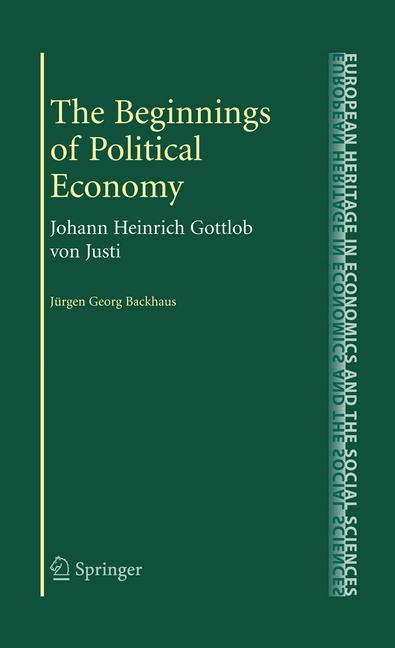
The Beginnings of Political Economy (eBook)
196 Seiten
Springer US (Verlag)
978-0-387-09779-4 (ISBN)
Ju* rgen G. Backhaus 1 Johann Heinrich Gottlob (von) Justi was born in 1702 in Bru* cken in Prussia (county of Sangerhausen), studied law and cameral sciences in Wittenberg and Jena, yet had to leave the university, entered the Prussian military service, was captured during the Austrian war of succession by the Austrians but escaped to Leipzig (Saxony) where he studied mineral sciences. In 1750 he was called to a chair ''Cameral Sciences and Rhetorics'' at the new Theresian Academy of Knights in Vienna. There, he gave two important inaugural lectures which are the focal point of this book. In 1754, Justi was appointed a mineral counsellor in Gottingen * (Hanover), and lectured at the Saxonian University on both state sciences and natural sciences. In 1762, Frederic II (the Great) of Prussia appointed him Prussian captain (highest supervisory position) of mines and general supervisor of fiscal-mineral activities. In 1768 he was accused of embezzlement, and before he could prove his innocence, he died in 1771 as a prisoner in the (decaying) fortress of Ku* strin. Due to his death, the case was never decided. But Frederic had obviously made his own decision. When he appointed Justi, the appointee pointed out that he was suffering from weak eye sight and could not readily check the bookkeeping. Frederic replied: You may have weak eyes but you have a bright mind. I shall put two eyes by your side.
Contents 8
Contributors 10
Introduction 11
From Wolff to Justi 13
Introduction 13
Part I: Describing the Early Development of the Sciences of State 15
Part II: Impressions of Justi 18
Part III: The Connections Between Wolff and Justi 20
Summary and Conclusions 26
Notes 26
References 29
A Bibliography of J.H.G. von Justi 31
2.1 Introduction to Justi’s Bibliography 31
2.2 Bibliographical Sources 34
Johann Heinrich Gottlob von Justi – The Life and Times of an Economist Adventurer 44
3.1 ‘‘State Adventurers’’ in English and German Economic History 44
3.2 Justi’s Life 46
3.3 Justi’s Influence in Denmark-Norway 55
3.4 Systematizing Justi’s Writings 59
3.5 Justi as the Continuity of the Continental Renaissance Filiation of Economics 63
3.6 Economics at the Time of Justi: ‘Laissez-faire with the Nonsense Left out’ 66
3.7 What Justi Knew, Adam Smith Later Left out of Economics 71
3.7.1 Geography 71
3.7.2 International Trade Theory and Uneven Economic Development 72
3.7.3 The Reason for the Urban Bias of Early Economic Development 73
3.7.4 How Economic Activities Differ and The Role of Skills and Human Learning 74
3.7.5 Context Matters 75
3.7.6 Agriculture and Forestry 75
3.7.7 The Size of the Population and Population Density 75
3.7.8 The Limitations to the Power of the Nobility 76
3.7.9 Inventions, Innovations and Technological Change 76
3.7.10 Colonies 77
3.7.11 ‘‘Dutch Disease’’, or, How Too Much Unearned Wealth Destroys an Economy 77
3.8 Conclusion: Lost Relevance that Could Be Regained 78
Notes 81
References 81
Justi and the Post-Montesquieu French Debate on Commercial Nobility in 1756 86
4.1 Introduction 86
4.2 Origins of the French Debate in 1756 88
4.3 Montesquieu’s Theory of a Non-commercial Nobility 90
4.4 Coyer’s Theory of a Trading Nobility 91
4.5 Immediate Reactions and d’Arc’s Reply 94
4.6 Justi’s Involvement into the Debate 97
4.7 Relation to Justi’s Other Works 100
4.8 Justi’s Governmental Ideal: A Reformed, Commercially Orientated Monarchy 100
Notes 101
References Primary Sources 107
Secondary Sources 108
The International Aspects of Justi’s Work 110
5.1 Foreign Policy 111
5.2 Trade Policy 112
5.3 Population Policy 114
5.4 Immigration 115
5.5 Depopulation 116
5.6 Conclusion 117
Notes 118
References 121
Justi and Japan 122
Notes 127
References 127
Justi’s Concept of Moral Economics and the Good Society 128
7.1 Introduction 128
7.2 The Wisdom of the Fables 129
7.3 Justi’s Moral-Philosophical Writings 131
7.4 Traces of the Good Society and Moral Economics in Justi’s System des Finanzwesens 133
7.5 Conclusion 138
Notes 138
References 142
Cameralism and Labour in von Justi’s Economic Thinking 144
8.1 Introduction 144
8.2 Some Fundamental Principles Concerning the Relationship Between Labour and Wealth Production in Mercantilism 145
8.3 Labour and Wealth Production in the Cameralist System Under Special Consideration of von Justi 148
8.4 Summary 154
Notes 155
References 155
J.H.G. Justi in Austria: His Writings in the Context of Economic and Industrial Policies of the Habsburg Empire in the 18th Century 157
9.1 Introduction 157
9.2 Justi in Vienna 158
9.3 Protection, Promotion, Competition: Justi on Industrial Policy (‘‘Gewerbepolitik’’) 159
9.4 Taxation and Credit 162
9.5 Conclusion 163
Notes 164
Reference 165
Justi’s Concept of Taxation 167
10.1 Introduction 167
10.2 Justi on Aims of the State 167
10.3 Justi on Taxes and Fees 170
10.4 Is There a Concept of Taxation in Justi’s Oeuvre? 174
10.5 Conclusions 176
Notes 177
References 179
Johann Heinrich Gottlob von Justi (1717–1771): Health as Part of a State’s Capital Endowment 181
11.1 Social and Health Related Thought in Cameralism 181
11.2 People, the Wealth of the State 183
11.2.1 Major Population-Based Measures 183
11.2.2 The Impact of the Thirty Years War 184
11.2.3 Distinctive Feature of Cameralism: the Concern with the Police Function 185
11.3 Justi’s Contributions 187
11.3.1 Justi’s Notion of Social Welfare 187
11.3.2 How to Prevent Starvation 188
11.3.3 How to Abolish Begging 189
11.3.4 The Human Toll of Winter Campaigns 190
11.3.5 Health Measures Against the Depopulation of a Country 191
11.3.6 Public Health Tradition in Cameralism 193
11.4 Relevance of Justi’s Thought 194
Summary 196
Notes 197
References 203
| Erscheint lt. Verlag | 13.11.2008 |
|---|---|
| Reihe/Serie | The European Heritage in Economics and the Social Sciences | The European Heritage in Economics and the Social Sciences |
| Zusatzinfo | XII, 196 p. |
| Verlagsort | New York |
| Sprache | englisch |
| Themenwelt | Geschichte ► Teilgebiete der Geschichte ► Wirtschaftsgeschichte |
| Sozialwissenschaften ► Politik / Verwaltung ► Politische Theorie | |
| Sozialwissenschaften ► Soziologie | |
| Wirtschaft ► Allgemeines / Lexika | |
| Wirtschaft ► Volkswirtschaftslehre ► Wirtschaftspolitik | |
| Schlagworte | 18th century • Biography • Commercial stability • Economics • Good Society • Health Economics • Moral Economics • Nation • Policy • Policy Sciences • Political Economy • Taxation |
| ISBN-10 | 0-387-09779-1 / 0387097791 |
| ISBN-13 | 978-0-387-09779-4 / 9780387097794 |
| Informationen gemäß Produktsicherheitsverordnung (GPSR) | |
| Haben Sie eine Frage zum Produkt? |
 PDF (Wasserzeichen)
Größe: 2,1 MB
DRM: Digitales Wasserzeichen
Dieses eBook enthält ein digitales Wasserzeichen und ist damit für Sie personalisiert. Bei einer missbräuchlichen Weitergabe des eBooks an Dritte ist eine Rückverfolgung an die Quelle möglich.
Dateiformat: PDF (Portable Document Format)
Mit einem festen Seitenlayout eignet sich die PDF besonders für Fachbücher mit Spalten, Tabellen und Abbildungen. Eine PDF kann auf fast allen Geräten angezeigt werden, ist aber für kleine Displays (Smartphone, eReader) nur eingeschränkt geeignet.
Systemvoraussetzungen:
PC/Mac: Mit einem PC oder Mac können Sie dieses eBook lesen. Sie benötigen dafür einen PDF-Viewer - z.B. den Adobe Reader oder Adobe Digital Editions.
eReader: Dieses eBook kann mit (fast) allen eBook-Readern gelesen werden. Mit dem amazon-Kindle ist es aber nicht kompatibel.
Smartphone/Tablet: Egal ob Apple oder Android, dieses eBook können Sie lesen. Sie benötigen dafür einen PDF-Viewer - z.B. die kostenlose Adobe Digital Editions-App.
Buying eBooks from abroad
For tax law reasons we can sell eBooks just within Germany and Switzerland. Regrettably we cannot fulfill eBook-orders from other countries.
aus dem Bereich