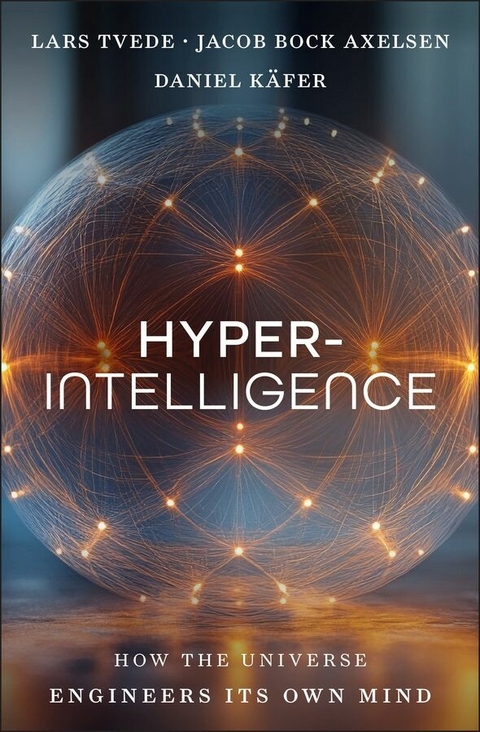
Hyperintelligence (eBook)
365 Seiten
Wiley (Verlag)
978-1-394-36610-1 (ISBN)
A captivating journey through the evolution of human and artificial intelligence
Hyperintelligence: How the Universe Engineers Its Own Mind is a must-read for anyone who wants a glimpse into the AI-driven future. This entertaining and thought-provoking book tells the story of how complexity and intelligence developed out of cosmic nothingness. The authors take a big-picture analytical approach to identify the major forces that set this process in motion and led straight to the development of AI. Taking a close look at three of these forces-complexity cascades, critical density, and creative pulse-they sketch out the next chapter in the 13.8-billion-year history of intelligence, highlighting the enormous opportunities that AI and other new technologies present. You'll find yourself fascinated, enlightened, reassured, and inspired to help drive innovation for a brighter and more intelligent future for all.
- Discover how the swirling particles released in the Big Bang came together to generate complexity and intelligence
- Gain an optimistic perspective on new technology when you see it as part of the big picture of biological and social evolution
- Learn about the latest data-driven predictions for the future of AI and other innovations
- Prepare to shift your mindset and embrace the possibilities AI offers
Written in an accessible and engaging style, Hyperintelligence is a great read for business leaders, entrepreneurs, and anyone curious about, not only the future, but also how that future fits into the grand cosmic story that began 13.8 billion years ago.
LARS TVEDE is an award-winning serial entrepreneur, successful financial investor, and bestselling author with a million books sold. Among his many startups are Supertrends, a firm that uses AI, text-mining, and crowd-sourcing to map global innovation, and 55 Capital.
JACOB BOCK AXELSEN is an expert in mathematical modelling and a specialist in AI and quantum computers. Jacob holds degrees in mathematics and economics (BSc), biophysics (MSc), and physics (PhD), and worked for many years on scientific research and in senior management consulting.
DANIEL KÄFER is an international futurist with management experience from telecom, social media, music publishing and business advisory. He's an expert in AI, the metaverse, social media, digital transformation, and digital marketing.
A captivating journey through the evolution of human and artificial intelligence Hyperintelligence: How the Universe Engineers Its Own Mind is a must-read for anyone who wants a glimpse into the AI-driven future. This entertaining and thought-provoking book tells the story of how complexity and intelligence developed out of cosmic nothingness. The authors take a big-picture analytical approach to identify the major forces that set this process in motion and led straight to the development of AI. Taking a close look at three of these forces complexity cascades, critical density, and creative pulse they sketch out the next chapter in the 13.8-billion-year history of intelligence, highlighting the enormous opportunities that AI and other new technologies present. You'll find yourself fascinated, enlightened, reassured, and inspired to help drive innovation for a brighter and more intelligent future for all. Discover how the swirling particles released in the Big Bang came together to generate complexity and intelligence Gain an optimistic perspective on new technology when you see it as part of the big picture of biological and social evolution Learn about the latest data-driven predictions for the future of AI and other innovations Prepare to shift your mindset and embrace the possibilities AI offers Written in an accessible and engaging style, Hyperintelligence is a great read for business leaders, entrepreneurs, and anyone curious about, not only the future, but also how that future fits into the grand cosmic story that began 13.8 billion years ago.
1.
VIRTUALLY NOTHING
In this chapter, we witness the universe ignite with a mighty bang. Millions of years later, the first stars blaze to life, their fiery hearts becoming cosmic forges. See how stars transform simple elements into the building blocks of planets and life, scattering them across the universe in supernova explosions. We are, quite literally, made of stardust.
It's a very early August morning on the Croatian coast. As the first light creeps through the curtains in the bedroom, Maria wakes up. She's staying in a charming little family-run hotel, and beside her in bed lies her husband, John, still sound asleep.
Maria stretches, her muscles releasing the tensions of sleep. Then she slips almost silently out of bed, careful not to wake John. She tiptoes across the cool floor and puts on her favorite bikini. With a last glance back at her sleeping husband, she opens the door, sneaks out, and carefully closes it behind her. And then she walks down the seven steps to the hotel's small beach. Birds are singing out here, and the air smells of pine trees and wildflowers. Nearby, several colorful butterflies flutter among the blossoms.
The sea is glassy smooth. Maria takes a deep breath and lets a feeling of calm wash over her. It's so beautiful – the view, the sounds, the scent. Everything! She wades out into the crystal-clear water. Small fish swim playfully around her ankles in the clear shallows. A deep sense of gratitude spreads through her. All of this – the land, the air, the sea, life itself, she thinks – it's so amazing.
And then she remembers something scientists say. They say that it all arose from the void, from nothingness itself. The thought is strange.
The Strange Bang
Yes, very strange indeed. Today, there's almost universal agreement among physicists and astronomers that our universe originated from a single, enormous explosion called the Big Bang. Maria, the Earth, the ocean, the flowers, and the butterflies all came from that. This monumental event began from an incredibly tiny point, possibly smaller than a single atom. And perhaps the explosion started from nothing at all.
It's hard to imagine anything more absurd. But the scientific evidence for it is overwhelming. So even though this story seems utterly astonishing, it also appears to be true.
Another astounding aspect of the Big Bang is the incredible speed at which these events first unfolded. Most likely, this tiny speck grew to the size of Earth within less than a billionth of a second! Almost immediately after, the universe had expanded to the mighty size of the sun. And within the first full second, it may have even encompassed 10–20 light-years across – a distance equivalent to billions of kilometers. Not only did it expand much faster than the speed of light, but it grew to light-years across within an unimaginably tiny timeframe, shorter than it takes light to travel the width of an atom. This incredible first second of the Big Bang is now called “inflation.”
Now imagine that during their Croatian vacation, Maria and John lie on the beach close to midnight, gazing into the clear, starry night sky. They might see the stars Alpha Centauri A and B, which are 4.37 light-years away. The distance to these is likely well within the size the universe had grown to within the first second after the Big Bang began.
Wild! But let's take the events step by step. Until about 10−36 seconds after the beginning, the universe was incredibly hot and dense, filled only with an immense amount of energy, so it's not really accurate to say there was nothing. Because there was a tremendous amount of energy. This energy was initially in the form of a unified “field,” where all of nature's forces were completely entangled with each other. As we passed 10−36 seconds, the universe had expanded and cooled enough to allow the separation of the four different forces: gravity, strong and weak nuclear forces, and the electromagnetic force.
After 10−12 seconds, when the energy density and temperature had dropped further, some of this energy began to transform into mass through Einstein's famous equation: E = mc2; energy equals “mass” (or what we call weight here on Earth) times the “speed of light” squared. This phenomenon, where energy can become mass, led to the creation of fundamental particles like quarks, leptons, and bosons. Quarks form protons, leptons include electrons, and bosons are particles like light.
In total, within one second, 17 different kinds of fundamental particles and their symmetrical antimatter counterparts had emerged, making 34 in total.
Complexity Cascade #1
- What? Formation of particles
- When? 10−12 seconds after the start of the Big Bang
- Why? Cooling of the universe within the first fraction of a second.
Already in the first minutes after the start of the Big Bang, protons and neutrons began to combine, forming the first atomic nuclei. This process, called nucleosynthesis, continued for about 20 minutes and created a universe filled with hydrogen and helium, along with traces of lithium and beryllium.
Complexity Cascade #2
- What? Formation of the first four atoms
- When? Up to 20 minutes after the start of the Big Bang
- Why? Further cooling of the universe.
The Red Shift and the Rumble
No matter how long anyone ponders this whole story, it will forever remain very, very strange. Despite this, the idea isn't entirely new. In fact, the Big Bang theory was first proposed in the 1920s thanks to the pioneering work of the Belgian priest and astronomer Georges Lemaître. In a groundbreaking 1927 article, Lemaître introduced the concept of an expanding universe containing an unchanging amount of matter. This article was partly based on Einstein's groundbreaking general theory of relativity from a few years earlier, which described gravity as part of a whole that we call spacetime. So, space and time are a single entity, and gravity is a curvature in spacetime. Furthermore, Lemaître knew there were preliminary indications that stars and galaxies were moving away from each other.
Spacetime. Spacetime is a concept from physics that unites the three dimensions of space (length, width, height) with time as a fourth dimension. Imagine it as a kind of fabric that can be stretched and bent by mass and energy, and on which all events in the universe take place.
But no one paid much attention to this bizarre theory in 1927. Just two years later, in 1929, however, astronomer Edwin Hubble found evidence that galaxies were actually moving away from us, with their speed proportional to their distance – a relationship now known as Hubble's Law.
This was truly significant. Imagine placing dots on an inflated balloon, each representing a galaxy. As the balloon expands, the dots (or galaxies) move further apart. In our three-dimensional universe, this expansion is driven by the vacuum – the space between atoms and particles. Hubble's observation showed that everything started in the same place, and that vacuum is constantly being produced and stretching the very fabric of space. By the way, it's a bit strange to think about an expanding vacuum. We usually think of a vacuum as nothing. But if it's constantly growing, it's intellectually a weird thing to explain.
How did Hubble measure how galaxies were moving? He built upon the so-called Doppler effect, which you can experience in your everyday life as a high-pitched tone when an ambulance siren approaches, and then a lower pitch as it moves away. Similarly, the light from distant galaxies appears to be “redshifted” due to their movement away from us. Instead of the tone of a siren, think of light shifting from blue (higher energy) moving towards us, to red (lower energy) when its source moves away from the observer. The red-shifting is, however, mostly due to the fact that space itself stretches light and thus lowers its frequency making it “redder.”
To measure the distance to the galaxies, Hubble used special stars with a known brightness. By comparing their actual brightness to how faint they appeared, he could calculate how far away they were. The farther away a galaxy is, the greater its redshift. As mentioned, this indicated an initial explosion.
Many have wondered where the common starting point, the center of the universe, is. However, this question is based on a common misunderstanding. The Big Bang wasn't an explosion from a specific point in space, but rather an expansion of space itself. This uniform expansion means there's no central starting point, and therefore the entire universe can be seen as an expansion from within, effectively making every point a center for the universe's expansion. Bizarre perhaps, but all observations support this.
Despite Edwin Hubble's groundbreaking discovery of the expanding universe, many skeptics still regarded the theory as a fringe idea, perhaps even worthy of ridicule. In fact, the term “Big Bang” was coined in 1949 by the British astronomer Fred Hoyle during a BBC radio broadcast where he, yes, mocked it. Yes, the name Big Bang was intended as a sarcastic put-down of the theory.
Over time, however, more and more observations...
| Erscheint lt. Verlag | 13.8.2025 |
|---|---|
| Sprache | englisch |
| Themenwelt | Wirtschaft ► Betriebswirtschaft / Management ► Unternehmensführung / Management |
| Schlagworte | AI Evolution • ai future • AI futurism • AI History • ai predictions • Artificial intelligence evolution • Business book • business tech book • executive AI • future tech • Futurism • Human Evolution • Human Innovation • Innovation Book • intelligence history |
| ISBN-10 | 1-394-36610-8 / 1394366108 |
| ISBN-13 | 978-1-394-36610-1 / 9781394366101 |
| Informationen gemäß Produktsicherheitsverordnung (GPSR) | |
| Haben Sie eine Frage zum Produkt? |
 EPUB (Adobe DRM)
Kopierschutz: Adobe-DRM
Adobe-DRM ist ein Kopierschutz, der das eBook vor Mißbrauch schützen soll. Dabei wird das eBook bereits beim Download auf Ihre persönliche Adobe-ID autorisiert. Lesen können Sie das eBook dann nur auf den Geräten, welche ebenfalls auf Ihre Adobe-ID registriert sind.
Details zum Adobe-DRM
Dateiformat: EPUB (Electronic Publication)
EPUB ist ein offener Standard für eBooks und eignet sich besonders zur Darstellung von Belletristik und Sachbüchern. Der Fließtext wird dynamisch an die Display- und Schriftgröße angepasst. Auch für mobile Lesegeräte ist EPUB daher gut geeignet.
Systemvoraussetzungen:
PC/Mac: Mit einem PC oder Mac können Sie dieses eBook lesen. Sie benötigen eine
eReader: Dieses eBook kann mit (fast) allen eBook-Readern gelesen werden. Mit dem amazon-Kindle ist es aber nicht kompatibel.
Smartphone/Tablet: Egal ob Apple oder Android, dieses eBook können Sie lesen. Sie benötigen eine
Geräteliste und zusätzliche Hinweise
Buying eBooks from abroad
For tax law reasons we can sell eBooks just within Germany and Switzerland. Regrettably we cannot fulfill eBook-orders from other countries.
aus dem Bereich