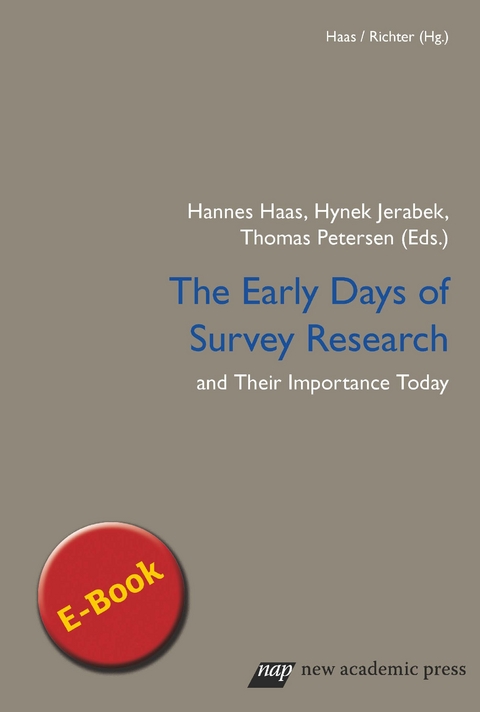
The Early Days of Survey Research and Their Importance Today (eBook)
312 Seiten
new academic press (Verlag)
978-3-7003-2026-5 (ISBN)
Contents 5
Preface 9
Introduction 10
Acknowledgments 16
References 16
1 Six Examples of Collaboration Between Paul F. Lazarsfeld and Robert K. Merton 18
1. The Program Analyzer and the Focused Interview 19
2. “Mass Persuasion” and the “Firehouse Projects” 22
3. Patterns of Influence: “Influentials” – the Siblings of “Opinion Leaders” 25
4. Interplay of Theory and Empirical Research 27
5. Theory and Methodology in Teaching Seminars and “Friendship as a Social Process” as an Example 29
6. “A Professional School for Training in Social Research” (PFL and RKM 1950) and the Battle for a Model of Post-graduate Study (1952–1956) 32
Conclusion: Two Evaluations of the Collaboration between Lazarsfeld and Merton 36
References 40
2 Paul Lazarsfeld: Marginality, Migration and the Institutionalization of Research 44
Importance 47
Methods and procedures 48
Columbia and dominance 53
The irony of marginality 55
Social change and the fate of ideas 57
References 58
3 Asking for Justifications: An Aspect of Paul Lazarsfeld’s “Reason Analysis” 59
An Observation about Emotive Trigger Events 61
A Commentary 63
References 63
4 Lazarsfeld’s Approach to Researching Audience 65
The Context of Media Research 65
Coverage Analysis 68
Audience Segmentation 68
Evaluative and Affective Reactions 69
Methods and Techniques 69
Program Analyzer 71
The Program Analyzer at Work 72
Customary Applications and the Later Use of the Program Analyzer 75
After the Program Analyzer 75
The Legacy of Lazarsfeld’s Approach 77
References 79
5 Straw Polls in the U. S.: Measuring Public Opinion 100 Years Ago 82
The Literary Digest 88
Business and Politics 90
Today’s business-news poll links 93
References 94
6Hadley Cantril’s Theoretical and Methodological Legacy in Current Public Opinion Research 101
Cantril as a Prominent Public Opinion Theorist 101
Toward Methodological Knowledge 104
Toward Relevant Research Outcomes 109
Conclusion 111
References 112
7 Three Stages in the Institutionalization of Empirical Social Research 116
1. A short review of literature on the institutionalization of ESR 116
2. General Model of Establishment of Empirical Social Research as Part of Academic Sociology 118
3. Twelve Key Decisions in Chicago – The First Stage in the Institutionalization of Empirical Social Research 118
4. Processing Mass Data: Survey Research – the Second Stage in the Institutionalization of Empirical Social Research 122
5. Survey Analysis: A New Strategy of Data Analysis – the Third Stage in the Institutionalization of Empirical Social Research 125
6. Empirical Social Research Is a Part of Academic Sociology – What Does This Mean? 130
References 132
8 Rediscovering the Prehistory of Social Research in Austria 135
Basic notions, broader ideas and methods 136
Social research and its tasks 140
Conclusion 142
References 143
9 Cenek Adamec and the Early Stages of Public Opinion Research in the Czech Lands 145
The Czechoslovak Institute for Public Opinion Research 146
Cenek Adamec 152
Theoretical and Methodological Questions 156
The Year 1948 and the End of the Institute 160
References 163
10 The Early Days of Survey Research in Latin America 166
The first surveys in Latin America and the “Office of Inter-American Affairs” 166
Debates within the U. S. State Department 166
Hadley Cantril: the founder of communication research in Latin America 167
“The Export Information Bureau” and its mass media research activities 169
The first scientific surveys in Brazil and Argentina 170
Frictions between the State Department and the OIAA 170
The cancellation of the contracts with 4 A’s 174
The Coordination Committees and research on the mass media in Latin America 174
Research conducted in the field of radio 176
Research conducted in the field of the press 177
Research in the field of motion pictures 178
Early survey research in Latin America – a balance 179
References 180
11 “The Obvious and Logical Way to Ascertain the Public’s Attitude Toward a Problem”: Roy Morgan and The Australian Gallup Poll, 1941–1973 182
The Gallup Method 184
Sampling 185
Weighting 190
Question formats 192
Defining the “problem” 194
Conclusion 197
References 198
12 Indirect and “Hidden” Surveys: An Almost Forgotten Survey Technique from the Early Years 202
The challenge of conducting surveys in an enemy country 202
The Canadian pilot study 203
The Moroccan study: experiences and consequences 206
The methodology of disguised interviewing 207
From disguised to open interviewing in occupied enemy countries 209
Research on the usefulness and validity of disguised interviewing after the war 211
Other forms and traditions of disguised interviewing 213
Final remarks 215
References 217
13 One of the Earliest Practical Applications of Survey Research: Surveys for Legal Evidence 219
The early days 220
Initial attempts to submit survey findings as legal evidence 222
The Struggle for Acceptance by the Courts 222
Transferring the survey method to Europe 225
References 227
14 The Art of Discovering Something Simple and New.The Role of Outsiders in the History of Social Research 229
Gottlieb Schnapper-Arndt 233
Adolf Levenstein 237
How does one go about discovering simple new things? 240
References 245
15 Imagination – The Philosophical Foundation of Survey Analysis 248
1 Imagination in Survey Analysis 249
2 Inspiration from the History of Science 254
Conclusion 259
References 259
16 Paul Lazarsfeld, Early Polling and the Internet: Pioneering Research as a Guide for Twenty-First Century Scholarship 261
Paul Lazarsfeld and the democratic experiment 262
A brief history of survey research: Gallup, Cantril and presidential autonomy 268
Public opinion expression in the 21 century and beyond 269
Conclusion 272
References 272
17 Pollsters as Entertainers in the SpotlightDo We Need Special Guidelines for Pollsters’ Appearance in the Media? 275
1 The historical development of pollsters’ role as experts in the media 276
2 Criticism of pollsters’ media appearances 279
3 Do we need special guidelines for pollsters’ media appearances? 280
References 281
18 Why Academic and Commercial Survey Research Institutes Must Not Drift Apart:Lessons to be Learned from the Early Days of Survey Research 284
The influence of academic research on survey methodology 288
The need for cooperation 292
References 294
Notes on Contributors 297
Index 301
| Erscheint lt. Verlag | 30.6.2017 |
|---|---|
| Sprache | englisch |
| Themenwelt | Wirtschaft |
| ISBN-10 | 3-7003-2026-4 / 3700320264 |
| ISBN-13 | 978-3-7003-2026-5 / 9783700320265 |
| Informationen gemäß Produktsicherheitsverordnung (GPSR) | |
| Haben Sie eine Frage zum Produkt? |
 PDF (Wasserzeichen)
Größe: 7,8 MB
DRM: Digitales Wasserzeichen
Dieses eBook enthält ein digitales Wasserzeichen und ist damit für Sie personalisiert. Bei einer missbräuchlichen Weitergabe des eBooks an Dritte ist eine Rückverfolgung an die Quelle möglich.
Dateiformat: PDF (Portable Document Format)
Mit einem festen Seitenlayout eignet sich die PDF besonders für Fachbücher mit Spalten, Tabellen und Abbildungen. Eine PDF kann auf fast allen Geräten angezeigt werden, ist aber für kleine Displays (Smartphone, eReader) nur eingeschränkt geeignet.
Systemvoraussetzungen:
PC/Mac: Mit einem PC oder Mac können Sie dieses eBook lesen. Sie benötigen dafür einen PDF-Viewer - z.B. den Adobe Reader oder Adobe Digital Editions.
eReader: Dieses eBook kann mit (fast) allen eBook-Readern gelesen werden. Mit dem amazon-Kindle ist es aber nicht kompatibel.
Smartphone/Tablet: Egal ob Apple oder Android, dieses eBook können Sie lesen. Sie benötigen dafür einen PDF-Viewer - z.B. die kostenlose Adobe Digital Editions-App.
Zusätzliches Feature: Online Lesen
Dieses eBook können Sie zusätzlich zum Download auch online im Webbrowser lesen.
Buying eBooks from abroad
For tax law reasons we can sell eBooks just within Germany and Switzerland. Regrettably we cannot fulfill eBook-orders from other countries.
aus dem Bereich