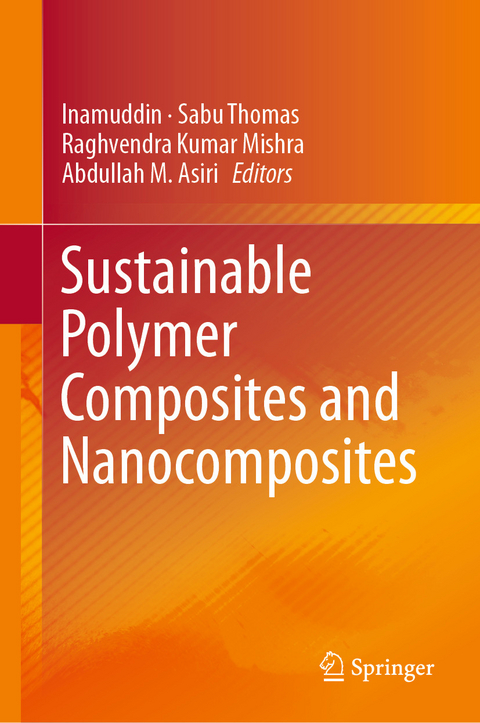
Sustainable Polymer Composites and Nanocomposites (eBook)
1440 Seiten
Springer International Publishing (Verlag)
978-3-030-05399-4 (ISBN)
This book presents emerging economical and environmentally friendly polymer composites that are free of the side effects observed in traditional composites. It focuses on eco-friendly composite materials using granulated cork, a by-product of the cork industry; cellulose pulp from the recycling of paper residues; hemp fibers; and a range of other environmentally friendly materials procured from various sources.
The book presents the manufacturing methods, properties and characterization techniques of these eco-friendly composites. The respective chapters address classical and recent aspects of eco-friendly polymer composites and their chemistry, along with practical applications in the biomedical, pharmaceutical, automotive and other sectors. Topics addressed include the fundamentals, processing, properties, practicality, drawbacks and advantages of eco-friendly polymer composites.
Featuring contributions by experts in the field with a variety of backgrounds and specialties, the book will appeal to researchers and students in the fields of materials science and environmental science. Moreover, it fills the gap between research work in the laboratory and practical applications in related industries.
Inamuddin is an Assistant Professor in the Department of Applied Chemistry, Aligarh Muslim University (AMU), Aligarh, India. He has extensive research experience in multidisciplinary fields of Analytical Chemistry, Materials Chemistry, and Electrochemistry and, more specifically, Renewable Energy and Environment. His research interest includes ion exchange materials, sensor for heavy metal ions, biofuel cells, supercapacitors and bending actuators.Sabu Thomas is a Professor of Polymer Science and Engineering at the School of Chemical Sciences, as well as the Director of Centre for Nanoscience and Nanotechnology, Mahatma Gandhi University, India. He is a fellow of the Royal Society of Chemistry, London and a member of the American Chemical Society. His research group focus on Polymer blends, Fibre filled polymer composites, Particulate-filled polymer composites and their morphological characterization, Ageing and degradation, Pervaporation phenomena, sorption and diffusion, Interpenetrating polymer systems, Recyclability and reuse of waste plastics and rubbers, Elastomer crosslinking, Dual porous nanocomposite scaffolds for tissue engineering, among others. Raghvendra Kumar Mishra is a Visvesvaraya Senior Research Fellow at the International and Interuniversity Centre for Nanoscience and Nanotechnology, Mahatma Gandhi University, India. His research interests include Polymer Recycling, Polymer blends, Fibre filled polymer composites, Particulate filled polymer composites and their morphological characterization, Ageing and degradation, Carbon nanotubes, Graphene, Conducting polymer blends and composites . Abdullah M. Asiri is the Head of the Chemistry Department at King Abdulaziz University since October 2009 and the founder and the Director of the Center of Excellence for Advanced Materials Research (CEAMR) since 2010. He is a Professor for Organic Photochemistry. His research interest covers color chemistry, synthesis of novel photochromic, thermochromic systems, synthesis of novel coloring matters and dyeing of textiles, Materials Chemistry, Nanochemistry and nanotechnology Polymers and plastics.
Contents 5
1 Processing, Characterization and Application of Micro and Nanocellulose Based Environmentally Friendly Polymer Composites 10
1 Introduction 10
2 Micro and Nano-cellulose 11
2.1 Brief Description 11
2.2 Obtaining Different Types of Micro and Nano-cellulose by the Mechanical, Chemical and Enzymatic Process 17
2.3 Functionalization or Surface Modification of Micro and Nano-cellulose 18
2.4 All-Based Micro and Nano-cellulose Films 24
3 Processing and Applications of Micro and Nano-cellulose Based on Biodegradable Polymers 28
4 General Applications 35
5 Conclusions 36
References 37
2 Extraction of Cellulose Nanofibers and Their Eco/Friendly Polymer Composites 45
1 Introduction 45
2 Nano-Scale Structure in Cellulose Fibers 46
2.1 Microcrystalline Cellulose 46
2.2 Cellulose Microfiberils 46
2.3 Cellulose Nanofibrils 47
2.4 Cellulose Nanocrystals 47
2.5 Amorphous Nanocellulose 47
2.6 Cellulose Nanoyarm 47
3 Source of Cellulose Nanofibers 48
4 Extraction and Isolation of Cellulose Nanoparticle 48
5 Chemicals Methods 49
6 Applications of CNPs 56
7 Medicals 56
8 Drug Delivery Systems 57
9 Industrial Application 59
10 Preparation of Polymer Composites 61
10.1 Packaging 61
10.2 Emulsifiers and Solvent Thickner 62
11 Conclusion 63
References 63
3 Synthesis, Characterization and Applications of Polyolefin Based Eco-Friendly Polymer Composites 73
1 Introduction to Polyolefins 73
2 Non-functionalised Polyolefins 74
3 Synthesis of Polyolefins 74
4 Polypropylene 75
4.1 Controlled Polymerisation of Polyolefins 76
4.1.1 Future of Metallocenes or Single-Site Catalysts 76
5 Synthesis of Functionalised Polyolefins with Better Eco-Friendliness 77
5.1 Randomly Functionalised Copolymers 78
5.1.1 Polymer Post-functionalization 78
5.1.2 Ring-Opening Metathesis Polymerization (ROMP) 79
5.1.3 Acyclic Diene Metathesis Polycondensation (ADMET) 79
5.1.4 Radical Polymerization 79
5.1.5 Catalytic Routes 79
5.2 Chain-End Functionalized Copolymers 80
5.2.1 End-Capping of Living Polymerizations 80
5.2.2 Chain-Transfer Reactions 80
5.2.3 Functionalisation of Unsaturated Chain Ends 81
5.3 Segmented Copolymers: Block and Graft Copolymers 81
5.3.1 Synthesis of Block Copolymers 81
5.3.2 Synthesis of Graft Copolymers 81
6 Synthesis of Eco-Friendly Polyolefin Composites 83
6.1 Extrusion and Pultrusion 84
6.2 Injection Molding 84
6.3 Calendering 85
6.4 Compression Molding and Thermoforming 85
7 Improvement of Composite Compatibility Between Polyolefins and Natural Additives 85
7.1 Chemical Methods 86
7.2 Physical Methods 86
8 Characterization of Polyolefins and Composites 87
8.1 Microstructural Properties 87
8.1.1 Gel Permeation Chromatography (GPC) 87
8.1.2 Differential Scanning Calorimetry (DSC) 89
8.1.3 Nuclear Magnetic Resonance (NMR) 89
8.1.4 Fourier Transform Infrared Spectroscopy (FTIR) 90
8.1.5 Crystallization Analysis Fractionation (CRYSTAF) and Temperature Rising Elution Fractionation (TREF) 91
8.1.6 Crystallization Elution Fractionation (CEF) 93
8.1.7 Osmometry 93
8.1.8 Viscometry 93
8.1.9 Raman Spectroscopic Analysis 94
8.2 Morphological Properties 95
8.2.1 Optical Microscopy 95
8.2.2 Scanning Electron Microscopy (SEM) 95
8.2.3 Atomic Force Microscopy (AFM) 96
8.2.4 X-Ray Diffraction (XRD) 98
8.2.5 Transmission Electron Microscopy (TEM) 99
8.3 Mechanical Properties 100
8.3.1 Three-Point Flexural Test 100
8.3.2 Tensile Test 101
8.3.3 Dynamic Mechanical Analysis 101
9 Degradation of Polyolefins and Composites 101
9.1 Ageing and Corrosion 101
9.2 Chemical Degradation 102
9.3 Biodegradation 102
10 Applications of Polyolefins and Eco-Friendly Composites 102
11 Conclusion 104
References 104
4 Spectroscopy and Microscopy of Eco-friendly Polymer Composites 112
1 Introduction 113
2 Isolation of Eco-friendly Polymers 114
2.1 Eco-friendly Polymers of Plant Origin 115
2.1.1 Cellulose Extraction 115
2.1.2 Hemicellulose Extraction 116
2.1.3 Lignin Extraction 116
2.1.4 Starch Extraction 117
2.1.5 Alginate Extraction 117
2.1.6 Zein Extraction 117
2.1.7 Soy Extraction 118
2.2 Animal-Based Eco-friendly Polymers 118
2.2.1 Collagen Extraction 118
2.2.2 Gelatin Extraction 118
2.2.3 Chitin Extraction 119
2.2.4 Casein Extraction 119
2.2.5 Hyaluronan (HA) Extraction 119
2.3 Bacterial-Based Eco-friendly Polymers 120
2.3.1 Bacterial Cellulose Extraction 120
2.3.2 Pullulan Extraction 120
2.4 Synthetic Eco-friendly Polymers 120
2.4.1 PLA Synthesis 120
2.4.2 PLGA Synthesis 121
2.4.3 Polyesters Synthesis 121
3 Spectroscopic and Microscopic Characterization of Biopolymers and Their NCs 121
3.1 Polysaccharide-Based Biopolymers 121
3.1.1 CHNS Analysis 122
3.1.2 FT-IR Spectroscopy 122
3.1.3 Powder XRD 124
3.1.4 NMR 125
3.1.5 DLS and Zeta Potential 126
3.1.6 UV-Vis 127
3.1.7 SAXS 127
3.1.8 TGA 127
3.1.9 TGMS 128
3.1.10 DSC 128
3.1.11 ICP-MS 128
3.1.12 SEM 129
3.1.13 TEM 130
3.1.14 AFM 130
3.2 Polypeptide-Based Biopolymers 131
3.2.1 CHNS Analysis 131
3.2.2 FT-IR 132
3.2.3 Powder XRD 133
3.2.4 NMR 133
3.2.5 DLS and Zeta Potential 134
3.2.6 UV-Vis and Fluorescence Studies 134
3.2.7 Circular Dichroism (CD) Spectroscopy 134
3.2.8 TGA 134
3.2.9 DSC 135
3.2.10 SEM 135
3.2.11 TEM 135
3.2.12 AFM 135
3.3 Synthetic Based Polymers 136
3.3.1 FT-IR 136
3.3.2 Powder XRD 137
3.3.3 NMR 137
3.3.4 TGA 137
3.3.5 DSC 138
3.3.6 SEM 138
3.3.7 TEM 138
4 Future Perspectives 138
Acknowledgements 139
References 139
5 Biocompatible and Biodegradable Chitosan Composites in Wound Healing Application: In Situ Novel Photo-Induced Skin Regeneration Approach 149
1 Introduction 150
2 Biodegradable Polymers 152
3 Biocompatible Polymers 154
4 Wounds 155
4.1 Insights to the Wound Healing Process 156
4.1.1 Coagulation and Hemostasis Phase 156
4.1.2 Inflammatory Phase 157
4.1.3 Proliferation Phase 158
4.1.4 Remodelling Phase 159
4.2 Classical Wound Healing 159
5 Bioactive Materials and Their Progress in Treating Wounds 160
6 Chitosan 161
6.1 Properties of Chitosan 161
6.1.1 Solubility of Chitosan 162
6.1.2 Degree of N-Deacetylation 162
6.1.3 The Molecular Weight (MW) 163
6.2 Chitosan Sources and Production 163
6.2.1 Demineralization (DM) 164
6.2.2 Deproteinization (DP) 164
6.2.3 Decoloration (DC) 164
6.2.4 Deacetylation (DA) 164
6.3 Modified Chitosan 165
6.3.1 Thiolated Chitosan 165
6.3.2 O, N-Carboxymethyl Chitosan 166
6.3.3 Highly Cationic Chitosan 166
6.3.4 PEGylated Chitosan Derivatives 166
7 Chitosan Composites and Their Inherent Biological Properties 167
7.1 Non-toxicity 168
7.2 Antimicrobial Activity 168
7.3 Anti-inflammatory Nature 169
7.4 Biocompatibility 170
7.5 Biodegradability 170
7.6 Hemostatic Properties 170
7.7 Mucoadhesivity 171
8 Modified Chitosan and the Biomedical Engineering of Wound Healings 172
8.1 Wound Healing Using Chitosan Impregnated Drug 172
8.1.1 Wound Dressing Using Sulfadiazine Loaded Chitosan Nanoparticles 172
8.1.2 Wound Dressing Using Simvastatin—Chitosan Microparticles Loaded Polyvinyl Alcohol Hydrogels 173
8.1.3 Wound Dressing Using Scaffolds of Chitosan-Fibrin (CF) Loaded with Quercetin 174
8.1.4 Wound Dressing Using Melatonin-Loaded Chitosan-Based Microspheres (Mel/CS MS) 175
8.2 Wound Healing Due to Chitosan Composites with Metal or Metal Oxide Nanoparticles 175
8.3 Wound Healing Based on Hydrogels and Growth Factor Delivery 178
8.4 Wound Healing via Bioactive Modified Chitosan Based on Photodynamic Therapy 179
9 Study Case for the Anti-bacterial Activity of Chitosan Grafted Poly(N-Methylaniline) Nanoparticles 180
10 A Case Study in Wound Healing Due to Chitosan Grafted Poly(N-Methylaniline) Nanoparticles of Photo-Driven Skin Regeneration 181
11 Future Prospective 183
References 183
6 Mechanical, Thermal and Viscoelastic Properties of Polymer Composites Reinforced with Various Nanomaterials 190
1 Introduction 190
2 Mechanical Properties of Nanocomposites 191
2.1 Mechanical Properties of Polymer Reinforced with Cellulose-Based Nanofillers 191
2.2 Mechanical Properties of Polymer Nanocomposites Reinforced with Carbonaceous Nanofillers 192
2.2.1 Mechanical Properties of Biopolymers Reinforced with Carbonaceous Fillers 194
2.3 Mechanical Properties of Polymer Reinforced with Nanoclays 196
2.3.1 Mechanical Properties of Biopolymers Reinforced with Nanoclays 200
3 Thermal Properties 201
3.1 Thermogravimetric Analysis (TGA) 201
3.2 Differential Scanning Calorimetry (DSC) 203
4 Dynamic Mechanical Analysis (DMA) 206
5 Melt Rheology Properties 209
6 Conclusions 210
References 211
7 Preparation and Characterization of Antibacterial Sustainable Nanocomposites 219
1 Introduction 219
2 Synthesis of Different Nanoparticles 221
2.1 Different Methods Used to Synthesise Nanoparticles 222
2.2 Preparation and Antibacterial Mechanisms of the NPs 223
2.2.1 Silver Nanoparticles (AgNPs) 223
2.2.2 Zinc Nanoparticles 227
2.2.3 Gold Nanoparticles (AuNPs) 228
2.2.4 Copper Nanoparticles 229
2.2.5 Carbon-Based Nanoparticles 230
2.2.6 Clay Minerals 231
3 Preparation of Antibacterial Nanocomposites 232
4 Antibacterial Nanocomposites 233
4.1 Silver/Biopolymer Nanocomposites 233
4.2 Zinc/Biopolymer Nanocomposites 235
4.3 Gold/Biopolymer Nanocomposites 237
4.4 Copper/Biopolymer Nanocomposites 237
4.5 Carbon-Based/Biopolymer Nanocomposites 238
4.6 Clay Minerals/Biopolymer Nanocomposites 240
5 Hybrid Biopolymer Nanocomposites 241
6 Conclusion and Future Recommendations 243
References 243
8 Extraction of Nano Cellulose Fibres and Their Eco-friendly Polymer Composite 249
1 Introduction 249
2 Production of Cellulose Nanofibrils 251
3 NFC Polymer Composite 252
4 Challenges of NFC Polymer Composite 253
5 Poly-lactic Acid (PLA) Based Nanocellulosic Composites 254
6 Polyhydroxyalkanoate (PHA) Based Nanocellulosic Composites 255
7 Starch-Based Nanocellulosic Composites 255
8 NFC Polymer Composite in Thermoplastics Materials 256
9 NFC Polymer Composite in Automotive 257
10 Conclusions 257
Acknowledgements 258
References 258
9 Static and Dynamic Mechanical Properties of Eco-friendly Polymer Composites 262
1 Introduction 262
2 Constituent Materials: Polymer Matrixes and Natural Fibres 263
2.1 Static Mechanical Properties 264
2.2 Dynamic Mechanical Properties 270
3 Fibre/Matrix Adhesion 271
4 Static Mechanical Properties 274
4.1 Random Short Fibres Biocomposites 275
4.2 MAT Biocomposites 282
4.3 Long Fibre Biocomposites 282
5 Dynamic Mechanical Properties 287
6 Conclusions 291
References 292
10 Synthesis, Characterization, and Applications of Hemicellulose Based Eco-friendly Polymer Composites 296
1 Introduction 296
2 Definitions About Hemicellulose and Derivatives 298
2.1 Properties 300
3 Hemicellulose Based Composites and Their Applications 301
3.1 Composite Formation and Characterization with Layered Silicates 303
3.2 Packaging Materials 304
3.3 Other Applications 305
3.4 Basic Components of Composite Materials 306
3.5 The Effect of Fibers on Composite Materials 307
4 Conclusions 307
References 308
11 Impact of Nanoparticle Shape, Size, and Properties of the Sustainable Nanocomposites 315
1 Introduction 315
2 Composites 316
2.1 Nanocomposites 317
2.2 Sustainable Polymeric Nanocomposites 317
3 Preparation Methods 318
3.1 Electrospinning 318
3.2 One Step in-Situ Polymerization Method 319
3.3 Thermal Spray Synthesis 319
3.4 Sol-Gel Method 319
4 Biophysical Properties 320
4.1 Structure 320
4.2 Shape 321
4.3 Size 321
4.4 Surface Area/Morphology 322
4.5 Applications 322
4.6 Biological Applications 323
4.7 Drug Delivery/Gene Delivery 323
4.8 Wound Healing 325
4.9 Tissue Engineering 325
4.10 Water Treatment 327
4.11 Agriculture 329
5 Conclusion 330
References 330
12 Polymeric Composites as Catalysts for Fine Chemistry 339
1 Introduction 339
2 Electrocatalytic Activity of Polymer Composite 340
2.1 Composite Polymer-Carbon Black Supports 342
2.2 Composite Polymer-CNT Supports 343
2.3 Composite Polymer-Ceramic Supports 344
3 Catalysing Cross-Coupling Reactions 345
3.1 Suzuki-Miyaura Reactions 346
3.2 Heck Cross-Coupling Reactions 347
3.3 Sonogashira-Hagihara Reaction 348
4 Photocatalytic Degradation of the Pollutant 348
5 Catalytic Reduction of 4-Nitrophenol 349
6 Conclusions 352
References 353
13 Fabrication Methods of Sustainable Hydrogels 357
1 Introduction 358
2 Classifying Hydrogel: What’s the Bottom Line? 360
3 Methodology for Making Hydrogels and Sustainable Hydrogels 363
3.1 Goals and Technical Features 363
3.2 Technologies Developed for Their Preparation 364
3.3 Preparation and Optimization: Few Examples 368
4 Innovative Sustainable Hydrogels: What’s New? 370
4.1 Utilization of Current and Classical Hydrogel Products 370
4.2 An Innovative Strategy for Making Hydrogel Products 372
4.3 Focus on the Nano to Micro ECM Gel Coating System 379
4.3.1 Live-Staining of Secreted Elastin by Smooth Muscle Cells in All Tissues 379
4.3.2 Adipose Tissue Regeneration Inducing and Maintaining the Functionality of Both Pre and Mature Adipocytes in Long-Term Cultures 380
5 Conclusions 380
Acknowledgements 381
References 381
14 Application of Sustainable Nanocomposites for Water Purification Process 389
1 Introduction 389
2 Conventional Water Purifications Technologies 391
3 Types of Nanocomposites and Its Application in Water Purification 392
3.1 Metal Nanocomposite 392
3.2 Metal Oxide Nanocomposite 394
3.3 Carbon Nanocomposite 397
3.4 Polymer Nanocomposite 398
3.5 Membranes Nanocomposite 401
3.5.1 Conventional Nanocomposite Membranes 403
3.5.2 Thin-Film Nanocomposites 405
3.5.3 TFC with Nanocomposite Substrate 406
4 Future Outlooks 408
5 Conclusion 408
References 409
15 Sustainable Nanocomposites in Food Packaging 415
1 Introduction 416
1.1 Nanocomposites 416
2 Nanocomposite Preparation 418
2.1 Polymer Solution Casting 419
2.2 Polymerization 421
2.3 Melt Mixing 426
3 Characterization of Nanocomposites 427
3.1 Mechanical Property 427
3.2 Thermal Property 428
3.3 Degradation Behaviour 428
3.4 Migration Testing 429
3.5 Antimicrobial Testing 430
3.6 Optical Behaviour 432
3.7 Permeability and Barrier Properties 433
Acknowledgements 434
References 434
16 Mechanical Techniques for Enhanced Dispersion of Cellulose Nanocrystals in Polymer Matrices 439
1 Introduction 439
2 Liquid Feeding 441
3 Masterbatch Approach 442
3.1 Solvent Casting 442
3.1.1 Formation of Aggregates in Masterbatch Films 443
3.2 Spin-Coating 444
3.2.1 Formation of Aggregates in Masterbatch Films 446
3.3 Variation of Aggregates in Masterbatch Along the Cross-Sectional Thickness 446
4 Conclusion 448
Acknowledgements 448
References 448
17 Processing and Industrial Applications of Sustainable Nanocomposites Containing Nanofillers 452
1 Introduction 453
2 Fabrication Techniques of Nanocomposites 457
2.1 Intercalation Method 457
2.2 Sol-Gel Method 459
2.3 Direct Dispersion Method 460
3 Applications of Sustainable Nanocomposites 462
3.1 Electronic Applications 464
3.2 Shape Memory and Biomedical Applications 465
3.3 Mechanical Applications 467
4 Conclusions 470
References 470
18 Recent Advances in Paper-Based Analytical Devices: A Pivotal Step Forward in Building Next-Generation Sensor Technology 480
1 Introduction 482
2 Sensing in the Physical World 483
3 Sensing in Biomedical Health Care and Clinical Diagnostics 489
3.1 Colorimetric Sensing 489
3.2 Electrochemical Sensing 491
3.3 Luminescence-Based Sensing 493
3.4 Other Sensor Types 494
4 Sensing for Environmental Monitoring 496
4.1 Colorimetric Sensing 496
4.2 Electrochemical Sensing 497
4.3 Luminescence-Based Sensing 498
4.4 Other Sensor Types 500
5 Sensing for Food and Water Quality 501
5.1 Colorimetric Sensing 501
5.2 Electrochemical Sensing 504
5.3 Luminescence-Based Sensing 504
5.4 Other Sensor Types 506
6 Sensing for Forensics and Security 507
7 Summary, Challenges and Future Perspectives 508
Acknowledgements 509
References 509
19 Polymers and Polymer Composites for Adsorptive Removal of Dyes in Water Treatment 519
1 Introduction 521
2 Modified or Functionalized Polymers and Polymer Composites 522
3 Polyaniline and Its Composites 530
4 Magnetic Polymer Composites 535
5 Polymer/Clay Composites 541
6 Polymer/by-Products or Waste Composites 543
7 Conclusions 543
Acknowledgements 544
Appendix 544
References 553
20 Current Scenario of Nanocomposite Materials for Fuel Cell Applications 557
1 Introduction 558
1.1 Working Principle of FC 558
1.2 Proton Conduction Mechanism in FC 560
2 Nanocomposites in FC 561
2.1 Nafion®- Metal Oxide-Based Nanocomposite 563
2.2 Graphene-Based Nanocomposites 566
2.3 Carbon Nanotubes and Its Hybrid Nanocomposites 570
2.4 Chitosan-Based Nanocomposites 574
2.5 Polybenzimidazole (PBI) Based Nanocomposite Membranes 578
2.6 Poly (ether ether ketone) Based Nanocomposite 581
2.7 Polyvinyl Alcohol (PVA) Based Nanocomposites 584
3 Conclusion 587
Acknowledgements 587
References 588
21 Rubber Clay Nanocomposites 593
1 Introduction 594
2 Reinforcement Particles 595
2.1 Carbon Black 595
2.2 Silica 596
2.3 Clay 596
3 Layered Silicates 597
3.1 Structure and Physical Characteristics 597
3.2 Classification of Clays 599
4 Chemical Modification of Clays 600
4.1 Synthesis of Organoclays 601
5 Characterization of Clay Nanoparticles 602
5.1 X-Ray Diffraction (XRD) 603
5.2 Microscopy 603
5.3 Fourier Transform Infrared Spectroscopy 605
5.4 Thermal Properties 605
6 Elastomeric Clay Composites 606
6.1 Natural Rubber 606
6.2 Styrene Butadiene Rubber 608
6.3 Nitrile-Butadiene Rubber 609
6.4 Ethylene-Propylene-Diene Rubbers 610
6.5 Role of Nanofiller as Compatibilizer in Rubber Blends 611
7 Preparation of Nanocomposites 612
7.1 Melt Mixing 613
7.2 Solution Blending 614
7.3 Latex Blending/Latex Compounding 615
7.4 Sol-Gel Processing 616
7.5 Emulsion Polymerization 616
8 Rubber/Clay Nanocomposites Properties 617
8.1 Vulcanization Variables 617
8.2 Rheological Properties 620
8.3 Mechanical Properties 620
8.4 Barrier Properties 621
9 Applications 622
10 Final Remarks 623
Acknowledgements 624
References 624
22 Organic/Silica Nanocomposite Membranes Applicable to Green Chemistry 629
1 Introduction 629
1.1 Challenges in Synthesizing Organic/Si Nanocomposite Membranes 631
1.2 Possible Methods to Overcome the Challenges 632
1.3 Ex Situ Technique 633
1.4 In Situ Technique 633
2 Si Preparation 634
3 Surface Modification of Si 636
3.1 Chemical Modification 636
3.2 Modification by Physical Interaction 638
3.3 Blending 638
3.3.1 Melt Blending 638
3.3.2 Solution Blending 639
3.3.3 Cryomilling Methods 640
3.3.4 Thermal Spraying 640
4 Physical Properties of the Organic/Si Nanocomposite Membranes 642
4.1 Thermal Properties 642
4.2 Mechanical Properties 643
4.3 Proton Conductivity 644
4.4 Water Uptake 644
4.5 Cell Performance Investigation 646
5 Summary and Future Direction 646
References 648
23 Extraction of Cellulose Nanofibers and Their Eco-friendly Polymer Composites 653
1 Introduction 654
2 Overview of Cellulose Nanofibers 656
2.1 Cellulose: Structure and Chemistry 657
2.2 Cellulose Nanofibers 659
2.2.1 Types of Cellulose Nanofibers 659
2.2.2 Feedstock 660
2.2.3 Preparation of Cellulose Nanofibres 662
Preparation of Cellulose Nanocrystals 664
Preparation of Cellulose Nanofibrils 665
Preparation of Other Families of Cellulose Nanofibers Materials 666
3 Cellulose Modification 667
3.1 Acid Hydrolysis 667
3.2 Enzyme Hydrolysis 669
3.3 Ionic Liquid 669
3.4 Mechanical Treatment 670
3.5 Subcritical Water 671
3.6 2,2,6,6-Tetramethyl-1-Piperidinyloxy 671
3.7 Combined Method 671
4 Characterization of Cellulose Nanofibers 671
4.1 Fourier Transform Infrared 671
4.2 X-ray Diffraction Analysis 673
4.3 Scanning Electron Microscope 675
4.4 Transmission Electron Microscope 675
4.5 Atomic Force Microscopy 676
4.6 Thermal Behaviour 677
5 The Recent Development of Cellulose Nanofibre as Filler in Polymer Composite 679
6 Concluding Remarks 683
Acknowledgements 683
References 683
24 Recyclable and Eco-friendly Single Polymer Composite 692
1 Introduction 692
2 Recyclable Single Polymer Composite 694
2.1 Basic Polymer Chemistry 694
2.2 Structural Modification 696
2.3 Production of Polymeric Fibers 702
2.4 Fabrication of the Polymeric Fibres with the Matrix 703
3 Eco-friendly Single Polymer Composites 706
3.1 PLA-Based 707
3.1.1 PLA Synthesis 707
3.1.2 PLA SPCs 712
3.2 PVA-Based 715
4 Conclusion and Future Outlook 717
References 718
25 Processing Aspects and Biomedical and Environmental Applications of Sustainable Nanocomposites Containing Nanofillers 725
1 Introduction 725
2 Characteristics and Fabrication of Nano-fillers 727
3 Green Nanocomposites 731
3.1 Cellulose Nanocomposites 731
3.2 Chitosan Nanocomposites 733
3.3 Magnetic Nanocomposites 734
4 Applications 736
4.1 Nano-drug Delivery 736
4.2 Tissue Engineering 738
4.3 Biosensor, Electrical Conductive Polymer and Insulator 741
4.4 Catalysis and Environmental Remediation 742
5 Conclusion and Future Outlook 746
References 746
26 Smart Materials, Magnetic Graphene Oxide-Based Nanocomposites for Sustainable Water Purification 756
1 Introduction 756
2 Properties of Graphene 760
2.1 Electrical and Electronic Properties 760
2.2 Magnetic Properties 761
2.3 Chemical Properties 762
2.4 Mechanical Properties 762
2.5 Thermal Properties 763
3 Preparation Methods of MGO Nanocomposites 763
4 Structural Characterization and Properties of MGOs 764
5 Applications to Sustainable Water Purification 766
5.1 Heavy Metals Removal 767
5.2 Organic Pollutants Removal 771
6 Conclusion and Future Perspective 772
Acknowledgments 773
References 773
27 Functionalized Carbon Nanomaterial for Artificial Bone Replacement as Filler Material 779
1 Introduction 779
2 Bone Structure and Mechanics 782
3 History of Artificial Organ 783
3.1 Artificial Bone Materials 785
4 Carbon Nanomaterials 786
5 Carbon Nanotubes 786
5.1 Structure and Properties of Carbon Nanotubes 787
5.1.1 Single-Walled Carbon Nanotubes (SWNTs) 787
5.1.2 Multi-walled Carbon Nanotubes (MWNTs) 788
5.2 Synthesis of Carbon Nanotubes 789
6 Functionalization of Carbon Nanomaterials 789
6.1 Covalent Approach for CNTs 791
6.1.1 Oxidation Treatment 791
6.1.2 Cycloaddition Reaction 793
6.1.3 Radical-Additions 793
6.2 Non-covalent Approach for CNTs 795
7 Conclusion and Perspectives 796
References 796
28 Inorganic Nanocomposite Hydrogels: Present Knowledge and Future Challenge 801
1 Introduction 802
1.1 Classification of Hydrogels 803
1.2 Feature Characteristics of Hydrogels 804
2 Nanocomposite Hydrogels 806
2.1 Nanoparticles Preparation 806
2.2 Nanocomposite Hydrogel Preparation Methods 808
2.2.1 Formation of a Hydrogel in a Nanoparticle Suspension 809
2.2.2 Physical Introduction of Nanoparticles into the Prepared Gels 809
2.2.3 In Situ Formation of Reactive Nanoparticles 809
2.2.4 Nanoparticles as the Multifunctional Crosslinking Agents 810
2.2.5 Nanoparticles and Conductive Additives Along with Polymeric Binders 811
2.3 How Nanoparticles Improve Mechanical Strength of Hydrogels? 812
2.4 Characterization Methods of Nanocomposites Hydrogels 813
2.5 Types of Nanocomposite Hydrogels and Their Applications 814
2.5.1 Inorganic Ceramics and Non-metal Nanoparticles 814
2.5.2 Silicon-Based Nanoparticles 824
2.5.3 Carbon-Based Nanoparticles 824
2.5.4 Metal and Metal Oxide Nanoparticles 831
3 Summary and Outlooks 840
References 841
29 Processing, Characterization and Application of Natural Rubber Based Environmentally Friendly Polymer Composites 850
1 Introduction 851
2 NR Composites Filled with Plant Fibers 857
3 Coir/Coconut Fiber (CF) 859
4 Oil Palm Fiber (OPF) 859
5 Sisal Fiber (SF) 859
6 Bamboo Fiber (BF) 859
7 Isora Fiber (IF) 860
8 Pineapple Leaf Fiber (PLF) 860
9 Processing 860
10 Characterization 861
10.1 Mechanical Properties 861
10.2 Dynamic Mechanical Properties 862
11 Application 866
12 NC Reinforced NR NCPs 866
13 Processing 867
14 Characterization 869
14.1 Biodegradability 869
14.2 Mechanical Properties 869
14.3 Dynamic Mechanical Properties 877
15 Application 878
15.1 Packaging 878
16 NR Composites Based on Recycled Rubber Granulate (RRG) 879
17 Processing 879
18 Characterization 880
18.1 Mechanical Properties 880
19 Application 884
20 NR Composites Containing Proteins 884
21 Processing 884
22 Characterization 888
22.1 Mechanical Properties 888
22.2 Dynamic Mechanical Properties 889
22.3 Biodegradability 890
23 Application 890
24 Conclusions 890
Acknowledgements 891
References 891
30 Electrical Properties of Sustainable Nano-Composites Containing Nano-Fillers: Dielectric Properties and Electrical Conductivity 893
1 Introduction 893
2 Nanocomposites with Nanofillers 894
3 Dielectric Properties of Nanocomposites 896
3.1 Dielectric Constant 897
3.2 Dielectric Loss Factor 898
3.3 Tangent Loss 900
3.4 Static Permittivity 901
3.5 Relaxation Time 902
4 The Electrical Conductivity of Nanocomposite 903
4.1 Characteristics of Electrically Respond Polymer Nanocomposites 904
4.2 Parameters Influencing Electrical Conductivity of Nanocomposites 905
5 Conclusion 905
References 905
31 Thermal Properties of Sustainable Thermoplastics Nanocomposites Containing Nanofillers and Its Recycling Perspective 909
1 Introduction 909
2 Sustainable Thermoplastic Nanocomposite 910
3 Thermal Properties of Sustainable Nanocomposites Based on Types of Sustainable Polymers 911
3.1 Polylactic Acid (PLA) Based Nanocomposites 911
3.2 Thermoplastic Starch (TPS) 913
3.3 Polycaprolactone (PCL) 915
3.4 Polyamide/Clay Nanocomposites 915
3.5 Polypropylene/Layered Silicates Nanocomposites 916
4 Thermal Properties of Sustainable Nanocomposites Based on Various Thermal Properties 917
4.1 Thermogravimetric/Differential Thermogravimetric Analysis (TGA/DTG) 917
4.2 Differential Scanning Calorimetry (DSC) 918
4.3 Thermal Conductivity 920
5 Recycling Perspective 921
6 Conclusion 924
References 924
32 Application of Sustainable Nanocomposites in Membrane Technology 928
1 Introduction 928
2 Types of Nanoparticles 930
2.1 Inorganic Metal Oxide and Hydroxide 930
2.2 Inorganic Nanoparticles to Prepare Polymeric Nanocomposite Membranes 932
3 Thin-Film Nanocomposite (TFN) 933
3.1 Thin-Film Nanocomposite (TFN) Membranes for Water Desalination 933
3.2 Thin-Film Nanocomposite (TFN) Membranes for Wastewater Treatment 935
3.3 Thin-Film Nanocomposite (TFN) Membranes for Gas Separation 935
3.4 Thin-Film Nanocomposite (TFN) Membranes for Fuel Cell Applications 938
3.5 Thin-Film Nanocomposite (TFN) Membranes for Flue Gas Dehydration 942
4 Conclusions 948
References 948
33 Reliable Natural-Fibre Augmented Biodegraded Polymer Composites 954
1 Introduction 954
2 Classification of Fibres 956
2.1 Drawbacks of Natural Fibres 956
2.2 Advantages of Natural Fibres 957
2.3 Strategies for Surface Modification in Natural Fibres 957
2.3.1 Chemical Techniques 958
2.3.2 Physical Techniques 960
3 Types of Biodegradable Polymer Composites (BPC’S) 961
3.1 Coir Fibre Reinforced Composite 962
3.2 Cellulose Fibre Reinforced Composite 963
3.3 Jute Fibre Reinforced Composite 963
3.4 Poly Lactide (PLA) Fibre Reinforced Composite 963
3.5 Polyhydroxyalkanoates Fibre Reinforced Composite 965
3.6 Thermoplastic Starch (TPS) 965
4 Conclusions 965
References 966
34 An Overview on Plant Fiber Technology: An Interdisciplinary Approach 969
1 Introduction 970
2 Biology of Plant Fibers 970
2.1 Fiber Quality 974
3 Fiber Chemistry 975
4 Engineering Aspects of Non-wood Fibers in Composite Applications 983
5 Conclusion 987
Acknowledgements 987
References 988
35 Nanocellulose-Reinforced Adhesives for Wood-Based Panels 992
1 Introduction 992
2 Wood-Based Panels 993
3 Adhesives and Adhesion 995
3.1 Adhesives 995
3.2 Adhesion 1000
3.2.1 Factors Influencing the Adhesion Process 1001
Physico-Chemical Characteristics of the Adhesive 1001
Intrinsic Characteristics of Wood 1002
3.3 Adhesive Additives 1004
4 Nanocellulose 1005
5 Nanocellulose-Reinforced Adhesives Performance and Properties 1007
5.1 Effects of the Addition of Nanocellulose on Adhesives 1007
5.2 Wood Composites with Nanocellulose-Reinforced Adhesives 1008
6 Final Considerations 1010
Acknowledgements 1011
References 1011
36 Nanocellulose in the Paper Making 1017
1 Introduction 1017
2 Wood for Pulp and Paper Production 1019
3 Paper Making 1021
3.1 Pulping 1021
3.2 Bleaching 1022
3.3 Drying 1024
3.4 Paper Production 1025
3.4.1 Preparation of the Cellulosic Pulp 1025
3.4.2 The Paper Machine 1026
4 Cellulose 1027
5 Nanocellulose 1030
5.1 Method of CNF and CMF Production 1032
5.1.1 Mechanical Methods 1032
5.1.2 Electrospinning 1035
5.2 Methods of CNC and MCC Production 1036
5.2.1 Acid Hydrolysis 1036
5.2.2 Enzymatic Hydrolysis 1038
6 Applications of Nanocellulose in Paper Making 1038
6.1 Nanocellulose-Reinforced Pulp 1038
6.2 Coating and Films 1041
7 Market and Opportunities 1046
8 Final Considerations 1047
Acknowledgements 1047
References 1048
37 Impact of Nanoparticle Shape, Size, and Properties of Silver Nanocomposites and Their Applications 1057
1 Introduction 1057
2 Different Synthesis Methods of Silver Nanoparticles 1059
2.1 Physical Methods 1059
2.2 Photochemical Methods 1060
2.3 Biological Methods 1060
2.3.1 Microbe-Assisted Synthesis 1061
2.3.2 Plant-Mediated Synthesis 1061
2.4 Chemical Methods 1062
3 Nanocomposite Systems 1063
3.1 Silver-Ceramic Matrix Nanocomposites 1064
3.2 Silver-Metal Matrix Nanocomposites 1065
3.3 Silver-Polymer Matrix Nanocomposites 1065
4 Applications of Silver Nanocomposites 1067
4.1 Medical Field 1067
4.2 Food Industry 1069
4.3 Water Treatment 1071
4.4 Textiles 1072
4.5 Nanopaints 1072
4.6 Personal Care Products 1072
5 Conclusion 1073
References 1073
38 Toxicological Evaluations of Nanocomposites with Special Reference to Cancer Therapy 1082
1 Introduction 1082
1.1 Nanocomposite Systems 1084
1.2 Synthesis of Nanocomposite Systems: Nanocomposite Materials Are Generally Synthesized Using One of the Two Methods 1084
1.2.1 In Situ Method 1084
1.2.2 Ex Situ Method 1085
1.3 Synthesis of Au/Ag Supported Mesoporous Metal-Oxide Nanocomposites 1085
1.4 Synthesis of Au/Ag Supported Graphene Nanocomposites 1086
1.5 Synthesis of Au/Ag Supported Polymer Nanocomposites 1088
1.6 Synthesis of Au/Ag Supported Dendrimer Nanocomposites 1089
2 Applications and Toxicological Evaluations of Gold Nanocomposites 1092
2.1 Silica-Based Gold Nanocomposite 1092
2.2 Lipid-Coated Gold Nanocomposite 1092
2.3 Manganese Oxide-Based Gold Nanocomposites 1093
2.4 Chitosan-Based Gold Nanocomposite 1093
2.5 Graphene-Based Gold Nanocomposite 1095
2.6 Dendrimer Stabilized Gold Nanoparticles 1096
2.7 Iron Oxide Gold Nanocomposite 1096
3 Applications and Toxicological Evaluations of Silver Nanocomposites 1096
3.1 Graphene Oxide Silver Nanocomposite 1097
3.2 Iron Oxide-Based Silver Nanocomposite 1098
3.3 Dendrimer-Based Silver Nanocomposites 1099
3.4 Silica-Based Silver Nanocomposite 1100
4 Conclusions 1100
References 1101
39 Synthesis, Characterization and Application of Bio-based Polyurethane Nanocomposites 1109
1 Introduction 1110
2 Synthesis of Bio-based Polyurethane Nanocomposite from Vegetable Oil 1114
2.1 Castor Oil Based Polyurethane Nanocomposites 1115
2.2 Jatropha Oil Based Polyurethane Nanocomposite 1124
2.3 Palm Oil-Based Polyurethane Nanocomposites 1127
3 Application of PU Nanocomposites 1130
3.1 Coatings 1130
3.2 Adhesives 1133
3.3 Medical 1134
3.4 Elastomers 1138
4 Conclusion 1142
References 1142
40 Clay Based Biopolymer Nanocomposites and Their Applications in Environmental and Biomedical Fields 1147
1 Introduction 1147
2 Preparation Methods of Polymer Clay Nanocomposites 1149
2.1 Solution Intercalation Method 1149
2.2 Melt Intercalation Method 1150
2.3 In Situ Intercalative Polymerization 1150
3 Biomedical Applications of Polymeric Clay Nanocomposites 1151
3.1 As Drug Delivery System 1151
3.2 In Tissue Engineering 1155
3.3 As Regenerative Repair in Wound Healing 1157
3.4 As Biosensors 1159
4 Environmental Applications of Polymeric Clay Nanocomposites 1161
4.1 For Heavy Metal Removal 1161
4.2 For Dye Removal 1163
4.3 For General Wastewater Treatment 1165
5 Future Challenges 1166
6 Conclusion 1166
References 1167
41 Thermal Behaviour and Crystallization of Green Biocomposites 1172
1 Introduction 1174
2 Thermal Analysis as an Analytical Method of Green Composites Characterization 1175
2.1 Differential Scanning Calorimetry 1175
2.2 Thermogravimetric Analysis 1177
3 Glass Transition and Physical Ageing of Green Biocomposites 1179
4 Melting and Crystallization of Green Biocomposites 1185
4.1 Effects Induced by Reinforcing of Natural Fibers 1185
4.2 Effect of Micro and Nanocellulose Loading 1193
5 Thermal Stability and Degradation of Green Composites 1201
5.1 Thermogravimetry of Green Composites Containing Natural Fibers 1202
5.2 Thermogravimetry of Green Composites Containing Cellulosic Nanoparticles 1208
6 Conclusions 1211
References 1214
42 Eco-friendly Polymer Composite: State-of-Arts, Opportunities and Challenge 1219
1 Introduction 1219
1.1 What Are Eco-friendly Composites (EFC) 1220
1.2 Why Eco-friendly Composites and Trends 1222
1.3 Properties of Eco-friendly Composites 1224
1.4 Challenges in the Processing of Eco-friendly Composites 1224
1.5 Opportunities 1225
2 Processing of Eco-friendly Composites 1225
2.1 Chemistry of Eco-friendly Composites: Matrix and Fillers for Production of EFC 1226
2.2 Various Processing Methods 1230
2.3 Effect of Processing Technique 1234
3 Challenges 1236
3.1 Drawbacks in the Processing of EFCs 1236
3.2 Work on Eco-friendly Composites and Effect on Properties 1238
4 Current Opportunities 1244
4.1 Future Opportunities in EFC 1244
5 Conclusions 1244
References 1245
43 Synthesis, Characterization, and Applications of Hemicelluloses Based Eco-friendly Polymer Composites 1252
1 Introduction 1256
1.1 Occurrence of Hemicellulose 1257
1.2 Structure of Hemicellulose 1257
2 Synthesis and Characterization of Modified Hemicelluloses (Zero-Dimensional) 1258
2.1 Esterification 1259
2.2 Etherification 1264
2.3 Amination 1268
2.4 Amidation 1270
2.5 Acetylation 1271
2.6 Grafting Copolymerization 1273
2.7 Oxidation 1274
3 Hemicellulose-Based Particles (Zero-Dimensional) 1276
4 Hemicelluloses-Based Films and Coatings (Two-Dimensional) 1278
4.1 Blending 1278
4.2 Cross-Linking 1283
4.3 Grafting 1283
4.4 Other Modifications 1284
5 Hemicellulose-Based Hydrogels (Three-Dimensional) 1285
5.1 Cross-Linking Hemicellulose-Based Hydrogels 1285
5.2 Conductive Hemicellulose-Based Hydrogels 1289
5.3 Hemicellulose-Polymer Composite Gels (Hydrogels and Aerogels) 1292
6 Summary and Outlook 1298
References 1299
44 Self-healing Bio-composites: Concepts, Developments, and Perspective 1308
1 Introduction 1308
1.1 Fundamentals of Self-healing 1309
1.2 Biocomposites: Substitutes for Fossil-Based Composites 1310
2 Self-healing Biocomposites Based on Non-covalent Bonding (Supramolecular) 1310
2.1 Self-healing of Biocomposites on the Basis of Hydrogen Bonding 1311
2.2 Self-healing of Biocomposites on the Basis of Metal-Ligand Coordination 1312
2.3 Self-healing of Biocomposites on the Basis of ?–? Stacking Interaction 1313
2.4 Self-healing of Biocomposites on the Basis of Ionic Interactions 1314
2.5 Self-healing of Biocomposites on the Basis of Macrocyclic Host–Guest Interactions 1314
3 Self-healing Biocomposites Based on Covalent Bonding 1315
3.1 DA Based Self-healing Nanocomposites 1316
3.2 DA Based Self-healing Biocomposites Containing Fibers 1317
3.3 DA Based Self-healing Biocomposites Containing Encapsulated Maleimides 1318
3.4 Self-healing of Schiff-Base Biocomposites 1318
4 Self-healing of Microcapsule-Based Biocomposites 1319
5 Self-healing of Biocomposites on the Basis of Melting-Recrystallization Cycles 1322
6 Summary and Outlook 1322
References 1323
45 Chemical Modification of Lignin and Its Environmental Application 1329
1 Introduction 1329
2 Modified Lignin for Dyes Adsorption 1331
3 Modified Lignin for Heavy Metals Adsorption 1338
4 Modified Lignin for Other Pollutants Adsorption 1342
5 Outlook and Conclusions 1344
Acknowledgements 1344
References 1344
46 Synthesis and Characterization and Application of Chitin and Chitosan-Based Eco-friendly Polymer Composites 1349
1 Introduction 1349
1.1 History of Chitosan 1349
2 Production 1351
3 Chitosan Oligomers 1352
4 Modifications of Chitosan 1353
5 Derivatives of Chitosan 1354
5.1 Quaternized Chitosan and N-Alkyl Chitosan 1354
5.2 Hydroxyalkyl Chitosan 1355
5.3 Carboxyalkyl Chitosan 1356
5.4 Sugar Functionalized Chitosan 1356
5.5 Cyclodextrin Linked Chitosan 1357
5.6 N-Acyl Chitosan 1357
5.7 O-Acyl Chitosan 1358
5.8 Thiolated Chitosan 1358
5.8.1 Mucous Adhesion Properties 1358
5.8.2 Increase in Permeable Properties 1359
5.8.3 Cohesive Properties 1359
5.9 Sulfate Modified Chitosan 1359
5.10 Phosphorylated Chitosan 1360
5.11 Enzymatic Modification of Chitosan 1361
5.12 Graft Copolymers of Chitosan 1361
5.12.1 Grafting Co-polymerization by Radical Production 1361
5.12.2 Polycondensation to Form Co-polymerization 1361
5.12.3 Coupling to Copolymerize via Oxidation 1362
5.13 Film-Forming Properties of CS 1362
5.14 Chitosan and Proteins 1362
5.15 Chitosan and Starch Blends 1363
5.16 Edible Membranes of Gelatin and Chitosan 1364
5.17 Composite of Chitosan, Carrageenan and Alginate 1365
5.18 Chitosan and Clay Natural Polymers 1365
5.19 Properties of Gas Permeability of Edible Coatings 1367
5.20 Antimicrobial Applications 1367
5.21 Anti-inflammatory Applications 1367
5.22 Biomedical Applications of Chitosan 1368
5.23 Chitosan-Based Composite Scaffolds in Wound Healings 1368
6 Introduction to Chitin 1369
7 Chemical Modifications of Chitin 1371
8 Chitin Fiber Formation 1372
9 Preparation of Blends with Other Fibers/Polymers 1372
10 Chitin General Characterization 1374
11 Chemical Structure and Properties 1375
12 Chitin Biosynthesis 1376
13 Industrial Processing of Chitin 1377
14 Chitin Biomedical and Nanomedical Applications 1379
14.1 Tissue Engineering 1379
14.2 Wound Healing 1380
14.3 Drug Delivery 1381
14.4 Cancer Diagnosis 1381
14.5 Chitin-Based Dressings 1382
14.6 Antiaging Cosmetics 1382
15 Conclusion 1382
References 1383
47 Nanocomposites for Environmental Pollution Remediation 1390
1 Introduction 1391
1.1 Heavy Metal Pollution 1391
1.2 Organic Pollutants 1392
1.2.1 Water Pollution by Synthetic Organic Dyes 1392
1.3 Methods for the Remediation of Pollutants 1393
2 Adsorption: An Advantageous Process for Pollution Remediation 1395
2.1 Biosorption 1396
3 Nanocomposites 1397
3.1 Bio-nanocomposites 1398
3.1.1 Bionanocomposites for Pollution Remediation 1398
3.2 Clay-Based Nanocomposites 1401
3.3 Polymer-Layered Silicate Nanocomposites (PLSN) 1404
3.3.1 Structure of PLSN 1404
3.3.2 Methods of Preparation of PLSN 1406
3.3.3 Challenges in Use of PLSN 1407
3.3.4 PLSN with Bio-based Polymer Matrices 1407
3.4 Clay-Based Nanocomposites for Pollution Remediation 1408
References 1415
Correction to: Chapter “Extraction of Nano Cellulose Fibres and Their Eco-friendly Polymer Composite” in: Inamuddin et al. (eds.), Sustainable Polymer Composites and Nanocomposites,https://doi.org/10.1007/978-3-030-05399-4_8 1424
| Erscheint lt. Verlag | 1.2.2019 |
|---|---|
| Zusatzinfo | IX, 1440 p. 461 illus., 316 illus. in color. |
| Verlagsort | Cham |
| Sprache | englisch |
| Themenwelt | Technik ► Maschinenbau |
| Wirtschaft | |
| Schlagworte | Cellulose fibers • eco-friendly polymer composites • Eco-friendly polymer nanocomposites • eco-friendly polymers in industry • Environmentally friendly polymers • granulated cork • green polymer composites • natural rubber • processing and structural protocol • recycled plastic • single polymer composites • Sustainable polymer composites |
| ISBN-10 | 3-030-05399-7 / 3030053997 |
| ISBN-13 | 978-3-030-05399-4 / 9783030053994 |
| Informationen gemäß Produktsicherheitsverordnung (GPSR) | |
| Haben Sie eine Frage zum Produkt? |
 PDF (Wasserzeichen)
DRM: Digitales Wasserzeichen
Dieses eBook enthält ein digitales Wasserzeichen und ist damit für Sie personalisiert. Bei einer missbräuchlichen Weitergabe des eBooks an Dritte ist eine Rückverfolgung an die Quelle möglich.
Dateiformat: PDF (Portable Document Format)
Mit einem festen Seitenlayout eignet sich die PDF besonders für Fachbücher mit Spalten, Tabellen und Abbildungen. Eine PDF kann auf fast allen Geräten angezeigt werden, ist aber für kleine Displays (Smartphone, eReader) nur eingeschränkt geeignet.
Systemvoraussetzungen:
PC/Mac: Mit einem PC oder Mac können Sie dieses eBook lesen. Sie benötigen dafür einen PDF-Viewer - z.B. den Adobe Reader oder Adobe Digital Editions.
eReader: Dieses eBook kann mit (fast) allen eBook-Readern gelesen werden. Mit dem amazon-Kindle ist es aber nicht kompatibel.
Smartphone/Tablet: Egal ob Apple oder Android, dieses eBook können Sie lesen. Sie benötigen dafür einen PDF-Viewer - z.B. die kostenlose Adobe Digital Editions-App.
Buying eBooks from abroad
For tax law reasons we can sell eBooks just within Germany and Switzerland. Regrettably we cannot fulfill eBook-orders from other countries.
aus dem Bereich