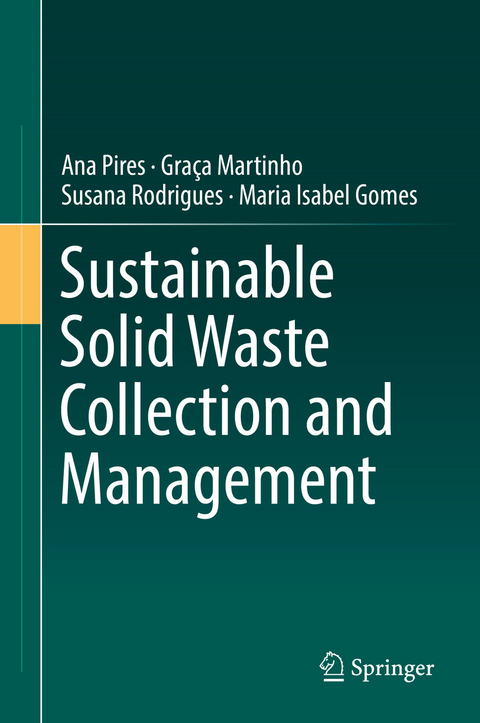
Sustainable Solid Waste Collection and Management (eBook)
XIV, 368 Seiten
Springer International Publishing (Verlag)
978-3-319-93200-2 (ISBN)
This volume focuses on the collection of waste and waste streams as an integral aspect of sustainable waste management. The authors take economic models and behavioral studies into account to go beyond just descriptions of waste collections technologies and collection route design. Models and tools for sustainable waste collection are described in detail, and the authors provide a comprehensive, integrated methodology to design waste collection systems that reduce environmental impacts, are economically viable, and achieve buy-in and participation from target populations.
Part I of the book provides fundamentals and context on waste hierarchy, including waste prevention, reduction and reuse, waste collection itself, and steps such as preparation for recycling, recycling, treatment, and landfilling. Background in environmental, social, and economic concerns surrounding waste collection is also provided here. Part II addresses tools for design, operation, and maintenance of waste collection systems. Part III focuses on how the tools presented in Part II can be used to support sustainability assessments and decisions that consider the entire life cycle of waste and the role of waste collection programs in waste prevention, reduction, reuse, recycling, treatment, and disposal. Part IV addresses the challenges of developing sustainable waste management systems and addresses the role of waste collection in sustainable waste management in the future.Ana Pires has a Ph.D. in Environmental Engineering from FCT NOVA. She is an associate researcher at the MARE research center (Center for Marine and Environmental Sciences). Her research interests include the development of methodologies to assess and implement sustainable solid waste systems. She is dedicated to life cycle assessment, carbon footprint, cost-benefit analysis, and multi-criteria decision making. Other interests are related to consumer behavior, recycling behavior, and marine litter.
Graça Martinho is an Associate Professor in the Department of Environmental Sciences and Engineering at FCt NOVA and MARE associate member. She is responsible for lecturing waste management in FCT NOVA's environmental engineering master's and doctoral programs. Her main fields of research include planning and policy instruments for waste management, waste collection and recycling and social psychology applied to waste management.
Susana Rodrigues has a Ph.D. in Environmental Studies from FCT NOVA. She has expertized as a consultant and as a manager of waste collection system in several waste companies. She is an associate member of MARE.
Maria Isabel Gomes is Associate Professor of the Department of Mathematics at FCT NOVA. Her research focuses on network design and planning, facility location, transportation and routing problems in both industry and waste collection contexts. She is an associate member of CMA research center (Center for Mathematics and Applications).
Ana Pires has a Ph.D. in Environmental Engineering from FCT NOVA. She is an associate researcher at the MARE research center (Center for Marine and Environmental Sciences). Her research interests include the development of methodologies to assess and implement sustainable solid waste systems. She is dedicated to life cycle assessment, carbon footprint, cost-benefit analysis, and multi-criteria decision making. Other interests are related to consumer behavior, recycling behavior, and marine litter. Graça Martinho is an Associate Professor in the Department of Environmental Sciences and Engineering at FCt NOVA and MARE associate member. She is responsible for lecturing waste management in FCT NOVA's environmental engineering master's and doctoral programs. Her main fields of research include planning and policy instruments for waste management, waste collection and recycling and social psychology applied to waste management. Susana Rodrigues has a Ph.D. in Environmental Studies from FCT NOVA. She has expertized as a consultant and as a manager of waste collection system in several waste companies. She is an associate member of MARE. Maria Isabel Gomes is Associate Professor of the Department of Mathematics at FCT NOVA. Her research focuses on network design and planning, facility location, transportation and routing problems in both industry and waste collection contexts. She is an associate member of CMA research center (Center for Mathematics and Applications).
I. Fundamental background1. Introduction (missing)
2. Prevention, reduction, reuse: waste hierarchy steps before waste collection (missing)
3. Waste collection: Technology status of waste collection systems
4. Preparation for recycling, recycling, treatment and landfilling: waste hierarchy steps after waste collection (missing)
5. Regulation and policy concerns (missing)
6. Psychosocial perspectives (missing)
7. Economic perspectives (missing)
8. Environmental concerns
II. Models and tools for waste collection
9. Design and planning of waste collection system
10. Operation and monitoring
11. Assessment and improvement
III. Sustainable solid waste collection: integrated perspective
12. Optimization in waste collection to reach sustainable waste management
13. Multi-criteria decision making in waste collection to reach sustainable waste management
14. A sustainable reverse logistics system: a retrofit case
15. Collection of used or unrecoverable products – the case of used cooking oil
IV. Challenges and perspectives for sustainable waste management through waste collection
16. The evolution of waste collection
17. Trend analysis on sustainable waste collection
18. Technical barriers and socioeconomic challenges
19. Future perspectives
Index
| Erscheint lt. Verlag | 20.9.2018 |
|---|---|
| Zusatzinfo | XIV, 368 p. 66 illus., 32 illus. in color. |
| Verlagsort | Cham |
| Sprache | englisch |
| Themenwelt | Technik ► Bauwesen |
| Wirtschaft | |
| Schlagworte | Integrated Waste Collection • Recycling and Landfilling • sustainability • Urban Waste • Waste Collection Models • Waste Collection Systems • Waste Hierarchy • waste streams |
| ISBN-10 | 3-319-93200-4 / 3319932004 |
| ISBN-13 | 978-3-319-93200-2 / 9783319932002 |
| Informationen gemäß Produktsicherheitsverordnung (GPSR) | |
| Haben Sie eine Frage zum Produkt? |
 PDF (Wasserzeichen)
DRM: Digitales Wasserzeichen
Dieses eBook enthält ein digitales Wasserzeichen und ist damit für Sie personalisiert. Bei einer missbräuchlichen Weitergabe des eBooks an Dritte ist eine Rückverfolgung an die Quelle möglich.
Dateiformat: PDF (Portable Document Format)
Mit einem festen Seitenlayout eignet sich die PDF besonders für Fachbücher mit Spalten, Tabellen und Abbildungen. Eine PDF kann auf fast allen Geräten angezeigt werden, ist aber für kleine Displays (Smartphone, eReader) nur eingeschränkt geeignet.
Systemvoraussetzungen:
PC/Mac: Mit einem PC oder Mac können Sie dieses eBook lesen. Sie benötigen dafür einen PDF-Viewer - z.B. den Adobe Reader oder Adobe Digital Editions.
eReader: Dieses eBook kann mit (fast) allen eBook-Readern gelesen werden. Mit dem amazon-Kindle ist es aber nicht kompatibel.
Smartphone/Tablet: Egal ob Apple oder Android, dieses eBook können Sie lesen. Sie benötigen dafür einen PDF-Viewer - z.B. die kostenlose Adobe Digital Editions-App.
Buying eBooks from abroad
For tax law reasons we can sell eBooks just within Germany and Switzerland. Regrettably we cannot fulfill eBook-orders from other countries.
aus dem Bereich