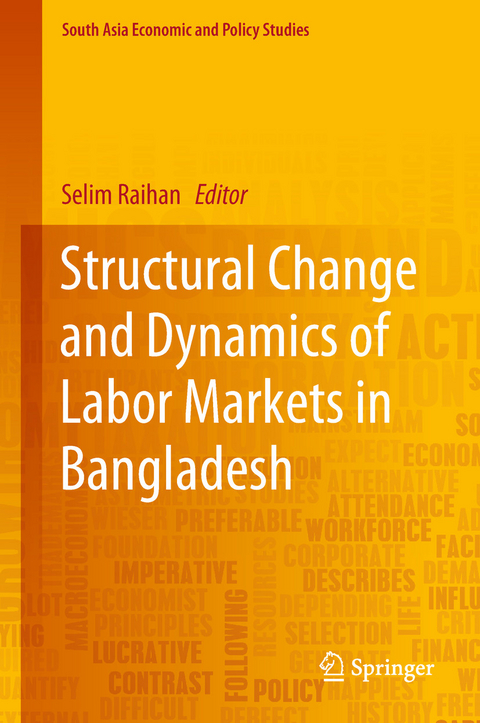
Structural Change and Dynamics of Labor Markets in Bangladesh (eBook)
XXXII, 205 Seiten
Springer Singapore (Verlag)
978-981-13-2071-2 (ISBN)
Outlining important policy requirements for Bangladesh to become an upper middle-income country, the book presents research work conducted during the project "e;Changing Labor Markets in Bangladesh: Understanding Dynamics in Relation to Economic Growth and Poverty,"e; sponsored by the International Development Research Center (IDRC), Canada. Bangladesh has experienced remarkable economic growth rates over the last decade. The country has recently been upgraded from a low-income country (LIC) to a lower-middle-income country (LMIC) as per the World Bank's classification system. By 2024, the country also aspires to graduate from the United Nation's list of least developed countries (LDC). The 7th five-year plan sets an ambitious target of 8 percent growth in GDP by 2020. There are also steep development targets to be achieved under the Sustainable Development Goals (SDGs) by 2030. All these will require an enormous leap forward from the current level of economic growth rate and sustaining itin the future. The situation also calls for considerable structural change in the economy, facilitating large-scale economic diversification. Rapid expansion of labor-intensive and high-productivity sectors, both in the farm and nonfarm sectors, is thus crucial for Bangladesh. Further, this should take place in conjunction with interventions to enhance productivity, jobs and incomes in traditional and informal activities where there are large pools of surplus labor. Given its relevance for Bangladesh and applicability to many other developing countries, the book offers a unique and pioneering resource for researchers, industry watchers as well as policy makers.
Dr. Selim Raihan is a Professor at the Department of Economics, University of Dhaka, Bangladesh and Executive Director of the South Asian Network on Economic Modeling (SANEM). His areas of interest include international trade and trade policy issues related to regional trading agreements, the WTO and domestic trade policies. He has extensive research experience in regional trade and development issues in South Asia, poverty and inequality issues, labor market issues, analysis of economic growth, political economy analysis of growth and development, and economic modeling.
Chapter 1: Structural Change in Bangladesh: Challenges for Growth and Employment Creation (by Selim Raihan).- Chapter 2: What determines the Choice between Farm and Nonfarm Employments in the Rural Bangladesh? (Selim Raihan and Syer Tazim Haque).- Chapter 3: How does Employment Status Matter for the Wellbeing of Rural Households in Bangladesh? (Selim Raihan and Fatima Tuz Zohora).- Chapter 4: Female Labor Market Participation in Bangladesh: Structural Changes and Determinants of Labor Supply (Simeen Mahmud and Sayema Haque Bidisha).- Chapter 5: Unpacking Unpaid Labor in Bangladesh (Selim Raihan, Sayema Haque Bidisha and Israt Jahan).- Chapter 6: Dynamics of Employment in the Urban Informal Sector in Bangladesh (Selim Raihan, K. M. Nafiz Ifteakhar and Mir Tanzim Nur Angkur).- Chapter 7: Some Estimates of First Demographic Dividend in Bangladesh: An Application of the Bangladesh National Transfer Account (Bazlul Haque Khondker and Muhammad Moshiur Rahman).- Chapter 8: How does Social Protection affect Labor Force Participation in Bangladesh? (Selim Raihan and Israt Jahan).- Chapter 9: How do Education and Skill development affect the Transition from ‘Good-enough’ Job to ‘Decent’ Job? (Selim Raihan and Mahtab Uddin).- Chapter 10: Does Participation in Vocational Training Differ on Agricultural Seasonality? (Israt Jahan and Abu S. Shonchoy).- Chapter 11: How does Remittance affect Labor Force Participation Behavior and Employment Choice in Bangladesh? (Selim Raihan, Muhammad Moshiur Rahman, Andilip Afroze and Mahtab Uddin).- Chapter 12: Growth and Distributional Impacts of Exogenous Demand Shock in Selected Activities in Bangladesh: Application of the Social Accounting Matrix Framework (Bazlul H. Khondker).- Chapter 13: Economy-wide and Employment Effects of different Scenarios in Bangladesh: Application of a CGE Model (Selim Raihan).
| Erscheint lt. Verlag | 29.8.2018 |
|---|---|
| Reihe/Serie | South Asia Economic and Policy Studies | South Asia Economic and Policy Studies |
| Zusatzinfo | XXXII, 205 p. 91 illus. |
| Verlagsort | Singapore |
| Sprache | englisch |
| Themenwelt | Wirtschaft ► Volkswirtschaftslehre ► Makroökonomie |
| Schlagworte | CGE Model • Decent Job • demographic dividend • Economic Growth • Gender • Labor Market • Nonfarm Sector • remittance • Structural Change |
| ISBN-10 | 981-13-2071-3 / 9811320713 |
| ISBN-13 | 978-981-13-2071-2 / 9789811320712 |
| Informationen gemäß Produktsicherheitsverordnung (GPSR) | |
| Haben Sie eine Frage zum Produkt? |
 PDF (Wasserzeichen)
DRM: Digitales Wasserzeichen
Dieses eBook enthält ein digitales Wasserzeichen und ist damit für Sie personalisiert. Bei einer missbräuchlichen Weitergabe des eBooks an Dritte ist eine Rückverfolgung an die Quelle möglich.
Dateiformat: PDF (Portable Document Format)
Mit einem festen Seitenlayout eignet sich die PDF besonders für Fachbücher mit Spalten, Tabellen und Abbildungen. Eine PDF kann auf fast allen Geräten angezeigt werden, ist aber für kleine Displays (Smartphone, eReader) nur eingeschränkt geeignet.
Systemvoraussetzungen:
PC/Mac: Mit einem PC oder Mac können Sie dieses eBook lesen. Sie benötigen dafür einen PDF-Viewer - z.B. den Adobe Reader oder Adobe Digital Editions.
eReader: Dieses eBook kann mit (fast) allen eBook-Readern gelesen werden. Mit dem amazon-Kindle ist es aber nicht kompatibel.
Smartphone/Tablet: Egal ob Apple oder Android, dieses eBook können Sie lesen. Sie benötigen dafür einen PDF-Viewer - z.B. die kostenlose Adobe Digital Editions-App.
Buying eBooks from abroad
For tax law reasons we can sell eBooks just within Germany and Switzerland. Regrettably we cannot fulfill eBook-orders from other countries.
aus dem Bereich