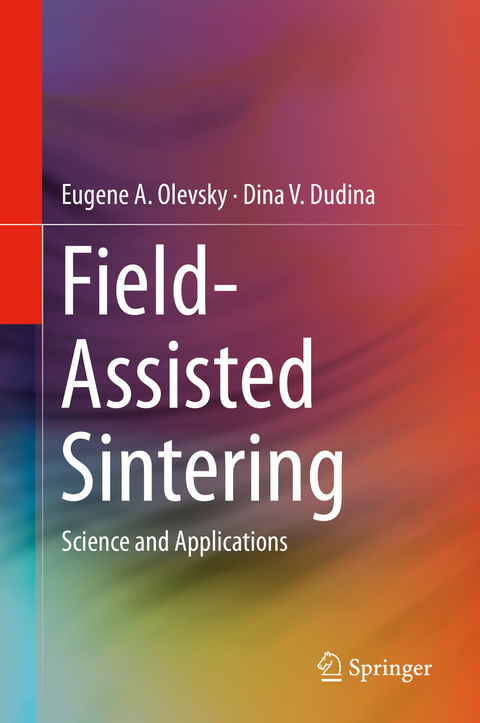
Field-Assisted Sintering (eBook)
XIV, 425 Seiten
Springer International Publishing (Verlag)
978-3-319-76032-2 (ISBN)
This book represents the first ever scientific monograph including an in-depth analysis of all major field-assisted sintering techniques. Until now, the electromagnetic field-assisted technologies of materials processing were lacking a systematic and generalized description in one fundamental publication; this work promotes the development of generalized concepts and of comparative analyses in this emerging area of materials fabrication.
This book describes modern technologies for the powder processing-based fabrication of advanced materials. New approaches for the development of well-tailored and stable structures are thoroughly discussed. Since the potential of traditional thermo-mechanical methods of material treatment is limited due to inadequate control during processing, the book addresses ways to more accurately control the resultant material's structure and properties by an assisting application of electro-magnetic fields. The book describes resistance sintering, high-voltage consolidation, sintering by low-voltage electric pulses (including spark plasma sintering), flash sintering, microwave sintering, induction heating sintering, magnetic pulse compaction and other field-assisted sintering techniques.
- Includes an in-depth analysis of all major field-assisted sintering techniques;
- Explains new techniques and approaches for material treatment;
- Provides detailed descriptions of spark plasma sintering, microwave sintering, high-voltage consolidation, magnetic pulse compaction, and various other approaches when field-assisted treatment is applied.
Eugene Olevsky is Interim Dean and Distinguished Professor of the College of Engineering of the San Diego State University, USA. Dr. Olevsky is the Director of the San Diego State University Powder Technology Laboratory. Prof. Olevsky has obtained two M.S. degrees in Mechanical Engineering and Applied Mathematics and Ph.D. degree in Materials Engineering. Dr. Olevsky's primary area of expertise is in experimentation and computational modeling on powder processing, including novel ceramic, metallic, and composite materials synthesis. Eugene Olevsky is the author of over 500 scientific publications and of more than 150 plenary, keynote, and invited presentations in the area of sintering research. Prof. Olevsky has supervised scientific sintering studies of more than 100 post-doctoral, graduate, and undergraduate students. Prof. Olevsky is a Fellow of the American Ceramic Society, a Fellow of the American Society of Mechanical Engineers, Fellow of the ASM International, Humboldt Fellow; he is a Full Member of the International Institute of Science of Sintering. Dr. Olevsky's most recent research is focused on field-assisted sintering techniques and sintering-assisted additive manufacturing.
Dina V. Dudina graduated from Siberian State Industrial University, Novokuznetsk, Russia. She obtained a Ph.D. (Candidate of Sciences) degree in Solid State Chemistry in 2004 after completing her postgraduate studies at the Institute of Solid State Chemistry and Mechanochemistry, Siberian Branch of the Russian Academy of Sciences, Novosibirsk, Russia. She conducted her postdoctoral research at the University of California, Davis, USA and Institut Polytechnique de Grenoble, France. In 2017, she defended a habilitation thesis in Engineering Sciences in Russia. At present, she is a senior scientist with Lavrentyev Institute of Hydrodynamics, Siberian Branch of the Russian Academy of Sciences, Novosibirsk. She teaches Materials Science courses at Novosibirsk State Technical University. Dina Dudina is the author/co-author of more than 90 publications in the area of powder processing, sintering and composite materials.
Eugene Olevsky is Interim Dean and Distinguished Professor of the College of Engineering of the San Diego State University, USA. Dr. Olevsky is the Director of the San Diego State University Powder Technology Laboratory. Prof. Olevsky has obtained two M.S. degrees in Mechanical Engineering and Applied Mathematics and Ph.D. degree in Materials Engineering. Dr. Olevsky’s primary area of expertise is in experimentation and computational modeling on powder processing, including novel ceramic, metallic, and composite materials synthesis. Eugene Olevsky is the author of over 500 scientific publications and of more than 150 plenary, keynote, and invited presentations in the area of sintering research. Prof. Olevsky has supervised scientific sintering studies of more than 100 post-doctoral, graduate, and undergraduate students. Prof. Olevsky is a Fellow of the American Ceramic Society, a Fellow of the American Society of Mechanical Engineers, Fellow of the ASM International, Humboldt Fellow; he is a Full Member of the International Institute of Science of Sintering. Dr. Olevsky’s most recent research is focused on field-assisted sintering techniques and sintering-assisted additive manufacturing. Dina V. Dudina graduated from Siberian State Industrial University, Novokuznetsk, Russia. She obtained a Ph.D. (Candidate of Sciences) degree in Solid State Chemistry in 2004 after completing her postgraduate studies at the Institute of Solid State Chemistry and Mechanochemistry, Siberian Branch of the Russian Academy of Sciences, Novosibirsk, Russia. She conducted her postdoctoral research at the University of California, Davis, USA and Institut Polytechnique de Grenoble, France. In 2017, she defended a habilitation thesis in Engineering Sciences in Russia. At present, she is a senior scientist with Lavrentyev Institute of Hydrodynamics, Siberian Branch of the Russian Academy of Sciences, Novosibirsk. She teaches Materials Science courses at Novosibirsk State Technical University. Dina Dudina is the author/co-author of more than 90 publications in the area of powder processing, sintering and composite materials.
Preface 5
Acknowledgments 6
Contents 7
About the Authors 11
Chapter 1: Introduction 13
1.1 A Brief Historical Overview 13
1.2 Thermal and Nonthermal Effects in Field-Assisted Sintering 18
1.2.1 Thermal Effects in Field-Assisted Sintering 19
1.2.2 Nonthermal Effects in Field-Assisted Sintering 24
References 33
Chapter 2: Resistance Sintering 37
2.1 Principle and Physical Mechanisms of Resistance Sintering 37
2.2 Resistance Sintering Equipment 40
2.3 Properties of Specimens Processed by Resistance Sintering 42
2.4 Summary 46
References 46
Chapter 3: Sintering by High-Voltage Electric Pulses 48
3.1 Principle and Physical Mechanisms of High-Voltage Consolidation 48
3.2 Stages of High-Voltage Consolidation 56
3.3 Processes at Inter-particle Contacts During High-Voltage Consolidation 57
3.4 High-Voltage Electric Discharge Consolidation (HVEDC) Apparatus 72
3.5 High-Energy High-Rate (HEHR) Consolidation Setup 78
3.6 Capacitor Discharge Sintering (CDS) Setup 79
3.7 Pulse Plasma Sintering (PPS) Setup 82
3.8 Briquetting by Electric Pulse Sintering 82
3.9 Pulsed Current-Assisted Shock Consolidation 85
3.10 Densification Kinetics Imposed by HVEDC 86
3.11 Selected Examples of Materials Processed by High-Voltage Electric Pulse Consolidation 89
3.12 Summary 94
References 95
Chapter 4: Sintering by Low-Voltage Electric Pulses (Including Spark Plasma Sintering (SPS)) 99
4.1 Principle and Physical Mechanisms of Low-Voltage Electric Pulse Sintering 99
4.2 Low-Voltage Electric Pulse Sintering Equipment 104
4.3 Macroscopic Temperature Gradients in SPS 106
4.4 Temperature Measurements and Heat Dissipation in SPS/FAST Facilities 110
4.5 Proportional-Integral-Derivative (PID) Control of Temperature During SPS and Regulation Quality Improvement 114
4.6 ``Plasma´´ Issue in SPS 116
4.7 Processes at the Inter-particle Contacts in SPS 122
4.8 The Effect of High Heating Rates: Experimental Studies 130
4.9 Modeling of the SPS Processes 137
4.9.1 Macroscopic Level of Analysis 138
4.9.2 Microscopic Level of Analysis: Grain-Boundary Diffusion Driven by Externally Applied Load and Surface Tension 140
4.9.3 Microscopic Level of Analysis: Power-Law Creep Driven by Externally Applied Load and Surface Tension 142
4.9.4 Theoretical Analysis of the Effect of High Heating Rates in the SPS 143
4.9.5 Influence of Thermal Diffusion 151
4.9.6 Contribution of Electromigration 157
4.9.7 Constitutive Equation of SPS Taking into Account the Enhanced Dislocation Motion by Local Resistive Heating 165
4.10 Selected Examples of Processes and Materials Developed Using SPS 170
4.10.1 Processing and Testing Methods Developed Using SPS Equipment 171
4.10.2 Joining of Materials by SPS 177
4.10.3 Surface Engineering by SPS 178
4.10.4 Dense Materials with Improved Properties Obtained by SPS 179
4.10.5 Porous Materials by SPS 186
4.11 Summary 192
References 193
Chapter 5: Flash Sintering 202
5.1 Principle of Flash Sintering 202
5.2 Mechanisms of Flash Sintering 219
5.3 Materials Densified by Flash Sintering 231
5.4 Summary 237
References 239
Chapter 6: Sintering in the Constant Electric Field in the Noncontact Mode and in Magnetic Field 242
6.1 Sintering in the Constant Electric Field in the Noncontact Mode 242
6.2 Sintering in the Constant and Pulsed Magnetic Fields 243
6.3 Summary 245
References 245
Chapter 7: Microwave Sintering 246
7.1 Principle of the Method and Microwave Heating Process 246
7.2 Effective Microwave Dielectric Properties 249
7.3 Heat Conduction Equation and Materials Parameters 252
7.4 Self-Consistent Electromagnetic and Thermal Modeling 253
7.5 Models of Microwave Sintering 254
7.6 Experimental Evidence of Microwave Nonthermal Effects 257
7.7 Models of Microwave Nonthermal Effects in Solids 261
7.8 Grain Growth During Microwave Sintering 269
7.9 Selected Examples of Materials Consolidated by Microwave Sintering 269
7.10 Summary 275
References 276
Chapter 8: Induction Heating Sintering 284
8.1 Principle of Induction Heating Sintering 284
8.2 Induction Sintering Equipment 287
8.3 High Heating Rates in Induction Heating Sintering 287
8.4 Selected Examples of Materials Processed by Induction Heating Sintering 293
8.5 Summary 297
References 298
Chapter 9: Magnetic Pulse Compaction 301
9.1 Principles of MPC 301
9.2 Equipment for MPC 304
9.3 Modeling of Uniaxial and Radial MPC 307
9.4 Selected Examples of Application of MPC to Different Materials 314
9.5 Summary 318
References 318
Chapter 10: Field Effects on Reacting Systems 322
10.1 Reactive Sintering: General Remarks 322
10.2 Driving Forces in Reactive Sintering 323
10.3 Modeling of Reactive Sintering 324
10.4 Diffusion During Heat Generation by a Contact Source and During Isothermal Annealing 325
10.5 Initiation of Reactions by Electric Current 326
10.6 Faster Reactions Under Applied Field 328
10.7 Slower Reactions Under Applied Field 335
10.8 Chemical Reactions Involved in High-Voltage Processes 336
10.9 Synthesis and Sintering by Microwaves 338
10.10 Enhancement of Chemical Reactivity by Magnetic Field 341
10.11 SPS Dies as Chemical Reactors with Controlled Temperature and Atmosphere 343
10.12 Comparison of Reactive SPS and SPS of the Products of Self-Propagating High-Temperature Synthesis (SHS) 353
10.13 Preparation of Reaction Mixtures for Reactive Sintering 354
10.14 Decomposition Reactions During SPS 360
10.15 Evolution of C-C Bonds Under Electric Current 360
10.16 Interaction of the Materials Sintered Using Graphite Foil and Graphite Tooling with Carbon 361
10.17 Selected Examples of Materials with Improved Properties Achieved by Reactive SPS. Syntheses in Non-conventional Assembli... 386
10.18 Summary 397
References 399
Chapter 11: Other Field-Assisted Sintering Techniques 408
11.1 IR Radiation-Assisted Sintering 408
11.2 Solar Sintering 409
11.3 Laser-Assisted Sintering 413
11.4 Photonic Sintering 413
11.5 UV-Assisted Sintering 416
11.6 Selected Examples of Materials Obtained Using Infrared, Solar, and Photonic Sintering 416
11.7 Summary 419
References 420
Concluding Remarks 422
Index 424
| Erscheint lt. Verlag | 9.8.2018 |
|---|---|
| Zusatzinfo | XIV, 425 p. 316 illus., 161 illus. in color. |
| Verlagsort | Cham |
| Sprache | englisch |
| Themenwelt | Technik ► Maschinenbau |
| Wirtschaft | |
| Schlagworte | Current Activated • Electric Current Assisted • Field Assisted • High Voltage Compaction • Induction Heating Sintering • Magnetic Pulse Compaction • Microwave Sintering • powder consolidation • Spark Plasma Sintering |
| ISBN-10 | 3-319-76032-7 / 3319760327 |
| ISBN-13 | 978-3-319-76032-2 / 9783319760322 |
| Informationen gemäß Produktsicherheitsverordnung (GPSR) | |
| Haben Sie eine Frage zum Produkt? |
 PDF (Wasserzeichen)
DRM: Digitales Wasserzeichen
Dieses eBook enthält ein digitales Wasserzeichen und ist damit für Sie personalisiert. Bei einer missbräuchlichen Weitergabe des eBooks an Dritte ist eine Rückverfolgung an die Quelle möglich.
Dateiformat: PDF (Portable Document Format)
Mit einem festen Seitenlayout eignet sich die PDF besonders für Fachbücher mit Spalten, Tabellen und Abbildungen. Eine PDF kann auf fast allen Geräten angezeigt werden, ist aber für kleine Displays (Smartphone, eReader) nur eingeschränkt geeignet.
Systemvoraussetzungen:
PC/Mac: Mit einem PC oder Mac können Sie dieses eBook lesen. Sie benötigen dafür einen PDF-Viewer - z.B. den Adobe Reader oder Adobe Digital Editions.
eReader: Dieses eBook kann mit (fast) allen eBook-Readern gelesen werden. Mit dem amazon-Kindle ist es aber nicht kompatibel.
Smartphone/Tablet: Egal ob Apple oder Android, dieses eBook können Sie lesen. Sie benötigen dafür einen PDF-Viewer - z.B. die kostenlose Adobe Digital Editions-App.
Buying eBooks from abroad
For tax law reasons we can sell eBooks just within Germany and Switzerland. Regrettably we cannot fulfill eBook-orders from other countries.
aus dem Bereich