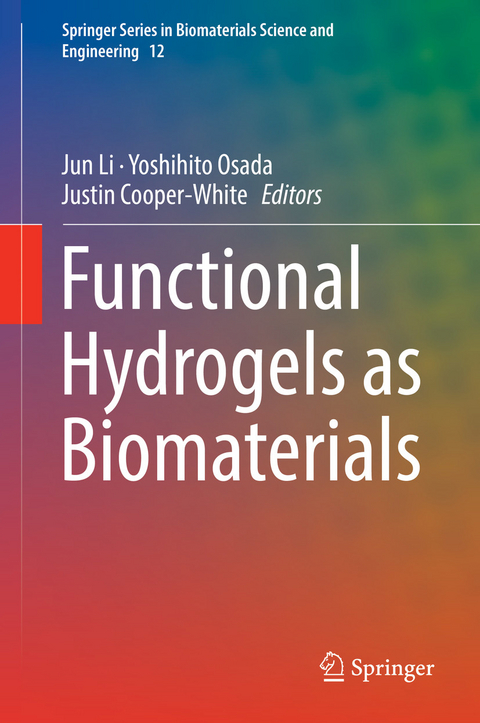
Functional Hydrogels as Biomaterials (eBook)
X, 163 Seiten
Springer Berlin Heidelberg (Verlag)
978-3-662-57511-6 (ISBN)
This book introduces readers to the latest advances in hydrogel biomaterials, mainly focusing on the emerging areas of synthetic and biopolymer hydrogels formed through specially designed chemical or physical crosslinking, and the cyclodextrin-based host-guest supramolecular self-assembly, for cell encapsulation, cell expansion, cell differentiation and tissue repair, stem cell culture, and cellular therapy and drug delivery applications.
The book was written by experts at the forefront of these interdisciplinary areas and is intended for all researchers working in the fields of biomaterials and biomedical engineering, as well as medical professions.
Jun Li is a Professor at the Department of Biomedical Engineering, National University of Singapore, Singapore.
Yoshihito Osada is a Professor at RIKEN Advanced Science Institute, Japan.
Justin Cooper-White is a Professor at the Australian Institute for Bioengineering and Nanotechnology, University of Queensland, Australia.
Jun Li is a Professor at the Department of Biomedical Engineering, National University of Singapore (NUS). He is also a Senior Member of the NUS Graduate School for Integrative Sciences and Engineering (NGS). Before joining NUS, he was a Senior Scientist at the Institute of Materials Research and Engineering (IMRE) under the Agency for Science, Technology and Research (A*STAR), Singapore. Prof. Li's expertise lies across the synthesis and modification of both synthetic and bio-based polymers, and their supramolecular self-assemblies for various applications such as drug and gene delivery, tissue engineering, personal care, and environmental sustainability.
Yoshihito Osada is a Professor emeritus of Hokkaido University, Japan. He is the Special Advisor to, and was the Deputy Director of the Advanced Science Institute, RIKEN, Japan. Before joining RIKEN, he was the Executive and Vice President of Hokkaido University, and was a Professor of Polymer Chemistry in the Division of Biological Sciences, Graduate School of Science, Hokkaido University. Prof. Osada's research interests are in the areas of polymer gels, artificial muscles, and bio-nanomachines.Justin Cooper-White is a Professor at the Australian Institute for Bioengineering and Nanotechnology, University of Queensland, Australia. Prof. Cooper-White's research interests include biomaterials processing, tissue engineering, non-Newtonian fluid mechanics, rheology and microfluidics. His projects in all of these areas have a common focus on providing fundamental insights into complex polymer-based structures and systems, with the aim of ultimately tailoring and controlling their interactions with biological systems.
Jun Li is a Professor at the Department of Biomedical Engineering, National University of Singapore (NUS). He is also a Senior Member of the NUS Graduate School for Integrative Sciences and Engineering (NGS). Before joining NUS, he was a Senior Scientist at the Institute of Materials Research and Engineering (IMRE) under the Agency for Science, Technology and Research (A*STAR), Singapore. Prof. Li’s expertise lies across the synthesis and modification of both synthetic and bio-based polymers, and their supramolecular self-assemblies for various applications such as drug and gene delivery, tissue engineering, personal care, and environmental sustainability. Yoshihito Osada is a Professor emeritus of Hokkaido University, Japan. He is the Special Advisor to, and was the Deputy Director of the Advanced Science Institute, RIKEN, Japan. Before joining RIKEN, he was the Executive and Vice President of Hokkaido University, and was a Professor of Polymer Chemistry in the Division of Biological Sciences, Graduate School of Science, Hokkaido University. Prof. Osada’s research interests are in the areas of polymer gels, artificial muscles, and bio-nanomachines. Justin Cooper-White is a Professor at the Australian Institute for Bioengineering and Nanotechnology, University of Queensland, Australia. Prof. Cooper-White’s research interests include biomaterials processing, tissue engineering, non-Newtonian fluid mechanics, rheology and microfluidics. His projects in all of these areas have a common focus on providing fundamental insights into complex polymer-based structures and systems, with the aim of ultimately tailoring and controlling their interactions with biological systems.
Biosynthetic hydrogels for cell encapsulation.- Synthetic hydrogels for expansion functional endothelial cells.- Hydrogels for directed stem cell differentiation and tissue repair.- Cross-linking of biological components for stem cell culture.- Hydrogels for stem cell encapsulation: Towards cellular therapy for diabetes.- Mobile properties of supramolecular polyrotaxane surfaces on modulation of cellular functions.- Recent advances in polymer-cyclodextrin inclusion complex based supramolecular hydrogel for biomedical applications.
| Erscheint lt. Verlag | 17.7.2018 |
|---|---|
| Reihe/Serie | Springer Series in Biomaterials Science and Engineering | Springer Series in Biomaterials Science and Engineering |
| Zusatzinfo | X, 163 p. 73 illus., 46 illus. in color. |
| Verlagsort | Berlin |
| Sprache | englisch |
| Themenwelt | Naturwissenschaften ► Physik / Astronomie |
| Technik ► Bauwesen | |
| Technik ► Maschinenbau | |
| Wirtschaft | |
| Schlagworte | biosensing • Cell Delivery • cell reprogramming • Gene Delivery • Polymeric hydrogels • Protein and Peptide Drug Delivery • stem cell culture • Stimuli-responsive Smart Hydrogels • Supramolecular Hydrogels • Tissue Engineering Scaffolds |
| ISBN-10 | 3-662-57511-6 / 3662575116 |
| ISBN-13 | 978-3-662-57511-6 / 9783662575116 |
| Informationen gemäß Produktsicherheitsverordnung (GPSR) | |
| Haben Sie eine Frage zum Produkt? |
 PDF (Wasserzeichen)
DRM: Digitales Wasserzeichen
Dieses eBook enthält ein digitales Wasserzeichen und ist damit für Sie personalisiert. Bei einer missbräuchlichen Weitergabe des eBooks an Dritte ist eine Rückverfolgung an die Quelle möglich.
Dateiformat: PDF (Portable Document Format)
Mit einem festen Seitenlayout eignet sich die PDF besonders für Fachbücher mit Spalten, Tabellen und Abbildungen. Eine PDF kann auf fast allen Geräten angezeigt werden, ist aber für kleine Displays (Smartphone, eReader) nur eingeschränkt geeignet.
Systemvoraussetzungen:
PC/Mac: Mit einem PC oder Mac können Sie dieses eBook lesen. Sie benötigen dafür einen PDF-Viewer - z.B. den Adobe Reader oder Adobe Digital Editions.
eReader: Dieses eBook kann mit (fast) allen eBook-Readern gelesen werden. Mit dem amazon-Kindle ist es aber nicht kompatibel.
Smartphone/Tablet: Egal ob Apple oder Android, dieses eBook können Sie lesen. Sie benötigen dafür einen PDF-Viewer - z.B. die kostenlose Adobe Digital Editions-App.
Buying eBooks from abroad
For tax law reasons we can sell eBooks just within Germany and Switzerland. Regrettably we cannot fulfill eBook-orders from other countries.
aus dem Bereich