


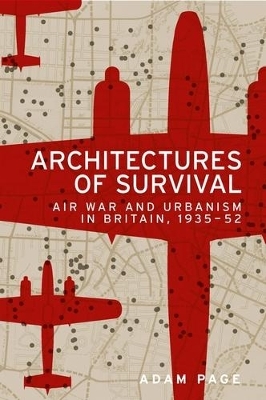
Architectures of Survival
Air War and Urbanism in Britain, 1935–52
Seiten
2019
Manchester University Press (Verlag)
978-1-5261-2258-2 (ISBN)
Manchester University Press (Verlag)
978-1-5261-2258-2 (ISBN)
- Titel z.Zt. nicht lieferbar
- Versandkostenfrei
- Auch auf Rechnung
- Artikel merken
Architectures of survival investigates how airpower influenced urbanism and debates about the future of cities in modern Britain. It traces the targeting of cities and militarisation of urban space from interwar to Cold War and highlights how air raids became incorporated into civilian planning debates about cities and infrastructure. -- .
Architectures of survival is an original and innovative work of history that investigates the relationship between air war and urbanism in modern Britain. It asks how the development of airpower and the targeting of cities influenced perceptions of urban spaces and visions of urban futures from the interwar period into the Cold War, highlighting the importance of war and the anticipation of war in modern urban history. Airpower created a permanent threat to cities and civilians, and this book considers how architects, planners and government officials reframed bombing as an ongoing urban problem, rather than one contingent to a particular conflict. It draws on archival material from local and national government, architectural and town planning journals and cultural texts, to demonstrate how cities were recast as targets, and planning for defence and planning for development became increasingly entangled. -- .
Architectures of survival is an original and innovative work of history that investigates the relationship between air war and urbanism in modern Britain. It asks how the development of airpower and the targeting of cities influenced perceptions of urban spaces and visions of urban futures from the interwar period into the Cold War, highlighting the importance of war and the anticipation of war in modern urban history. Airpower created a permanent threat to cities and civilians, and this book considers how architects, planners and government officials reframed bombing as an ongoing urban problem, rather than one contingent to a particular conflict. It draws on archival material from local and national government, architectural and town planning journals and cultural texts, to demonstrate how cities were recast as targets, and planning for defence and planning for development became increasingly entangled. -- .
Adam Page is Lecturer in History at the University of Lincoln -- .
Introduction
1 In the next war: the future of cities and the future of war
2 Planning a ‘militant peace’: air raid precautions for peace and for war
3 Cities under fire: the ‘new blitz reality’
4 Seeing cities through bombsights: urban geographies of war after 1945
5 A peace that is no peace: reconstruction, defence and development in town and country
Conclusion: the ordinariness of air raids?
Index -- .
| Erscheinungsdatum | 04.04.2019 |
|---|---|
| Zusatzinfo | 12 black & white illustrations |
| Verlagsort | Manchester |
| Sprache | englisch |
| Maße | 138 x 216 mm |
| Gewicht | 445 g |
| Themenwelt | Naturwissenschaften ► Geowissenschaften ► Geografie / Kartografie |
| Technik ► Architektur | |
| Wirtschaft ► Volkswirtschaftslehre | |
| ISBN-10 | 1-5261-2258-8 / 1526122588 |
| ISBN-13 | 978-1-5261-2258-2 / 9781526122582 |
| Zustand | Neuware |
| Informationen gemäß Produktsicherheitsverordnung (GPSR) | |
| Haben Sie eine Frage zum Produkt? |
Mehr entdecken
aus dem Bereich


aus dem Bereich
Buch | Hardcover (2024)
Schweizerbart'sche, E. (Verlag)
CHF 33,55
Zahlen, Fakten und Geschichten : in über 1000 Infografiken, Karten …
Buch | Hardcover (2025)
Marmota Maps (Verlag)
CHF 55,90
über eine faszinierende Welt zwischen Wasser und Land und warum sie …
Buch | Hardcover (2023)
dtv (Verlag)
CHF 33,55


