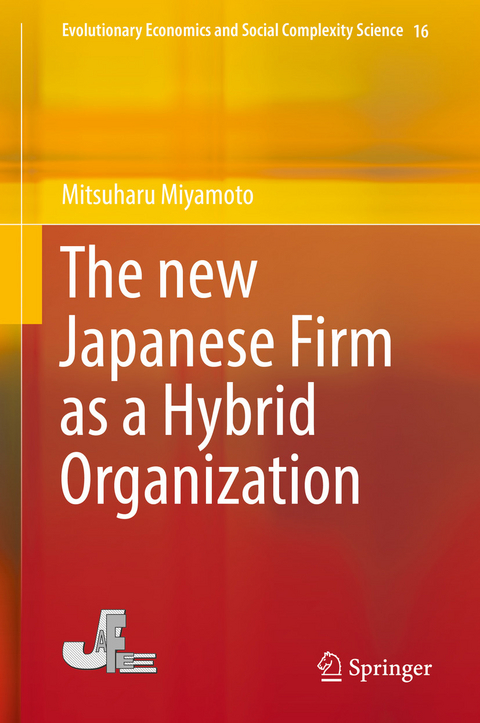
The new Japanese Firm as a Hybrid Organization (eBook)
XIV, 147 Seiten
Springer Singapore (Verlag)
978-981-10-8851-3 (ISBN)
This book examines corporate reform in Japan by focusing on corporate governance and the employment system. Contrary to a prevailing assertion of radical change, it is revealed that actual change is gradual, and a new type of Japanese firm is generated by reform with gradual change. Throughout the book, Japanese firms are seen to be evolving through gradual institutional change. Chapter 1 discusses how Japanese corporate governance changed incrementally and cumulatively to rebuild management and restore corporate performance. Chapter 2 focuses on reform in work organization and discusses how performance-related pay was introduced in tandem with corporate governance reform. It is shown that the practice of long-term employment has been maintained despite the prolonged depression and mounting pressure to shift to shareholder-oriented corporate governance. Chapter 3 investigates how Japanese firms are diversified into four types, based on whether performance-related pay is introduced and whether long-term employment is maintained. The author demonstrates that major Japanese firms reconstruct their organization as hybrid structures based on a combination of long-term employment and performance-related pay. Chapter 4 investigates how performance-related pay actually operates. It is analyzed by distinguishing the three main objectives to be attained by performance pay: succeeding in individual performance, contributing to overall organization performance, and meeting the challenge of new tasks. Finally, Chapter 5 investigates how employees react to changes in corporate governance. Using survey data, the book shows that Japanese employees approve of increasing shareholder value, regarding it as corporate value. They not only approve the monitoring of management by shareholders, but also demand a part in the monitoring. Employees seek to be engaged in corporate governance-a true challenge for a Japanese corporation.
Mitsuharu Miyamoto, Faculty of Economics, Senshu University.
This book examines corporate reform in Japan by focusing on corporate governance and the employment system. Contrary to a prevailing assertion of radical change, it is revealed that actual change is gradual, and a new type of Japanese firm is generated by reform with gradual change. Throughout the book, Japanese firms are seen to be evolving through gradual institutional change. Chapter 1 discusses how Japanese corporate governance changed incrementally and cumulatively to rebuild management and restore corporate performance. Chapter 2 focuses on reform in work organization and discusses how performance-related pay was introduced in tandem with corporate governance reform. It is shown that the practice of long-term employment has been maintained despite the prolonged depression and mounting pressure to shift to shareholder-oriented corporate governance. Chapter 3 investigates how Japanese firms are diversified into four types, based on whether performance-related pay is introduced and whether long-term employment is maintained. The author demonstrates that major Japanese firms reconstruct their organization as hybrid structures based on a combination of long-term employment and performance-related pay. Chapter 4 investigates how performance-related pay actually operates. It is analyzed by distinguishing the three main objectives to be attained by performance pay: succeeding in individual performance, contributing to overall organization performance, and meeting the challenge of new tasks. Finally, Chapter 5 investigates how employees react to changes in corporate governance. Using survey data, the book shows that Japanese employees approve of increasing shareholder value, regarding it as corporate value. They not only approve the monitoring of management by shareholders, but also demand a part in the monitoring. Employees seek to be engaged in corporate governance-a true challenge for a Japanese corporation.
Mitsuharu Miyamoto, Faculty of Economics, Senshu University.
Chaper 1. Change and continuity in Japanese corporate governance.- Change 2. Reform of the work organization: performance-related pay and employment system.- Chapter 3. Diversification of Japanese firms: how did a hybrid organization emerge from corporate governance reform?.- Chapter 4. How do Japanese employees react to performance-related pay: the working of hybrid organizations. - Chapter 5. How are Japanese employees reacting to changing corporate governance?.- Chapter 6. Conclusions.
| Erscheint lt. Verlag | 9.5.2018 |
|---|---|
| Reihe/Serie | Evolutionary Economics and Social Complexity Science | Evolutionary Economics and Social Complexity Science |
| Zusatzinfo | XIV, 147 p. 26 illus., 18 illus. in color. |
| Verlagsort | Singapore |
| Sprache | englisch |
| Themenwelt | Wirtschaft ► Allgemeines / Lexika |
| Wirtschaft ► Betriebswirtschaft / Management ► Personalwesen | |
| Wirtschaft ► Betriebswirtschaft / Management ► Unternehmensführung / Management | |
| Wirtschaft ► Volkswirtschaftslehre | |
| Schlagworte | Employee Engagement in Corporate Governance • Evolving Diversity in Japanese Firm • Gradual Institutional Change • Rebuilding of Japanese Management • Reform of Japanese Corporate Governance • Reform of Japanese Employment System |
| ISBN-10 | 981-10-8851-9 / 9811088519 |
| ISBN-13 | 978-981-10-8851-3 / 9789811088513 |
| Informationen gemäß Produktsicherheitsverordnung (GPSR) | |
| Haben Sie eine Frage zum Produkt? |
 PDF (Wasserzeichen)
DRM: Digitales Wasserzeichen
Dieses eBook enthält ein digitales Wasserzeichen und ist damit für Sie personalisiert. Bei einer missbräuchlichen Weitergabe des eBooks an Dritte ist eine Rückverfolgung an die Quelle möglich.
Dateiformat: PDF (Portable Document Format)
Mit einem festen Seitenlayout eignet sich die PDF besonders für Fachbücher mit Spalten, Tabellen und Abbildungen. Eine PDF kann auf fast allen Geräten angezeigt werden, ist aber für kleine Displays (Smartphone, eReader) nur eingeschränkt geeignet.
Systemvoraussetzungen:
PC/Mac: Mit einem PC oder Mac können Sie dieses eBook lesen. Sie benötigen dafür einen PDF-Viewer - z.B. den Adobe Reader oder Adobe Digital Editions.
eReader: Dieses eBook kann mit (fast) allen eBook-Readern gelesen werden. Mit dem amazon-Kindle ist es aber nicht kompatibel.
Smartphone/Tablet: Egal ob Apple oder Android, dieses eBook können Sie lesen. Sie benötigen dafür einen PDF-Viewer - z.B. die kostenlose Adobe Digital Editions-App.
Buying eBooks from abroad
For tax law reasons we can sell eBooks just within Germany and Switzerland. Regrettably we cannot fulfill eBook-orders from other countries.
aus dem Bereich