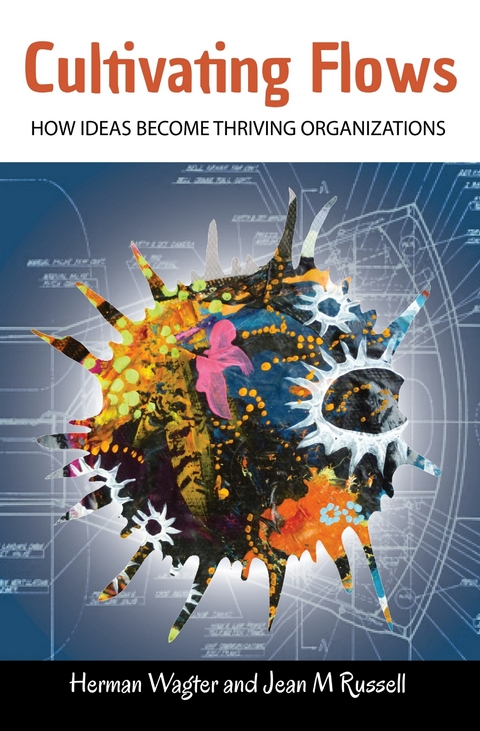
Cultivating Flows (eBook)
212 Seiten
Triarchy Press (Verlag)
978-1-909470-99-6 (ISBN)
The Internet has transformed the way we live and work - by unleashing the power of shared ideas, the power of instant communication, the power of cooperation while being separated by time and distance.
If the old idea of an organisation as a static machine, run hierarchically and designed for predictability, ever worked - it doesn't work now. Now that the brakes are off, we see torrents flow: vast flows of data, information, and knowledge; flows of influence and innovation; flows of ideas and people... once you notice them, it's increasingly clear that 'forms and flows' of ideas and information overwhelm the 'structures and processes' we were once comfortable with.
The force of shared ideas and information is clear: they shape how we organize ourselves. The challenge is to guide this force, to cultivate valuable flows, to nurture shared ideas into thriving organizations, to develop concepts and language to methodically approach this challenge.
Countless business start-ups, hybrid organizations and even conventional companies are frantically learning how to work with flows - there is no guidebook. Which is why Jean Russell and Herman Wagter, both long active in this field, set out to interview business pioneers and founders, researchers, practitioners, investors and others with experience of how flows work and how to shape them.
In Cultivating Flows (not 'Managing Flows'!) they pull together that experience, and their own, to explain how flows work and how best to work with them.
- They take us through key stages of development like Reframing, Navigating, Operationalizing and Iterating.
- They introduce us to key concepts like Emergent, Networked, Event-Driven (ENE) efforts; Social Technology, Social Protocols, and Social Organisms; Process Hierarchies; and Coherence
- They offer us a dozen, detailed Use-Cases of social flows in action.
And behind it all they're building a unique resource of interviews, articles, case studies and experience in a website that supports this book.
For anyone seeking to start, join, reimagine, reshape, update, or 'run' an organization or a movement in this exciting new world, Cultivating Flows is a kind of gardener's manual, an indispensable resource and an inspiration.
The Internet has transformed the way we live and work - by unleashing the power of shared ideas, the power of instant communication, the power of cooperation while being separated by time and distance.If the old idea of an organisation as a static machine, run hierarchically and designed for predictability, ever worked - it doesn't work now. Now that the brakes are off, we see torrents flow: vast flows of data, information, and knowledge; flows of influence and innovation; flows of ideas and people... once you notice them, it's increasingly clear that "e;forms and flows"e; of ideas and information overwhelm the "e;structures and processes"e; we were once comfortable with.The force of shared ideas and information is clear: they shape how we organize ourselves. The challenge is to guide this force, to cultivate valuable flows, to nurture shared ideas into thriving organizations, to develop concepts and language to methodically approach this challenge.Countless business start-ups, hybrid organizations and even conventional companies are frantically learning how to work with flows - there is no guidebook. Which is why Jean Russell and Herman Wagter, both long active in this field, set out to interview business pioneers and founders, researchers, practitioners, investors and others with experience of how flows work and how to shape them.In Cultivating Flows (not 'Managing Flows'!) they pull together that experience, and their own, to explain how flows work and how best to work with them.They take us through key stages of development like Reframing, Navigating, Operationalizing and Iterating.They introduce us to key concepts like Emergent, Networked, Event-Driven (ENE) efforts; Social Technology, Social Protocols, and Social Organisms; Process Hierarchies; and CoherenceThey offer us a dozen, detailed Use-Cases of social flows in action.And behind it all they re building a unique resource of interviews, articles, case studies and experience in a website that supports this book.For anyone seeking to start, join, reimagine, reshape, update, or run an organization or a movement in this exciting new world, Cultivating Flows is a kind of gardener s manual, an indispensable resource and an inspiration.
CHAPTER 2:
BEHIND THE CURTAIN—HOW SOCIAL FLOWS WORK
Social Flows have a number of key characteristics and it is helpful to understand these characteristics before we move into practice. Even though some of you will be deeply knowledgeable about many of these areas already, it might be helpful to check our terms in any case. The following concepts are some of our key assumptions in perceiving and cultivating social flows.
Networks
The word “network” has permeated our language. Decades ago most professionals talked about things like structure, hierarchy, functions, departments, and business units. Everything had to be given a specific place, and order gave people the sense of a designed piece, of an “optimum” design that needed only routine maintenance once a state of equilibrium had been attained.
Now we talk much more often about relationships and describe our world as a network: a network of corporations that constitute a supply network, a network of professionals, a social network. The word “network” has connotations of many relationships, of quickly adapting to new dynamics, of richness and complexity, of exchanging information which benefits all, of “the sum is more than the collection of parts.” Finally, the word “network” suggests that “as part of our context and wider environment, we can go further than we can go alone.” A network is something we are part of: it extends beyond the boundaries of our own organization and is in constant flux.
The idea of networks and flows gives us the opportunity to “design” them. Well, the word design would imply an engineering mindset. In practice it is more like cultivating a garden, a new variety of flowers or fruit. It is about dealing with life instead of matter.
Flow Interactions Seen as a Network
To understand social flows so we can cultivate them, it helps to look at some basic network science first. Social interactions, relationships, and transactions between people can be modeled as a network. The nodes of the network are individuals, the relationships between them are depicted as connections between nodes.
Social Network: a network of social interactions and relationships: “An axiom of the social network approach to understanding social interaction is that social phenomena should be primarily conceived and investigated through the properties of relations between and within units, instead of the properties of these units themselves.” [Wikipedia]
As Albert-László Barabási and others have shown, the natural development of this kind of social network will result in a particular topology, because it can continue to extend infinitely. Many nodes have a relatively small number of relationships, while a few nodes have many relationships. Some people are extremely well connected, one would say. The exciting part of this discovery is that the well-connected people play a vital role in making the network accessible and navigable.
Trust Beyond Dunbar’s Number
A human can only intimately know and trust a very limited number of people. Dunbar’s number is often cited as a natural limit. According to that theory, we build and maintain mental models of others. These models help us to understand and predict someone’s emotions, desires, and drives, and help us to estimate how far we can trust the other. The theory says that a human can keep approximately 150 individuals and their relationships (Dunbar’s number) in mind, which is very limited compared to the size of society. As trust is one of the core ingredients of relationships, and therefore of social flows, this limit could have been crippling.
But we found a bypass for it so we can deal with billions of relationships. Trust-by-proxy, in combination with well-connected people, is the means to overcome that limit to a large extent.
Trust-by-proxy means that you trust someone else’s judgment and character. For example, Kris is someone you know very well, someone you respect and trust, someone whose judgment has proven to be reliable on the topic at hand. Most likely close friends of Kris will have the same type of character and morals as Kris, or they would not be friends. As a default, it is relatively safe to trust friends of Kris on face value, as if they were Kris. And maybe even a friend of a friend of Kris. Of course this has limits and fails some of the time, yet it helps connect people every day. The opposite is true as well: you will be biased against the friends of someone you dislike and distrust.
H
We have more sensory equipment to assess trust than you might imagine. You need only a fraction of a second when entering a room to sense the “atmosphere”: is there hostility, joy or grief? Biologists have wondered for a long time why we humans (unlike most other animals) have 3 color receptors in our eyes, of which two are very close to each other in spectral sensitivity. The answer, according to Mark Changizi, is that this particular combination gives us a high sensitivity for reading variation in skin tones created by changes in the blood flow—even though we have remarkably few words to describe skin tones precisely. Your face shows in this way if you are agitated or not inside, if you are poised for aggression or not, if you are scared or not. Our eyes allow us to sense whether the words uttered match the state of the body. Masks and high levels of makeup hide this skin tone: we see the faces of geishas as being unreadable. It does not matter if someone has a Caucasian skin tone or an African skin tone. The spectral characteristics of both skin tones are much more alike than we might think them to be and we still can “read” the other’s state. It only takes a few weeks to recalibrate your senses from one tone to another, which might explain the high levels of mistrust when people with different skin tones first meet each other.
Well-connected people shorten the communication distance between any two individuals dramatically. They cause the famous “6 handshakes” or “6 degrees of separation” phenomenon: you can reach anybody in a world of 7 billion people within 6 handshakes. The math is simple: if I know someone who knows a 1,000 people, who knows someone who knows 1,000 people, and so on, we would potentially reach a billion people by the third handshake if there were no overlap between the networks. Even with only 150 instead of 1,000 connections you go beyond 6 billion in 5 handshakes.
If you know and trust a person who is very well connected, you may quickly find through her or him someone who you do not know but most likely can be trusted. Reputation is everything. Many of our emerging social technologies help us navigate trust beyond Dunbar’s number.
Social flows ride on social networks.
Self-Interest or Paying Forward
H
I have been told, “experience is what you get by pushing the envelope, wisdom is when you learn from experience to prevent mistakes.” Looking back, I would add that wisdom can be conveyed to you by people willing to share their experience, and how they have learned from it. At least that is how I experienced it.
Early on I became uncomfortable with the one-sidedness of this type of exchange: I could not return the favor. It gave me a sense of becoming indebted to them. When I expressed my uneasiness to someone, their answer was a surprise. “Of course you have to pay back the favor, with interest… by giving similar advice to others, later in your life, twice!” A great deal, from my point of view. I lost count of the number of times I was on the receiving end, so I just keep on giving advice (happily), including the “pay forward clause.” It makes me happy to pass on what I have learned.
We often over-simplify the concept of self-interest into economic terms. Here we mean something more nuanced. Humans have motivations for doing what we do. And they may not be the same for everyone. We may feel our self-interest is served if we experience a sense of connection and belonging with others. Or we may feel like we are part of a larger whole and a greater purpose than our own. We may derive meaning from altruism. Or, maybe, we are more motivated by a sense of achievement as we reach some goals we share together. Perhaps we are motivated by a desire to influence the world by changing policies or governance. We can also be motivated by the experience of being in flow states as we develop proficiency in a skill. Self-interest does not have to be about gaining economic value. Mutual self-interest means that we willingly engage in a group or team because we benefit in a way that matters to us.
Many real-life examples can be portrayed as a network of voluntary relationships, with multiple players, and not just two in a simple transaction closing out through reciprocity. The exchanges are not simple one-on-one (bartering), but convoluted and complex, weaving through the network before returning to you. When we design for mutual self-interest, we look at how each party may benefit directly, yes. So, at the meagre, economic level, helping out a friend of a friend might lead to a praise of your character in a time and place you may never be aware of. Something that might make a difference when your name comes up in a conversation, leading to a contact which is very beneficial to you. But we can also look beyond that to pay-it-forward, where a party may feel grateful about what they received, and gift it on to a third party. This forms giving chains, rather than simple reciprocity loops,...
| Erscheint lt. Verlag | 2.5.2016 |
|---|---|
| Sprache | englisch |
| Themenwelt | Sozialwissenschaften ► Pädagogik |
| Sozialwissenschaften ► Politik / Verwaltung | |
| Sozialwissenschaften ► Soziologie | |
| Wirtschaft ► Betriebswirtschaft / Management ► Planung / Organisation | |
| Wirtschaft ► Betriebswirtschaft / Management ► Unternehmensführung / Management | |
| Schlagworte | Leadership • Organization Design • Organizations • social flows • Social Technology • Strategic Planning |
| ISBN-10 | 1-909470-99-6 / 1909470996 |
| ISBN-13 | 978-1-909470-99-6 / 9781909470996 |
| Informationen gemäß Produktsicherheitsverordnung (GPSR) | |
| Haben Sie eine Frage zum Produkt? |
 EPUB (Ohne DRM)
Digital Rights Management: ohne DRM
Dieses eBook enthält kein DRM oder Kopierschutz. Eine Weitergabe an Dritte ist jedoch rechtlich nicht zulässig, weil Sie beim Kauf nur die Rechte an der persönlichen Nutzung erwerben.
Dateiformat: EPUB (Electronic Publication)
EPUB ist ein offener Standard für eBooks und eignet sich besonders zur Darstellung von Belletristik und Sachbüchern. Der Fließtext wird dynamisch an die Display- und Schriftgröße angepasst. Auch für mobile Lesegeräte ist EPUB daher gut geeignet.
Systemvoraussetzungen:
PC/Mac: Mit einem PC oder Mac können Sie dieses eBook lesen. Sie benötigen dafür die kostenlose Software Adobe Digital Editions.
eReader: Dieses eBook kann mit (fast) allen eBook-Readern gelesen werden. Mit dem amazon-Kindle ist es aber nicht kompatibel.
Smartphone/Tablet: Egal ob Apple oder Android, dieses eBook können Sie lesen. Sie benötigen dafür eine kostenlose App.
Geräteliste und zusätzliche Hinweise
Buying eBooks from abroad
For tax law reasons we can sell eBooks just within Germany and Switzerland. Regrettably we cannot fulfill eBook-orders from other countries.
aus dem Bereich