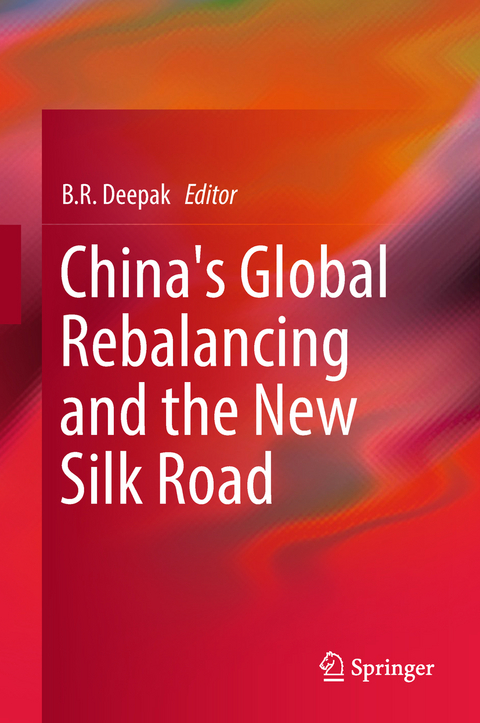
China's Global Rebalancing and the New Silk Road (eBook)
XIII, 253 Seiten
Springer Singapore (Verlag)
978-981-10-5972-8 (ISBN)
This collaborative volume discusses the One Belt One Road, or the New Silk Road, initiative of Chinese President Xi Jinping from the perspectives of the Belt and Road countries. This initiative has been viewed as a re-globalization drive by China in the backdrop of financial crisis of the West and the latter's increasingly protectionist tendencies of late. Rather than 'rebalancing' towards a certain region, this is supposed to be China's 'global rebalancing' aimed at inclusiveness and a win-win partnership. The initiative has raised hopes as well as suspicions about China's goals and intentions; that is, whether this is in sync with China's foreign policy goals, such as multipolarity, no hegemonic aspirations, and common security, or if this is an antidote to the U.S. foreign policy goals in the region, and China's ambition to realizing its long-term vision for Asian regional and global order.
In this volume, a galaxy of eminent academics from India, China, Pakistan, Uzbekistan, Germany and Southeast Asia have critically analysed every aspect of this mammoth project, including the six major economic corridors identified by China for policy coordination, infrastructure connectivity, unimpeded trade, monetary circulation, and people to people exchanges. The authors have interpreted China's peripheral, regional as well as global diplomacy both over land and sea. This topical volume is of interest to scholars and students of Asian studies, China studies, Asian history, development studies, international relations and international trade.
Professor B. R. Deepak (狄伯杰) was trained in Chinese history and India-China relations at the Peking University and Chinese Academy of Social Sciences, Beijing, at Jawaharlal Nehru University, New Delhi and University of Edinburgh, UK. He has been the Nehru and Asia Fellow at the Chinese Academy of Social Sciences, Beijing. Dr. Deepak's publications include India and China: Foreign Policy Approaches and Responses (2016), India and China 1904-2004: A Century of Peace and Conflict (2005); India-China Relations in first half of the Twentieth Century (2001); India-China Relations: Future Perspectives (co ed. 2012); India-China Relations: Civilizational Perspective (2012) China: Agriculture, Countryside and Peasants (2010); and Confucius Sukti Sangrah (The Analects of Confucius) (2016); The author has been a visiting professor at the Chinese Academy of Social Sciences, Tianjin Foreign Studies University, Beijing Language University, China, Doon University, Dehradun India, and Teaching Fellow at the Scottish Centre of Chinese Studies in the University of Edinburgh, UK.
This collaborative volume? discusses the One Belt One Road, or the New Silk Road, initiative of Chinese President Xi Jinping from the perspectives of the Belt and Road countries. This initiative has been viewed as a re-globalization drive by China in the backdrop of financial crisis of the West and the latter's increasingly protectionist tendencies of late. Rather than 'rebalancing' towards a certain region, this is supposed to be China's 'global rebalancing' aimed at inclusiveness and a win-win partnership. The initiative has raised hopes as well as suspicions about China's goals and intentions; that is, whether this is in sync with China's foreign policy goals, such as multipolarity, no hegemonic aspirations, and common security, or if this is an antidote to the U.S. foreign policy goals in the region, and China's ambition to realizing its long-term vision for Asian regional and global order. In this volume, a galaxy of eminent academics from India, China, Pakistan,Uzbekistan, Germany and Southeast Asia have critically analysed every aspect of this mammoth project, including the six major economic corridors identified by China for policy coordination, infrastructure connectivity, unimpeded trade, monetary circulation, and people to people exchanges. The authors have interpreted China's peripheral, regional as well as global diplomacy both over land and sea. This topical volume is of interest to scholars and students of Asian studies, China studies, Asian history, development studies, international relations and international trade.
Professor B. R. Deepak (狄伯杰) was trained in Chinese history and India-China relations at the Peking University and Chinese Academy of Social Sciences, Beijing, at Jawaharlal Nehru University, New Delhi and University of Edinburgh, UK. He has been the Nehru and Asia Fellow at the Chinese Academy of Social Sciences, Beijing. Dr. Deepak's publications include India and China: Foreign Policy Approaches and Responses (2016), India and China 1904-2004: A Century of Peace and Conflict (2005); India-China Relations in first half of the Twentieth Century (2001); India-China Relations: Future Perspectives (co ed. 2012); India-China Relations: Civilizational Perspective (2012) China: Agriculture, Countryside and Peasants (2010); and Confucius Sukti Sangrah (The Analects of Confucius) (2016); The author has been a visiting professor at the Chinese Academy of Social Sciences, Tianjin Foreign Studies University, Beijing Language University, China, Doon University, Dehradun India, and Teaching Fellow at the Scottish Centre of Chinese Studies in the University of Edinburgh, UK.
Preface 5
Contents 7
Editors and Contributors 9
Abbreviations 11
1 China’s Global Rebalancing: Will It Reshape the International Political and Economic Order? 14
1 Intent, Content and Aim of the BRI 15
2 Regional Responses to the BRI 17
3 Responses from the Strategic Community 18
3.1 India’s Responses 20
4 India’s Options 23
5 Conclusion 23
References 24
Civilizational Moorings 26
2 Silk Road Cultures and the Silk Road Economic Belt 27
1 Introduction 27
2 Silk Road Cultures 28
3 Silk Road and the Cross-Cultural Interface 29
4 Silk Road Cultures and the Silk Road Economic Belt 32
5 Conclusion 33
References 34
3 Silk Road and Civilizational Connections Between India and China: Role of the Buddhist Scholar Monks 35
1 Sutra Translation in Ancient China 36
1.1 Translation of Non-Buddhist Classics 40
2 Translation Methods and Legacy of Buddhist Scholar Monks 41
3 Conclusion 43
References 43
The ‘Belt and Road’ Initiative and the Corresponding Economic Corridors 45
4 The ‘Belt and Road’ Initiative: Fundamental Principles, Content, and Significance for Sino-Indian Relations 46
1 The ‘Belt and Road Initiative’: Fundamental Principles and Contents 46
2 Significance of the BRI to Sino-India Relations 48
2.1 India’s Anxieties and Some Recommendations 49
3 Conclusion 52
References 52
5 ‘Belt and Road’ Initiative: Building a China–South Asian Security Community 53
1 Context and De-conceptualization of “Security Community” 54
2 South Asian Structural Characteristics and Relevances to “China–South Asian” Security Community 55
3 Main Approach to Build a Security Community Under the Framework of ‘Belt and Road’ 56
4 Challenges and Some Suggestions 59
References 60
6 Bangladesh, China, India, Myanmar Economic Corridor (BCIM-EC): Security Dilemma Rider to Regional Economic Integration 61
1 Locating BCIM in History 61
2 Initiatives for the Revival of Routes 63
3 From ‘Kunming Initiative’ to BCIM-EC 64
3.1 The First Round 1999–2003 64
3.2 The Second Round 2004–2010 65
3.3 Third Round 2011–2013 66
3.4 Joint Study Group (JSG) Meetings 67
4 Evaluating the BCIM Regional Cooperation Progress? 67
4.1 Air Connectivity 67
4.2 Overland and Water Routes 68
4.3 Trade and Commerce 68
5 Infrastructure Connectivity and Challenges 69
5.1 Roadways 69
5.2 Railways 70
5.3 Waterways 70
6 Importance of BCIM-EC 70
6.1 Integrated Transportation Network 71
6.2 Linking of the Markets and Better Access 71
6.3 Energy Cooperation 72
6.4 Cooperation in Tourism 73
6.5 BCIM-EC Will Build ‘Mutual Political Trust’ 73
6.6 Strategic Significance for Neighborhood Policy 73
7 Challenges 74
7.1 Regional Representation Missing 74
7.2 Is the Security Environment One of the Major Negative Factors? 75
7.3 Poor and Backward Transportation Connectivity 75
7.4 Disequilibrium in Regional Economic Cooperation 76
8 Conclusion 76
References 77
7 The China–Pakistan Economic Corridor (CPEC): A Game Changer for Pakistan’s Economy 79
1 The Rationale for the CPEC 80
2 Unimpeded Trade 82
3 Economic Turnaround 85
4 Regional Connectivity 87
5 Conclusion 89
Appendix 1 The On-Going CPEC Projects 90
Appendix 2 CPEC Proposed Mineral and Industrial Zones 92
References 92
8 China–Pakistan Economic Corridor (CPEC): Regional Cooperation in the Wider South Asian Region 94
1 Introduction 94
2 Expected Benefits from the CPEC for China and Pakistan 96
2.1 Pakistani Interests 96
2.2 Chinese Interests 98
3 India’s ‘Uneasiness’ with the CPEC 99
4 Impacts of CPEC on Regional Cooperation 101
5 Conclusion 105
References 106
9 China–Mongolia–Russia Economic Corridor: Opportunities and Challenges 110
1 China’s ‘Neighborhood’ Policy 111
2 ‘One Belt, One Road’ (OBOR) Initiative 113
3 Opportunities Deriving from China-Mongolia-Russia Economic Corridor 115
3.1 Key Projects Under the Trilateral Economic Corridor 117
3.1.1 Transportation Infrastructure Sector 118
3.1.2 Industry Sector 119
3.1.3 Border Checkpoint Reforms 119
3.1.4 Energy Sector 120
3.1.5 Trade, Customs, Specialized Inspection, and Quarantine 120
3.1.6 Environmental Protection and Ecology Sector 120
3.1.7 Scientific and Technological Sector 121
3.1.8 Humanitarian Sector 121
3.1.9 Agriculture Sector 121
3.1.10 Medical Science Sector 121
4 Challenges for China-Mongolia-Russia Economic Corridor 122
5 Conclusion 124
References 124
10 Contemporary Central Asia: Balancing Between Chinese and Trans-Asian ‘Silk Road’ Diplomacy 127
1 Post-Soviet Geopolitics in Central Asian 128
2 SCO and the “Belt and Road” 129
3 Central Asia and Japan’s ‘Silk Road’ Diplomacy 131
4 Connectivity as the Driving Force for Inter-Asian Integration 131
5 Externality: From Conflicting to Cooperating Approaches 134
6 Conclusion 135
References 136
11 India’s Silk Road Strategy: Can It Meet China’s Belt and Road Initiative? 137
1 Existing ‘Silk Road’ Strategy 138
2 India’s Silk Road Strategy 139
3 Why the Russian Vector Is Important? 141
3.1 Russian Initiatives for Eurasian Integration 142
4 Conclusion 144
References 145
12 ‘One Belt-One Road Initiative’ and ASEAN Connectivity: Synergy Issues and Potentialities 147
1 ASEAN’s Connectivity Needs and Challenges 149
2 AMPC and OBOR: A Possible Synergy? 153
3 Alternative Infrastructure Initiatives in Asia 155
4 Conclusion 156
References 157
The Maritime Silk Road, the United States and the Asia Pacific 159
13 21st Century ‘Maritime Silk Road’ and Sino-Indian Maritime Cooperation 160
1 Strategic Targets of China’s MSR 161
2 What Are the Cooperation Priorities of MSR? 162
3 India’s Ambiguous Attitude Toward the MSR 164
3.1 India’s Responses 165
4 The Emerging Maritime Hedging Between China and India 167
5 The Way Ahead 168
5.1 Can Both Navies Cooperate in the MSR Initiative? 168
6 Way Ahead 169
References 171
14 The Clash of Interests: Issues of the US Pivot to Asia and China’s Maritime Silk Road 173
1 Frameworks of the US Pivot and China’s Maritime Silk Road 174
2 US Pivot’s China Focus 177
3 China’s Maritime Silk ?Road?: Geopolitical, Geo-Economic and Strategic Imperatives 180
4 The Contrasting Salience of the Pivot and the Maritime Silk Road 181
5 Conclusion 183
References 184
15 ‘One Belt, One Road’: China, US and the Emerging Hegemonic Struggle in Asia 187
1 Global Power Transition 188
2 Contest for Hegemony 189
3 Implications for “One Belt, One Road” Initiative 191
4 India’s Dilemma 192
5 Conclusion 194
References 195
16 Interrogating Competing Claims in South East Asia: The South China Sea or the West Philippine Sea 197
1 Introduction 197
2 China’s Assertiveness in the Maritime Domain and ASEAN 199
2.1 ASEAN’s Diverse Views on the South China Sea 199
3 Spat Over the Spratlys 200
3.1 China’s Claim and Response 201
3.2 The US’s Response 203
4 Managing an Asymmetric Relationship 204
5 Conclusion 207
References 209
Risks Along the ‘Belt and Road’ and China’s Role in the Emerging Global Order 211
17 Dealing with the Risks of the Belt and Road Initiative 212
1 Political Risks 212
2 Security Risks 215
2.1 Traditional Security and Non-traditional Security 215
2.1.1 Natural Risks 215
2.1.2 Environmental Risks 215
2.1.3 Threat of Extremist Forces 216
2.1.4 Threat of Non-governmental Organizations 217
2.1.5 Maritime Security Risks 217
3 Economic Risks 217
3.1 Macro Risks 220
3.2 Industrial Risks 221
3.3 Lack of Risk Response Mechanisms 222
3.4 Lack of Supporting Facilities for the Modern Service Industry 222
4 Legal Risks 222
4.1 Legal Risks Due to Investment 223
4.2 Legal Risks Due to Labor Issues 224
4.3 Legal Risks Due to Environmental Issues 225
4.4 Legal Risks Due to Poor Management 225
4.5 Legal Risks Due to Imperfect Laws 225
4.6 Legal Risks Due to Trade 226
5 Moral Risks 226
5.1 Moral Risks at the National Level 226
5.2 Moral Risks at the Enterprise Level 227
5.3 Moral Risks at the Individual Level 228
6 Conclusion 230
References 230
18 Emerging International Order and China’s Role 231
1 Theoretical Framework 231
1.1 The Concept of Sovereign Equality 232
1.2 The Primacy of National Interests 233
1.3 The Rule of International Law 233
1.4 Great Power Leadership 234
1.5 Respect for Human Rights 234
2 Shaping and Reshaping of the International Order 235
3 Who Will Dictate International Order? 240
4 Riders to International Order 242
5 China’s Opportunity to Shape the International Order 245
References 249
Index 251
| Erscheint lt. Verlag | 10.1.2018 |
|---|---|
| Zusatzinfo | XIII, 253 p. 2 illus. in color. |
| Verlagsort | Singapore |
| Sprache | englisch |
| Themenwelt | Geisteswissenschaften ► Geschichte ► Regional- / Ländergeschichte |
| Naturwissenschaften | |
| Sozialwissenschaften ► Politik / Verwaltung ► Europäische / Internationale Politik | |
| Sozialwissenschaften ► Soziologie ► Spezielle Soziologien | |
| Wirtschaft ► Volkswirtschaftslehre ► Makroökonomie | |
| Schlagworte | Area Studies • China and ASEAN • China-Pakistan corridor • Chinese nautical classics • cooperation with Central Asia • corridor with Myanmar and Bangladesh • Maritime Silk Road • Philippines-China dispute • regional cooperation • Sino-US relations |
| ISBN-10 | 981-10-5972-1 / 9811059721 |
| ISBN-13 | 978-981-10-5972-8 / 9789811059728 |
| Informationen gemäß Produktsicherheitsverordnung (GPSR) | |
| Haben Sie eine Frage zum Produkt? |
 PDF (Wasserzeichen)
DRM: Digitales Wasserzeichen
Dieses eBook enthält ein digitales Wasserzeichen und ist damit für Sie personalisiert. Bei einer missbräuchlichen Weitergabe des eBooks an Dritte ist eine Rückverfolgung an die Quelle möglich.
Dateiformat: PDF (Portable Document Format)
Mit einem festen Seitenlayout eignet sich die PDF besonders für Fachbücher mit Spalten, Tabellen und Abbildungen. Eine PDF kann auf fast allen Geräten angezeigt werden, ist aber für kleine Displays (Smartphone, eReader) nur eingeschränkt geeignet.
Systemvoraussetzungen:
PC/Mac: Mit einem PC oder Mac können Sie dieses eBook lesen. Sie benötigen dafür einen PDF-Viewer - z.B. den Adobe Reader oder Adobe Digital Editions.
eReader: Dieses eBook kann mit (fast) allen eBook-Readern gelesen werden. Mit dem amazon-Kindle ist es aber nicht kompatibel.
Smartphone/Tablet: Egal ob Apple oder Android, dieses eBook können Sie lesen. Sie benötigen dafür einen PDF-Viewer - z.B. die kostenlose Adobe Digital Editions-App.
Buying eBooks from abroad
For tax law reasons we can sell eBooks just within Germany and Switzerland. Regrettably we cannot fulfill eBook-orders from other countries.
aus dem Bereich