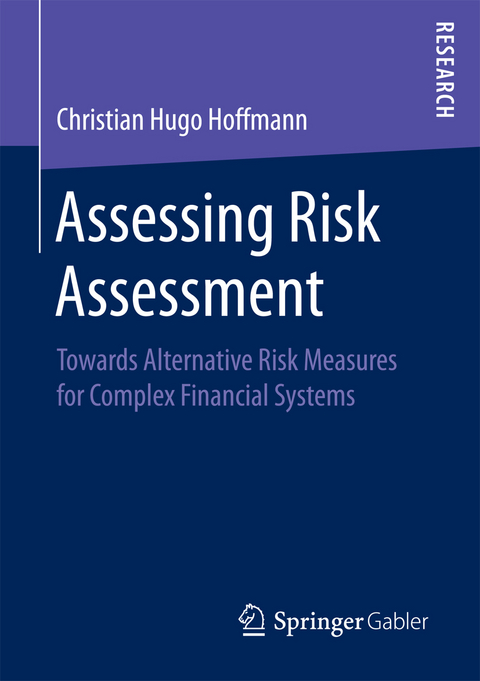
Assessing Risk Assessment (eBook)
XIV, 377 Seiten
Springer Fachmedien Wiesbaden (Verlag)
978-3-658-20032-9 (ISBN)
Christian Hugo Hoffmann completed his doctoral studies at the University of St. Gallen and Yale University. He co-founded a financial risk management start-up which translates these theoretical results into practical impact.
Table of Contents 5
List of Tables and Figures 8
Abstract 10
Zusammenfassung 12
Introduction 14
Part I:Concepts, Model Level and Risk Assessment 33
1. Introduction to Part I 34
2. Literature Synthesis, Theoretical Background and Research Focus 36
2.1. Complexity and Modern Financial Systems 36
2.2. Risk and Risk Management in the Financial World 43
2.2.1. Risk modeling 48
2.2.2. Value at Risk (VaR) 52
2.2.3. Expected Shortfall (ES) 58
2.3. Systemic Risk Assessment 60
2.3.1. Tools primarily for regulators: Conditional Value at Risk (CoVaR) and Systemic Expected Shortfall (SES) 62
2.3.2. Extreme Value Theory (EVT) 64
2.4. General Appraisal 66
2.4.1. Advantages of conventional risk models and measures 67
2.4.2. Weaknesses of conventional risk models and measures 69
2.5. Excursus: Benoît Mandelbrot's Plea for Fractal Methods 74
3. Research Questions 83
4. On an Adequate Concept of Risk and Systemic Risk in the realm of Banking 85
4.1. The Notion of Risk 85
4.2. The Concept of Systemic Risk 101
5. On the Relevance of Systemic Risks for Banks 113
5.1. Why should Banks take account of, and try to deal with, Systemic Risks? 113
5.2. What are concrete Systemic Risk Scenarios for Banks? 125
6. Dealing with Quantitative Risk Management in Banking as a Complex Systems Problem 132
6.1. A Trichotomy of Scientific Problems – Warren Weaver’s Scheme as a General Answer to How to Manage Complexity 137
6.1.1. Tackling disorganized complexity versus organized simplicity 137
6.1.2. Disorganized complexity and statistical techniques 140
6.1.3. Tackling organized complexity: open questions remain 143
6.1.4. Synopsis 145
6.2. Weaver’s Taxonomy Revisited: Attempts of Clarification, Extension and Refinement 148
6.2.1. Approaches towards the operationalization of Weaver’s concept of organized complexity 148
6.2.2. The bigger picture of complexity and randomness 151
6.3. Organized Complexity, Financial Systems and Assessing Extreme and Systemic Risks 161
6.3.1. On the level of structures 163
6.3.2. On the level of events 164
6.4. A Tentative Bottom Line 166
7. The Fundamental Inadequacy of Probability Theory as a Foundation for Modeling Systemic and Extreme Risk in a Banking Context 168
7.1. Philosophical Roots of the Problem of Induction: some Preliminaries 170
7.2. Probability Theory in a Nutshell, its Embeddedness and its Applications 173
7.3. The Central Argument against using Probability Theory for Financial Risk Management 184
7.4. Linking the Central Argument with the Current State of the Literature (IIIa)-c)) 192
8. Conclusion to Part I 195
8.1. Résumé 196
8.2. Outlook: Explanatory Models for In-House Risk Management in Banking 199
Part II:The Transition to the Decision Level, Risk Assessment andManagement 203
9. Introduction to Part II 204
10. The Critical Turn: The Renaissance of Practical Wisdom 206
11. Scenario Planning in a Nutshell and its Role in Risk Management in Banking 212
12. Strengths and Weaknesses of Scenario Planning as a Risk Management Tool 220
13. Deriving Lessons for Rethinking the Approach to Assessing Extreme and Systemic Risks 226
Part III:In Search of a New Paradigm: The Third Way as a Road toLogic-Based Risk Modeling (LBR) 230
14. Introduction to Part III 231
15. Theoretical Foundations of a Logic-Based Risk Modeling (LBR) Approach 236
15.1. A less Restrictive Axiomatization 236
15.2. Non-Probabilistic Models of Uncertainty 244
15.3. Ranking Theory 248
15.4. Syntax of a Language for Describing Contracts and Correlations 251
15.5. Semantics: Financial Contracts as Uncertain Sequences in a Non-Probabilistic Risk Model Context 257
15.5.1. Uncertain sequences by example 258
15.5.2. From contract value to risk 262
15.5.3. Formalization of the approach 263
15.5.4. Concrete instantiations of uncertainty monads: ranking functions 1
15.5.5. Evaluating risk models 275
15.6. Model Interpretation and Output: An Exact, Explanatory Scenario Planning Method 280
16. Case Study: LTCM and Extreme Risk 284
16.1. Example Trade 285
16.2. A Fixed Income Portfolio in LBR 286
16.3. Analysis 289
16.3.1. Overview 290
16.3.2. Zoom and filter 291
16.3.3. Details on demand 293
16.4. Discussion and Conclusion 293
17. Managerial Implications 296
18. Scales of Measurement and Qualitative Probabilities 302
19. Model Validation 308
Part IV:Meta Level: Thinking about Thinking and Practices – What itMeans to Reach Effective Risk Management Decisions 325
20. Introduction to Part IV as Overall Conclusion 326
21. Escaping the Traps for Logicians: Towards Decision-Making Competency in Risk Management 328
22. Final Remarks and a Path for Future Research 341
References 346
Appendices 377
| Erscheint lt. Verlag | 14.11.2017 |
|---|---|
| Zusatzinfo | XIV, 377 p. 36 illus. |
| Verlagsort | Wiesbaden |
| Sprache | englisch |
| Themenwelt | Wirtschaft ► Betriebswirtschaft / Management |
| Wirtschaft ► Volkswirtschaftslehre | |
| Schlagworte | Financial Crises • Functional Programming • Logic Based Risk Management LBR • monads • Probabilities • Ranking Theory • Risk Modeling • Systemic Risk in Banking Contexts |
| ISBN-10 | 3-658-20032-4 / 3658200324 |
| ISBN-13 | 978-3-658-20032-9 / 9783658200329 |
| Informationen gemäß Produktsicherheitsverordnung (GPSR) | |
| Haben Sie eine Frage zum Produkt? |
 PDF (Wasserzeichen)
DRM: Digitales Wasserzeichen
Dieses eBook enthält ein digitales Wasserzeichen und ist damit für Sie personalisiert. Bei einer missbräuchlichen Weitergabe des eBooks an Dritte ist eine Rückverfolgung an die Quelle möglich.
Dateiformat: PDF (Portable Document Format)
Mit einem festen Seitenlayout eignet sich die PDF besonders für Fachbücher mit Spalten, Tabellen und Abbildungen. Eine PDF kann auf fast allen Geräten angezeigt werden, ist aber für kleine Displays (Smartphone, eReader) nur eingeschränkt geeignet.
Systemvoraussetzungen:
PC/Mac: Mit einem PC oder Mac können Sie dieses eBook lesen. Sie benötigen dafür einen PDF-Viewer - z.B. den Adobe Reader oder Adobe Digital Editions.
eReader: Dieses eBook kann mit (fast) allen eBook-Readern gelesen werden. Mit dem amazon-Kindle ist es aber nicht kompatibel.
Smartphone/Tablet: Egal ob Apple oder Android, dieses eBook können Sie lesen. Sie benötigen dafür einen PDF-Viewer - z.B. die kostenlose Adobe Digital Editions-App.
Buying eBooks from abroad
For tax law reasons we can sell eBooks just within Germany and Switzerland. Regrettably we cannot fulfill eBook-orders from other countries.
aus dem Bereich