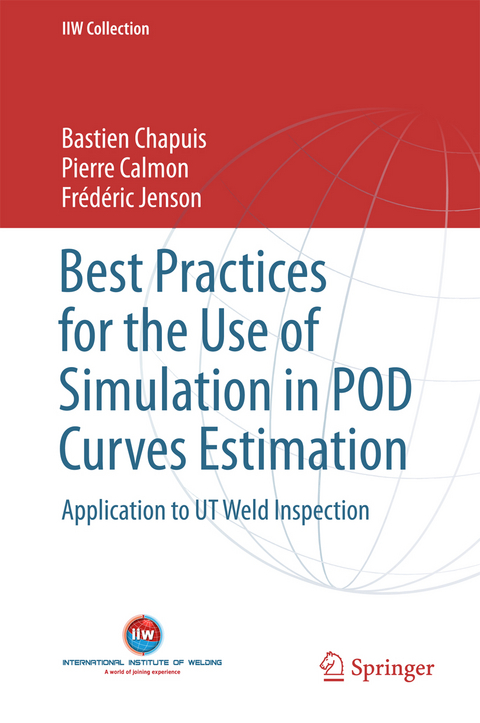
Best Practices for the Use of Simulation in POD Curves Estimation (eBook)
X, 56 Seiten
Springer International Publishing (Verlag)
978-3-319-62659-8 (ISBN)
This book provides best-practice guidance and practical recommendations on the use of numerical simulation for probability of detection (POD) curve estimation in the study of non-destructive testing reliability. It focuses on ultrasonic testing (UT) weld inspection but many of the principles can be applied to a broader range of techniques and situations.
The first part lists and briefly describes the principal documents that establish the recommended statistical framework adapted for POD curve estimation. It also presents the most important initiatives on the model assisted probability of detection (MAPOD) approach in recent years. The second part provides details of the advantages and limitations of the simulation in this context. The third part then describes the prerequisites for the use of simulation (validation of the software, expertise of the user), and the fourth and main part offers the methodology and guidance as well as possible applications for using POD curves determined using simulation.
Bastien Chapuis received his PhD degree in 2010 for his work prepared at the French Aerospace Lab (ONERA). Since then, he is research engineer at CEA LIST where he coordinates several industrial and academic research projects on NDT. In 2015 he has been nominated as CEA expert in NDT and is the current Chair of IIW sub-commission V-D “Structural Health Monitoring”. His research includes performance demonstration using simulation, signal processing for ultrasonic defect detection and development of structural health monitoring technologies.Pierre Calmon received in 1990 the PhD in Physics at the University of Paris Sud, France and joined the NDE department of the French Atomic Energy Commission (CEA). Since then his research activity is devoted to NDE. His main areas of interest are NDE simulation, imaging and diagnostics and reliability assessment. Nominated Senior Researcher in 2008, he is now scientific director of the NDE department. He is vice-president of the scientific hub of COFREND (French NDT Society) and he is the current Chair of IIW sub-commission V-F “NDE Reliability including simulation”. Frédéric Jenson (Engineering Degree, Ph.D) is head of the Non Destructive Testing (NDT) research team at Safran Tech. The team develops innovative NDT methods relying on ultrasonic, thermography, electromagnetics and computed tomography techniques. Before joining the Safran Group in 2015, he worked for ten years at the CEA, first as a research engineer specialized in ultrasonic techniques, then as the project manager for the development of the NDT simulation software CIVA, and finally, as head of the team dedicated to the development of NDT solutions for the industry. He also initiated and developed the Model Assisted POD (MAPOD) approach within CEA, in collaboration with the Airbus Group.
Acknowledgements 6
Contents 7
Introduction 9
Context 9
Scope of the Document 10
Content 10
Background on POD and MAPOD Approach 11
1 Recommendation Documents on Statistical Methodology Dedicated to POD Analysis 12
2 Documentation and Recent Initiatives on the Use of Simulation in the Context of POD 14
Advantages and Limitations of the Simulation 15
3 Advantages of Simulation 16
4 Difficulties, Limitations 18
Human Factors 18
Lack of Knowledge on Influential Parameters, Epistemic and Aleatory Uncertainties 19
Identification of Aleatory Parameters 20
Knowledge of Statistical Distributions of Aleatory Parameters 20
Availability of Suitable and Validated Models 21
5 Possible Ways of Using Simulation in the Context of POD Curve Estimation 22
Prerequisites for the Use of Simulation 24
6 Validation of the Software Tools 25
7 Training/Expertise of the Operators 27
Methodology and Guidance 28
8 Basics of Statistics for POD 29
POD Curves 29
Hit/Miss Analysis 31
Signal Response (or â vs. a) 32
Noise and Probability of False Alarms (PFA) 34
Min(POD) greaterthan 0 and/or Max(POD) lessthan 1 35
Variation of Sensitivity in the Inspected Zone 36
9 Best Practices Principles and Guidance for POD Curves Estimation Using Simulation 37
Step 1: Input of Nominal Values of Parameters 39
Step 2: Description of Aleatory Uncertainties (Variability of Influential Parameters) 40
Step 3: Simulations 42
Step 4: Analysis of the Results and Computation of the POD Curve 43
Step 5: Evaluation of the Reliability of a Simulated POD Curve 44
Step 6: Report 47
10 Best Practice Principles and Guidance for the Exploitation of Simulated POD Data in Relation with Experimental Data 48
Complement an Experimental Data Set for Estimation of a POD Curve 48
Comparison Between Experimental POD Curves and POD Curves Estimated by Simulation 49
Optimization of the Design of Experiments in a POD Study 50
Quantification of the Impact of an Additional Parameter 50
Quantification of the Influence of a Change in the Inspection Procedure 51
Modify the Procedure to Bring Back a POD Curve to an Acceptable Value 52
Conclusion 53
Appendix: Specificities of AUT Systems Using Zonal Discrimination Method 54
References 56
| Erscheint lt. Verlag | 27.10.2017 |
|---|---|
| Reihe/Serie | IIW Collection | IIW Collection |
| Zusatzinfo | X, 56 p. 9 illus. in color. |
| Verlagsort | Cham |
| Sprache | englisch |
| Themenwelt | Technik ► Maschinenbau |
| Wirtschaft | |
| Schlagworte | defect sizing curves • MAPOD approach • MIL-HDBK-1823A • non-destructive testing • numerical simulation for POD curve estimation • Ultrasonic testing UT |
| ISBN-10 | 3-319-62659-0 / 3319626590 |
| ISBN-13 | 978-3-319-62659-8 / 9783319626598 |
| Informationen gemäß Produktsicherheitsverordnung (GPSR) | |
| Haben Sie eine Frage zum Produkt? |
 PDF (Wasserzeichen)
DRM: Digitales Wasserzeichen
Dieses eBook enthält ein digitales Wasserzeichen und ist damit für Sie personalisiert. Bei einer missbräuchlichen Weitergabe des eBooks an Dritte ist eine Rückverfolgung an die Quelle möglich.
Dateiformat: PDF (Portable Document Format)
Mit einem festen Seitenlayout eignet sich die PDF besonders für Fachbücher mit Spalten, Tabellen und Abbildungen. Eine PDF kann auf fast allen Geräten angezeigt werden, ist aber für kleine Displays (Smartphone, eReader) nur eingeschränkt geeignet.
Systemvoraussetzungen:
PC/Mac: Mit einem PC oder Mac können Sie dieses eBook lesen. Sie benötigen dafür einen PDF-Viewer - z.B. den Adobe Reader oder Adobe Digital Editions.
eReader: Dieses eBook kann mit (fast) allen eBook-Readern gelesen werden. Mit dem amazon-Kindle ist es aber nicht kompatibel.
Smartphone/Tablet: Egal ob Apple oder Android, dieses eBook können Sie lesen. Sie benötigen dafür einen PDF-Viewer - z.B. die kostenlose Adobe Digital Editions-App.
Buying eBooks from abroad
For tax law reasons we can sell eBooks just within Germany and Switzerland. Regrettably we cannot fulfill eBook-orders from other countries.
aus dem Bereich