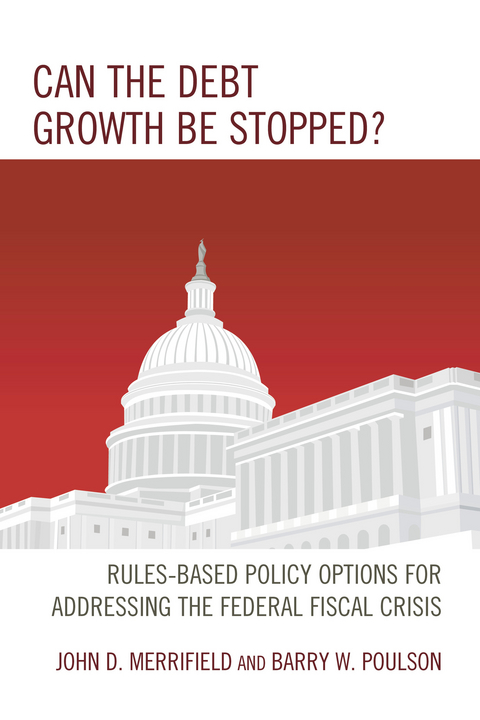
Can the Debt Growth Be Stopped? (eBook)
204 Seiten
Lexington Books (Verlag)
978-1-4985-1810-9 (ISBN)
This book explores new fiscal rules introduced in OECD countries and the relevance of fiscal rules for the unique fiscal policies and institutions in the United States. The rules in different countries are compared, with a more in depth analysis of two countries with arguably the most successful fiscal rules-Switzerland and Sweden. The study compares the challenge of fiscal consolidation facing the U.S. with that in other OECD countries. The centerpiece of the study is analysis of fiscal rules using a dynamic simulation model. A Swiss style fiscal rule is compared to an alternative fiscal rule proposed by Representative Amash, H.J.Res 24.The authors propose a new fiscal rule designed for the unique fiscal institutions in the U.S. Dynamic scoring is used to measure the impact of different fiscal rules on the federal budget, economic growth, and revenue. The effectiveness of the different fiscal rules is analyzed with respect to several criteria. A major objective of the rules is fiscal stabilization in the long run to bring debt/GDP ratios below tolerance levels. The fiscal rules are also designed for budget stabilization in the medium term, such that deficits in periods of recession are offset by surplus revenue in periods of economic expansion. The concluding section of the study explores the political economy of enacting new fiscal rules in the U.S. The study proposes fundamental changes in budget process required for the proposed fiscal rule to be effective. The study concludes with a discussion of alternative routes to enacting new fiscal rules, and the prospects for new fiscal rules to be enacted in the U.S.
John D. Merrifield is professor of economics at the University of Texas at San Antonio.Barry W. Poulson is emeritus professor of economics at the University of Colorado.
Chapter 1 A New Era of Fiscal RulesChapter 2 Economic Analysis of Fiscal RulesChapter 3 Case Studies: Fiscal Rules in Switzerland and SwedenChapter 4 Fiscal Rules in the U.S.Chapter 5 Should the U.S. Go Swiss?Chapter 6 Designing a New Fiscal Rule for the U.S.Chapter 7 Toward a New Budget ProcessChapter 8 The Political Economy of New Fiscal Rules
| Erscheint lt. Verlag | 1.3.2016 |
|---|---|
| Zusatzinfo | 22 Illustrations including: - 10 Tables; - 11 Graphs; - 1 Text Boxes. |
| Verlagsort | Lanham |
| Sprache | englisch |
| Themenwelt | Wirtschaft ► Betriebswirtschaft / Management ► Unternehmensführung / Management |
| Wirtschaft ► Volkswirtschaftslehre ► Makroökonomie | |
| Wirtschaft ► Volkswirtschaftslehre ► Wirtschaftspolitik | |
| Schlagworte | Budget • debt • deficit • Fiscal consolidation • Fiscal Policy • Fiscal Rules • fiscal stabilization • Public Finance |
| ISBN-10 | 1-4985-1810-9 / 1498518109 |
| ISBN-13 | 978-1-4985-1810-9 / 9781498518109 |
| Informationen gemäß Produktsicherheitsverordnung (GPSR) | |
| Haben Sie eine Frage zum Produkt? |
 EPUB (Adobe DRM)
Kopierschutz: Adobe-DRM
Adobe-DRM ist ein Kopierschutz, der das eBook vor Mißbrauch schützen soll. Dabei wird das eBook bereits beim Download auf Ihre persönliche Adobe-ID autorisiert. Lesen können Sie das eBook dann nur auf den Geräten, welche ebenfalls auf Ihre Adobe-ID registriert sind.
Details zum Adobe-DRM
Dateiformat: EPUB (Electronic Publication)
EPUB ist ein offener Standard für eBooks und eignet sich besonders zur Darstellung von Belletristik und Sachbüchern. Der Fließtext wird dynamisch an die Display- und Schriftgröße angepasst. Auch für mobile Lesegeräte ist EPUB daher gut geeignet.
Systemvoraussetzungen:
PC/Mac: Mit einem PC oder Mac können Sie dieses eBook lesen. Sie benötigen eine
eReader: Dieses eBook kann mit (fast) allen eBook-Readern gelesen werden. Mit dem amazon-Kindle ist es aber nicht kompatibel.
Smartphone/Tablet: Egal ob Apple oder Android, dieses eBook können Sie lesen. Sie benötigen eine
Geräteliste und zusätzliche Hinweise
Buying eBooks from abroad
For tax law reasons we can sell eBooks just within Germany and Switzerland. Regrettably we cannot fulfill eBook-orders from other countries.
aus dem Bereich