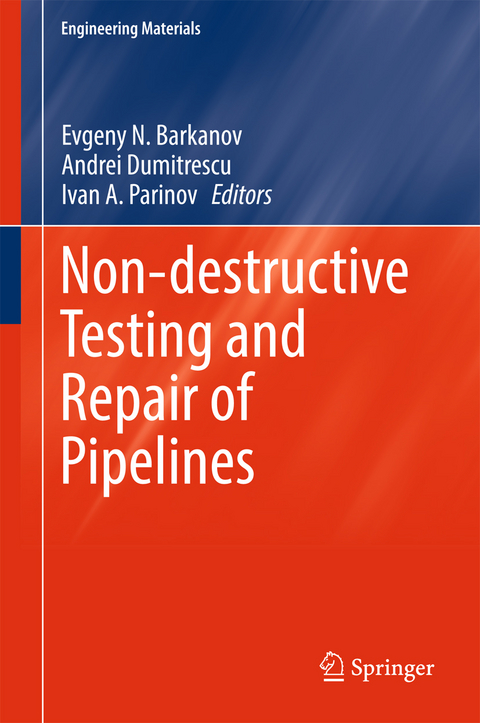
Non-destructive Testing and Repair of Pipelines (eBook)
XVII, 451 Seiten
Springer International Publishing (Verlag)
978-3-319-56579-8 (ISBN)
This book describes efficient and safe repair operations for pipelines, and develops new methods for the detection and repair of volumetric surface defects in transmission pipelines. It also addresses the physics, mechanics, and applications of advanced materials used for composite repair of corroded pipelines.
Presenting results obtained in the European Commission's INNOPIPES FRAMEWORK 7 programme, it develops long-range ultrasonic and phased array technologies for pipeline diagnostics, and explores their interactions with discontinuities and directional properties of ultrasonic antenna array. The book subsequently shares the results of non-destructive testing for different types of materials applications and advanced composite repair systems, and characterizes the mechanical properties by means of fracture methods and non-destructive techniques.
In turn, the book assesses the currently available technologies for reinforcement of pipelines, drawing on the experience gai
ned by project partners, and evaluates the recovery of the carrying capacity of pipeline sections with local corrosion damage by means of analytical and numerical procedures. It develops an optimization method based on the planning of experiments and surface techniques for advanced composite repair systems, before validating the numerical models developed and experimentally gauging the effectiveness of composite repair with the help of full-scale hydraulic tests.Prof., Dr.Sc.Ing. Evgeny Barkanov graduated from Riga Polytechnical Institute, Faculty of Technical Appliances and Automation in 1986 with the first-class Dipl.-Ing. He defended the Dr.Sc.Ing.thesis on Mechanics of Deformable Solids in 1993 at Riga Technical University. He is the author of 3 textbooks and more than 100 scientific publications in the field of computational mechanics, mechanics of composite materials, vibration damping and optimization. He improved the qualification and carried out scientific investigations abroad via TEMPUS JEP, TEMPUS IMG, the Royal Society, the British Council, NATO Research Fellowship, Konferenz der Deutschen Akademien der Wissenschaften, DFG, DAAD, NSC of Taiwan, SOCRATES. He is leader/contractor in many national and international projects (FRAMEWORK 5: SANDWICH; FRAMEWORK 6: ALCAS, FRIENDCOPTER, INTERSHIP, CASSEM, DE-LIGHT, MOMENTUM, SAND.CORe; FRAMEWORK 7: COALINE, INNOPIPES; MATERA: ADYMA; COST: COINAPO). He is a member of the Prof
essor Council in the Civil Engineering and Architecture, Promotion Councils RTU P-03 and RTU P-06, and RTU Academic Assembly. He is expert in the Latvian Ministry of Education and Science, Latvian Council of Science, EU FRAMEWORK 6-7 and HORIZON 2020 programs.
Prof., Ph.D. Eng. Andrei Dumitrescu graduated from the Technological Equipment Faculty of the Petroleum and Gas Institute of Ploiesti (presently PGUP) in 1989 with Merit Diploma (top position in the class). He defended the Ph.D thesis in Technical Sciences (Oilfield Equipment) in 1998 at the Petroleum-Gas University of Ploiesti (PGUP). He is the main/only author of 3 textbooks and co-author of other 6 textbooks and of more than 55 scientific publications in the field of petroleum equipment (mainly oilfield tubulars and transmission pipelines), materials technologies and production systems engineering. He had an experience abroad (in Italy) as R&D Sealines Engineer for Snamprogetti, S.p.A. an
d Senior Sealines Engineer for Saipem, S.p.A. He is leader/contractor in several national projects and for one European project (FRAMEWORK 7: INNOPIPES). He is a member of the Professor's Council of the Mechanical and Electrical Engineering Faculty, of the PGUP Senate, and of the PGUP Senate Bureau. He is the Editor-in-Chief of the Petroleum-Gas University of Ploiesti Bulletin, Technical Series, and expert of the Technical Committee 89 (Industrial valves) of ASRO (Romanian Standards Association). He is a member of the European Structural Integrity Society, Society of Petroleum Engineers, and Treasurer of the Romanian Association of Fracture Mechanics.
Dr Sc Ivan A. Parinov received his MSc degree in Mechanics from Rostov State University, Department of Mechanics and Mathematics in 1978 (Rostov-on-Don, Russia), his PhD in Physics and Mathematics from Rostov State University in 1990, and his Dr Sc from the South-Russian State Technical University i
n 2008. He is a Corresponding Member of the Russian Academy of Engineering (2014). He has worked at the I.I. Vorovich Mathematics, Mechanics and Computer Sciences Institute of the Southern Federal University (former Rostov State University) since 1978, where he is now the Chief Research Fellow.From 1993 to 2016 he was the Head of the Research Grants and Programs from Soros Foundation, Collaboration for Basic Science and Education (COBASE, USA), Russian Foundation for Basic Research (13 grants), and Russian Ministry for Science and Education (7 grants and scientific proposals).
He has published more than 280 scientific-technical publications, including 21 monographs (in particular, 4 books published with Springer and 11 books with Nova Science Publishers). He holds 11 Russian patents.
Dr Parinov has been a reviewer for the Zentralblatt für Mathematik (Germany) and Mathematical Reviews (USA) since 1994 (ca. 450 reviews), as well as the journal SOP Tra
nsactions on Theoretical Physics (Scientific Online Publishing) since 2013. Further, he is an Active Member of the New York Academy of Sciences, American Mathematical Society, European Mathematical Society, and Indian Structural Integrity Society, and holds the title 'Honorary Member of the All-Russian Society of Inventors and Rationalizers'.His research interests include R&D of novel materials and composites (in particular, high-temperature superconductors and ferro-piezoelectrics), fracture mechanics and strength physics, acoustic emissions, optics, mathematical modeling, and various applications of advanced materials and composites.
Prof., Dr.Sc.Ing. Evgeny Barkanov graduated from Riga Polytechnical Institute, Faculty of Technical Appliances and Automation in 1986 with the first-class Dipl.-Ing. He defended the Dr.Sc.Ing.thesis on Mechanics of Deformable Solids in 1993 at Riga Technical University. He is the author of 3 textbooks and more than 100 scientific publications in the field of computational mechanics, mechanics of composite materials, vibration damping and optimization. He improved the qualification and carried out scientific investigations abroad via TEMPUS JEP, TEMPUS IMG, the Royal Society, the British Council, NATO Research Fellowship, Konferenz der Deutschen Akademien der Wissenschaften, DFG, DAAD, NSC of Taiwan, SOCRATES. He is leader/contractor in many national and international projects (FRAMEWORK 5: SANDWICH; FRAMEWORK 6: ALCAS, FRIENDCOPTER, INTERSHIP, CASSEM, DE-LIGHT, MOMENTUM, SAND.CORe; FRAMEWORK 7: COALINE, INNOPIPES; MATERA: ADYMA; COST: COINAPO). He is a member of the Professor Council in the Civil Engineering and Architecture, Promotion Councils RTU P-03 and RTU P-06, and RTU Academic Assembly. He is expert in the Latvian Ministry of Education and Science, Latvian Council of Science, EU FRAMEWORK 6-7 and HORIZON 2020 programs. Prof., Ph.D. Eng. Andrei Dumitrescu graduated from the Technological Equipment Faculty of the Petroleum and Gas Institute of Ploiesti (presently PGUP) in 1989 with Merit Diploma (top position in the class). He defended the Ph.D thesis in Technical Sciences (Oilfield Equipment) in 1998 at the Petroleum-Gas University of Ploiesti (PGUP). He is the main/only author of 3 textbooks and co-author of other 6 textbooks and of more than 55 scientific publications in the field of petroleum equipment (mainly oilfield tubulars and transmission pipelines), materials technologies and production systems engineering. He had an experience abroad (in Italy) as R&D Sealines Engineer for Snamprogetti, S.p.A. and Senior Sealines Engineer for Saipem, S.p.A. He is leader/contractor in several national projects and for one European project (FRAMEWORK 7: INNOPIPES). He is a member of the Professor’s Council of the Mechanical and Electrical Engineering Faculty, of the PGUP Senate, and of the PGUP Senate Bureau. He is the Editor-in-Chief of the Petroleum-Gas University of Ploiesti Bulletin, Technical Series, and expert of the Technical Committee 89 (Industrial valves) of ASRO (Romanian Standards Association). He is a member of the European Structural Integrity Society, Society of Petroleum Engineers, and Treasurer of the Romanian Association of Fracture Mechanics. Dr Sc Ivan A. Parinov received his MSc degree in Mechanics from Rostov State University, Department of Mechanics and Mathematics in 1978 (Rostov-on-Don, Russia), his PhD in Physics and Mathematics from Rostov State University in 1990, and his Dr Sc from the South-Russian State Technical University in 2008. He is a Corresponding Member of the Russian Academy of Engineering (2014). He has worked at the I.I. Vorovich Mathematics, Mechanics and Computer Sciences Institute of the Southern Federal University (former Rostov State University) since 1978, where he is now the Chief Research Fellow. From 1993 to 2016 he was the Head of the Research Grants and Programs from Soros Foundation, Collaboration for Basic Science and Education (COBASE, USA), Russian Foundation for Basic Research (13 grants), and Russian Ministry for Science and Education (7 grants and scientific proposals). He has published more than 280 scientific-technical publications, including 21 monographs (in particular, 4 books published with Springer and 11 books with Nova Science Publishers). He holds 11 Russian patents. Dr Parinov has been a reviewer for the Zentralblatt für Mathematik (Germany) and Mathematical Reviews (USA) since 1994 (ca. 450 reviews), as well as the journal SOP Transactions on Theoretical Physics (Scientific Online Publishing) since 2013. Further, he is an Active Member of the New York Academy of Sciences, American Mathematical Society, European Mathematical Society, and Indian Structural Integrity Society, and holds the title “Honorary Member of the All-Russian Society of Inventors and Rationalizers”.His research interests include R&D of novel materials and composites (in particular, high-temperature superconductors and ferro-piezoelectrics), fracture mechanics and strength physics, acoustic emissions, optics, mathematical modeling, and various applications of advanced materials and composites.
Preface 6
Contents 11
Contributors 14
Non-destructive Testing of Transmission Pipelines 17
1 Long-Range Ultrasonic and Phased Array Technologies 18
Abstract 18
1 Introduction 18
2 Application of Phased Array Technology to Control Pipelines with Long-Range Ultrasound Technique 19
3 Pipe Types Modes and Dispersion Curves 22
4 Method Application and Restriction 24
5 Method Sensitivity to Discontinuities and to Pipelines Components 26
6 Conclusion 28
References 29
2 T- and L-Types of Long-Range Guided Waves for Defect Detection 30
Abstract 30
1 Introduction 31
2 Experimental Setup 33
3 Enhancement of Contrast in Detection of Small Defects 35
4 Comparison of T- and L-Modes in Detection of Through and Surface Defects 39
5 Influence of Liquid Filling 42
6 Conclusion 43
References 44
3 Directional Properties of Ultrasonic Antenna Array 45
Abstract 45
1 Introduction 46
2 Basic Principles and Methods for Theoretical Calculation of Ultrasonic Phased Antenna Array Fields 46
3 Numerical Method and Initial Data 48
4 Results and Discussion 52
5 Conclusion 56
References 57
4 Interaction of Low-Frequency Guided Waves with Discontinuities 58
Abstract 58
1 Introduction 59
2 Mathematical Modeling and Finite Element Approximations 60
3 Numerical Models of Defects and Initial Data for Simulations 62
4 Results of Finite Element Simulation 67
5 Conclusion 73
References 74
5 Vibration-Based Damage Detection of Steel Pipeline Systems 75
Abstract 75
1 Introduction 76
2 Numerical Research 77
3 Conclusions and Recommendations 83
Acknowledgements 83
References 83
6 Localization of Impact Damage in Thin-Walled Composite Structure Using Variance-Based Continuous Wavelet Transform 85
Abstract 85
1 Introduction 85
2 Experimental Vibration Testing 87
3 Low-Velocity Impact Tests 89
4 Damage Localization Methodology 90
5 Results and Discussion 94
6 Conclusions 99
Acknowledgements 100
References 100
7 Identification of Defects in Pipelines Through a Combination of FEM and ANN 102
Abstract 102
1 Introduction 103
2 Formulation of Direct and Inverse Problems 104
2.1 Direct Problem 104
2.2 Inverse Problems 105
3 Identification of Defects with the Use of Artificial Neural Networks 107
3.1 ANN Architecture 107
3.2 The Processing of Input Data for ANN 108
4 Numerical Experiments 109
4.1 Determination of Distance to the Defect by Using Hardware 109
4.2 Determination of Distance to the Defect Using ANN 111
4.3 Determination of Defect Parameters Using ANN 111
4.3.1 Reconstruction of Perpendicular Cracks 112
4.3.2 Reconstruction of Inclined Cracks 115
5 Conclusion 116
Acknowledgements 117
References 117
8 Dynamic Properties of Thin-Walled Structures Under Changing Pressure Conditions in the Contact Fluid 118
Abstract 118
1 Introduction 118
2 Mathematical Formulation of the Problem 119
3 Asymptotical Analysis of the Basic Integral Equation 121
4 Dynamic Deformation of the Plate 122
5 Numerical Results 123
References 125
Volumetric Surface Defects in Transmission Pipelines 126
9 Characterisation of Volumetric Surface Defects 127
Abstract 127
1 Introduction 127
2 Methods for the Assessment of Volumetric Surface Defects 132
3 Case Study 141
4 Conclusions 144
References 145
10 Assessment of the Remaining Strength Factor and Residual Life of Damaged Pipelines 146
Abstract 146
1 Introduction 147
2 Assessment of the Remaining Strength Factor for Pipelines with VSDs 149
3 Assessment of the Residual Life of Pipeline with VSDs in the Weld Area 155
4 Conclusions 160
References 160
11 Assessment of Interacting Volumetric Surface Defects 162
Abstract 162
1 Introduction 163
2 Criteria and Procedures for the Assessment of Interacting Defects 164
3 Finite Element Modelling 168
4 Conclusions 173
Acknowledgements 173
References 174
Materials Used for the Composite Repair Systems of Transmission Pipelines 175
12 Review on Materials for Composite Repair Systems 176
Abstract 176
1 Introduction 176
2 Filler Materials 178
3 Fibre-Reinforced Materials 182
4 Adhesive Materials 186
5 Conclusions 193
References 194
13 Techniques for Non-destructive Material Properties Characterisation 197
Abstract 197
1 Introduction 197
2 Non-destructive Techniques 199
2.1 Three-Points-Bending Test 199
2.2 Impulse Excitation Method 200
2.3 Inverse Technique 202
2.3.1 Experimental Setup 203
2.3.2 Numerical Model 203
2.3.3 Material Identification Procedure 204
3 Characterisation of Elastic Material Properties 206
3.1 Application of Three-Points-Bending Test 207
3.2 Application of Impulse Excitation Method 208
3.3 Application of Inverse Technique 209
3.4 Comparison of Identified Parameters 211
4 Conclusion 212
References 213
14 Characterization of Elastic Properties of Metals and Composites by Laser-Induced Ultrasound 214
Abstract 214
1 Introduction 214
2 Excitation and Detection of Optoacoustic Pulses 217
3 Attenuation and Scattering of Ultrasonic Pulses 222
4 Discussions 227
5 Conclusions 229
References 229
15 Experimental Characterization of Composite Material Properties 231
Abstract 231
1 Introduction 231
2 Actual Mechanical Properties 232
2.1 Materials of Reinforcing Element and Resin 232
2.2 Test Samples of Composite Material 232
2.3 Test Results of the Composite Material 234
2.4 Tensile Test of the Roving 234
2.5 Additional Research of the Material 235
2.5.1 Linear Density of the Roving 235
2.5.2 Photomicrography of the Roving 236
2.5.3 Measurement of the Cross-Section Area of Roving 236
3 Optimization of Service Characteristics 237
3.1 Effect of Disperse Fillers 237
3.2 Dynamic Mechanical Characteristics 238
3.3 Using of Perforated Metal Tapes 240
4 Conclusions 241
References 241
Technologies Used for the Composite Repair Systems of Transmission Pipelines 242
16 Comparative Analysis of Existing Technologies for Composite Repair Systems 243
Abstract 243
1 Introduction 243
2 Transmission Pipeline Repair Technologies Using Composite Materials 247
2.1 Reinforced Composite Materials Bands Used for Pipeline Repair 251
2.2 Pipeline Repair Using Composite Sleeves and Combined Protective Coupling Systems 253
3 Technologies Using Composite Materials for Corrosion Protection Systems 258
3.1 Band Coatings 259
3.2 Combined Band Coatings 262
3.3 The Causes of Defects Appearing on Wrapped Insulation Coating 264
4 Requirements for the Composite Materials Used for Pipeline Repair or Insulation Coating Systems 265
5 Conclusions 266
References 267
17 Design of Composite Repair Systems 270
Abstract 270
1 Introduction 271
2 Analysis of the Design Procedures for the Composite Materials Repair Systems 271
3 A New Design Procedure for the Composite Materials Repair Systems 278
4 Conclusions 285
References 285
Simulation of Advanced Composite Repair Systems of Transmission Pipelines 287
18 Finite Element Stress Analysis of Pipelines with Advanced Composite Repair 288
Abstract 288
1 Introduction 289
2 Material Properties of the Pipelines Used for the Numerical Analyses 289
3 Geometric Models of the Pipelines Used for the Numerical Analyses 292
4 Stress Intensity Versus Pressure Level in Unrepaired Pipe with VSD and Filler 295
5 Stress Level Versus Mechanical Properties of the Filler 295
6 The Evaluation of Mechanical Properties of Composite Wrap Versus Stress Intensity in Pipe with VSD 297
7 Analysis of Composite Wrap Thickness with Respect to ISO/TS 24817:2006 301
8 Aspects Regarding the Structural Optimization of Composite Wrap Used for Re-establishing the Integrity of Pipeline Using FEA Method with COSMOS Program 303
9 Conclusions 305
Acknowledgements 307
References 308
19 Finite-Element Modeling of a Repaired Pipeline Containing Two Volumetric Surface Defects 309
Abstract 309
1 Finite-Element Model 309
2 Numerical Experiments 311
3 Conclusion 317
Acknowledgements 318
References 318
20 Assessment of the Reinforcement Capacity of Composite Repair Systems for Pipelines with Interacting Defects 319
Abstract 319
1 Introduction 319
2 Analysis 322
2.1 General Considerations of Finite Element Analysis 322
2.2 Interaction Between Two VSDs Without Repair, on the External Surface 323
2.3 Interaction Between Two VSDs for the Repaired Pipe 327
3 Conclusions 331
3.1 Unrepaired Pipeline Case (Without Composite Wrap) 331
3.2 Repaired Pipeline Case (with Composite Wrap) 331
3.3 General Remarks 332
3.4 Further Developments 335
Acknowledgements 335
References 335
21 Modeling of the Contact Interaction Between Steel Pipe and Composite Bandage 337
Abstract 337
1 Introduction 337
2 Statement of the Problem 338
3 Mathematical Modeling and Analysis of Results 339
3.1 Scheme of Contact in the Corner Points of the Bandage 339
3.2 Contact at the Corner and the Central Points of the Bandage 343
3.3 Contact in the Corner Points, and in the Central Part of the Bandage 343
4 Conclusions 347
References 348
22 Experimental and Numerical Research of Renovated Pipeline Prototype with Surface Defect 350
Abstract 350
1 Introduction 350
2 Experimental Setup 351
3 Conduction of the Experiment 353
4 Analysis of Results 355
5 Conclusion 363
References 365
23 Analytical Modeling of the Damaged Zone of Pipelines Repaired with Composite Materials Systems 366
Abstract 366
1 Introduction 367
2 Problem Formulation 369
3 Assessment of the Nature of Decision at the Corner Points 372
4 Method for Solving the Problem 373
5 Computational Experiments 378
6 Conclusions 382
Acknowledgements 383
References 383
24 Optimal Design of Composite Repair Systems of Transmission Pipelines 384
Abstract 384
1 Introduction 384
2 Optimisation Methodology 385
2.1 Experimental Design 385
2.2 Response Surface Technique 386
2.3 Nonlinear Optimisation 387
3 Finite Element Modelling 387
4 Formulation of Optimisation Problems 388
5 Solution of Optimisation Problems 390
5.1 Equiresistant Design 391
5.2 Minimum Weight Design 392
5.3 Comparison of Optimal Results 393
6 Conclusion 394
References 394
Testing of Advanced Composite Repair Systems of Transmission Pipelines 396
25 Development of an Experimental Programme for Industrial Approbation 397
Abstract 397
1 Introduction 398
2 Previous Experimental Tests on Pipelines Repaired with Composite Wraps 399
3 Definition of the Experimental Parameters and Planned Experimental Programme 405
4 Conclusions 411
References 411
26 Inner Pressure Testing of Full-Scale Pipe Samples 413
Abstract 413
1 Preparation of Samples 413
2 Peculiarities of Full-Scale Samples Testing 418
3 Main Test Results 419
References 424
27 Effectiveness Assessment of Composite Repair Systems 426
Abstract 426
1 Evaluation Based on Change of Volume and Yield Pressure 426
2 Evaluation Based on Change of Sample Perimeter 429
3 Effect of Composite Wrap on Change of Deformations in a Defect 429
4 Matching of Loading Diagram 431
5 Efficiency Assessment by Numerical Calculations 432
5.1 Selection of Finite-Element Mesh 432
5.2 Solution of the Models and Analysis of Results 435
6 Conclusions 442
References 442
28 Errata to: Non-destructive Testing and Repair of Pipelines 443
Errata to:& #6
Index 444
| Erscheint lt. Verlag | 27.7.2017 |
|---|---|
| Reihe/Serie | Engineering Materials | Engineering Materials |
| Zusatzinfo | XVII, 451 p. 280 illus., 100 illus. in color. |
| Verlagsort | Cham |
| Sprache | englisch |
| Themenwelt | Naturwissenschaften ► Physik / Astronomie |
| Technik ► Bauwesen | |
| Technik ► Maschinenbau | |
| Wirtschaft | |
| Schlagworte | Composite Repair Systems • European gas grid • FP-7 INNOPIPES • INNOPIPES FRAMEWORK 7 • Mechanics of Advanced Materials • Processing Techniques of Advanced Materials • Transmission Pipelines • Volumetric Surface Defects |
| ISBN-10 | 3-319-56579-6 / 3319565796 |
| ISBN-13 | 978-3-319-56579-8 / 9783319565798 |
| Informationen gemäß Produktsicherheitsverordnung (GPSR) | |
| Haben Sie eine Frage zum Produkt? |
 PDF (Wasserzeichen)
DRM: Digitales Wasserzeichen
Dieses eBook enthält ein digitales Wasserzeichen und ist damit für Sie personalisiert. Bei einer missbräuchlichen Weitergabe des eBooks an Dritte ist eine Rückverfolgung an die Quelle möglich.
Dateiformat: PDF (Portable Document Format)
Mit einem festen Seitenlayout eignet sich die PDF besonders für Fachbücher mit Spalten, Tabellen und Abbildungen. Eine PDF kann auf fast allen Geräten angezeigt werden, ist aber für kleine Displays (Smartphone, eReader) nur eingeschränkt geeignet.
Systemvoraussetzungen:
PC/Mac: Mit einem PC oder Mac können Sie dieses eBook lesen. Sie benötigen dafür einen PDF-Viewer - z.B. den Adobe Reader oder Adobe Digital Editions.
eReader: Dieses eBook kann mit (fast) allen eBook-Readern gelesen werden. Mit dem amazon-Kindle ist es aber nicht kompatibel.
Smartphone/Tablet: Egal ob Apple oder Android, dieses eBook können Sie lesen. Sie benötigen dafür einen PDF-Viewer - z.B. die kostenlose Adobe Digital Editions-App.
Buying eBooks from abroad
For tax law reasons we can sell eBooks just within Germany and Switzerland. Regrettably we cannot fulfill eBook-orders from other countries.
aus dem Bereich