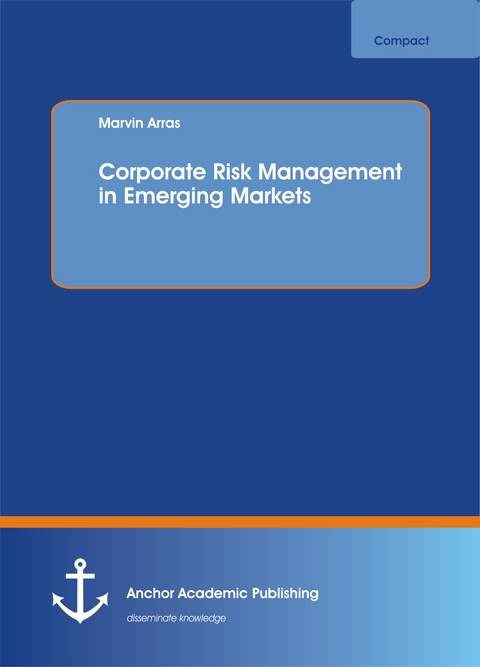
Corporate Risk Management in Emerging Markets
Anchor Academic Publishing (Verlag)
978-3-96067-078-0 (ISBN)
Text sample:Chapter 3. Corporate Risk Management in Emerging Markets:This chapter gives a short definition of EMs and describes their environments. After that the paragraphs deal with (1) the risk management process (2) the measurement of risk and (3) the corporate risk mitigation in EMs in comparison to DMs.3.1 An Introduction of Emerging Markets:3.1.1 Definition of Emerging Markets:Fund manager Antoine van Agtmael invented the phrase 'emerging markets' in 1981 (The Economist, 2008) [85]. At that time, Van Agtmael started a new Third-World Equity Fund and tried to attract more investors by giving it a more positive name (The Economist, 2008) [85]. He explains that "'Third world' suggested stagnation; 'emerging markets' suggested progress, uplift and dynamism" (Van Agtmael, 2007, p. 1) [88].Since the 1980s, the term has established itself in the common language, and it was attempted to give a specific definition by several organisations (The Financial Times, 2015) [86]. Ernst & Young (2007, p. 2) [21] defines EMs in one of its research papers as a "group of low-to-middle income countries pursuing substantial political and economic reform and a more complete integration into the global economy". In accordance to the World Bank definition, low-to-middle-income countries are those with a GNI per capita between $1.045 and $4.125 (The World Bank Group, 2016) [83]. However, the World Bank states on its website that the "use of this classification system does not imply a judgment concerning the development status of any country or territory" (The World Bank Group, 2016) [82].The IMF (International Monetary Fund, 2006) [83], meanwhile, has other criteria to define EMs, although the organisation agrees that countries with a "liberalized (...) financial system" and accessibility for "foreign investors" can be defined as an EM. In accordance to the World Economic Outlook (WEO), the IMF divides the world's economies only in 'advanced economies and emerging market & developing economies' based on (1) GDP per capita income (2) export variance and (3) inhabitants per country (International Monetary Fund, 2015, p. 147) [37]. The IMF publishes a yearly list of countries that are EMs under its definition.To get an impression of which countries are EMs financial institutions have developed groupings. Terms like the BRICS, the EAGLEs and the CIVETS are formed by the first letter of the countries and have appeared in literature and various research papers.In conclusion, Maxwell (2012, p. 36) [51] states in one of his reports that one characteristic of EMs is the fact that they "will continue to enjoy growth that dwarfs that of the developed markets".
| Erscheinungsdatum | 12.10.2016 |
|---|---|
| Sprache | englisch |
| Maße | 155 x 220 mm |
| Gewicht | 86 g |
| Einbandart | Paperback |
| Themenwelt | Wirtschaft ► Betriebswirtschaft / Management ► Allgemeines / Lexika |
| Wirtschaft ► Betriebswirtschaft / Management ► Unternehmensführung / Management | |
| Schlagworte | Corporate exposure • Corporate Risk • Currency Risk • emerging economy • Emerging market • Management • Political Risk • Risk Management • Risk Measurement • risk mitigation |
| ISBN-10 | 3-96067-078-8 / 3960670788 |
| ISBN-13 | 978-3-96067-078-0 / 9783960670780 |
| Zustand | Neuware |
| Informationen gemäß Produktsicherheitsverordnung (GPSR) | |
| Haben Sie eine Frage zum Produkt? |
aus dem Bereich