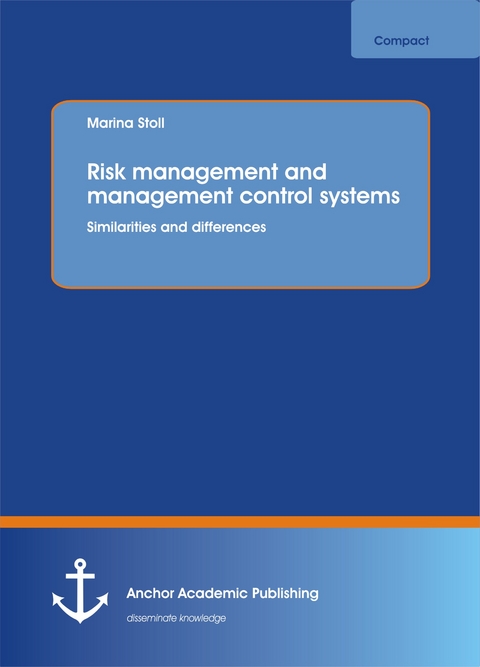
Risk management and management control systems. Similarities and differences
Anchor Academic Publishing (Verlag)
978-3-96067-031-5 (ISBN)
Text sample:Chapter 3.3.2. The main differences:3.3.2.1. Objectives:The basic goal of risk management and management control systems is the same, namely to help the company to achieve its goals, but upon a closer look it can be said that both do this in different ways, both have different sub objectives. First, human resources have two roles in RM: people as a source of risk and people as risk managers being important in handling risks. It can be said that MCSs focus on human resources risks (e.g. fraud), and RM focuses on all kind of risks that can occur in a company, thus RM analyses internal factors as well as external factors, whereas a MCS only analyses internal factors. A report by Deloitte (2008) says that people and their behavior are often the biggest sources of business risk.It can be derived from chapters 2.1. and 2.2. that MCSs aim to control behaviors and RM aims to handle risks. While supporting the company, MCSs try to reduce the probability of employees' behavior that could impact the company in a negative way, so it influences people's behavior, and RM tries to avoid, reduce or transfer negative impacts. Thus, RM has broader objectives than MCSs. One can say that RM contains MCS's objectives, but it is not RM's primary target to control employees and to regulate their behavior.In A method of Integrating Risk and Performance by KPMG (2008, p. 7), it is said that enterprise risk management "is focused on defining and mitigating risk, which means moving from higher to lower risk [and performance management] is focused on seeking higher returns on investment, which can often only result from moving from lower to higher risk". This shows that, even RM and MCSs have a lot a in common, they also may conflict. RM and MCSs could stand in the way of each other, because if limitations implemented through RM are too strict, one's performance could be too low.Another difference concerns the time orientation. An enterprise-wide RM concentrates on strategic, long-term risks, while PMSs draw attention to short-term issues (see Palermo, 2011, p. 4).
| Erscheinungsdatum | 18.06.2016 |
|---|---|
| Zusatzinfo | 9 |
| Sprache | englisch |
| Maße | 155 x 220 mm |
| Gewicht | 67 g |
| Einbandart | Paperback |
| Themenwelt | Wirtschaft ► Betriebswirtschaft / Management ► Allgemeines / Lexika |
| Wirtschaft ► Betriebswirtschaft / Management ► Rechnungswesen / Bilanzen | |
| Wirtschaft ► Betriebswirtschaft / Management ► Unternehmensführung / Management | |
| Schlagworte | Betriebswirtschaftslehre • Betriebswirtschaftslehre (BWL) • BWL • Controlling • Economics • Management Control System • Managementkontrollsystem • Risikomanagement • Risk Management • Wirtschaftwissenschaften |
| ISBN-10 | 3-96067-031-1 / 3960670311 |
| ISBN-13 | 978-3-96067-031-5 / 9783960670315 |
| Zustand | Neuware |
| Informationen gemäß Produktsicherheitsverordnung (GPSR) | |
| Haben Sie eine Frage zum Produkt? |
aus dem Bereich