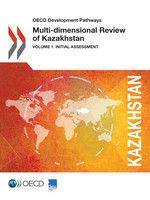
OECD Development Pathways Multi-dimensional Review of Kazakhstan Volume 1. Initial Assessment (eBook)
100 Seiten
OECD Publishing (Verlag)
978-92-64-25092-5 (ISBN)
Kazakhstan’s economy and society have undergone deep transformations since the country declared independence in 1991. Kazakhstan’s growth performance since 2000 has been impressive, averaging almost 8% per annum in real terms and leading to job creation and progress in the well-being of its citizens. Extractive industries play an important role in the dynamism of the economy, but sources of growth beyond natural resource sectors remain underexploited. In the social arena, dimensions of well-being beyond incomes and jobs have not kept pace with economic growth.
Kazakhstan has set itself the goal of becoming one of the 30 most developed countries in the world by 2050. To sustain rapid, inclusive and sustainable growth and social progress, Kazakhstan will need to overcome a number of significant challenges. Natural-resource dependency, the concentration of economic clout and a fragile and underdeveloped financial sector limit diversification and economic dynamism. Widespread corruption still affects multiple state functions, undermines the business environment, meritocracy and entrepreneurial spirit. More generally, the state has limited capacity to fulfil some of its functions, which affects the delivery of public services like health and education, as well as the protection of the environment and the generation of skills.
Kazakhstan's economy and society have undergone deep transformations since the country declared independence in 1991. Kazakhstan's growth performance since 2000 has been impressive, averaging almost 8% per annum in real terms and leading to job creation and progress in the well-being of its citizens. Extractive industries play an important role in the dynamism of the economy, but sources of growth beyond natural resource sectors remain underexploited. In the social arena, dimensions of well-being beyond incomes and jobs have not kept pace with economic growth.Kazakhstan has set itself the goal of becoming one of the 30 most developed countries in the world by 2050. To sustain rapid, inclusive and sustainable growth and social progress, Kazakhstan will need to overcome a number of significant challenges. Natural-resource dependency, the concentration of economic clout and a fragile and underdeveloped financial sector limit diversification and economic dynamism. Widespread corruption still affects multiple state functions, undermines the business environment, meritocracy and entrepreneurial spirit. More generally, the state has limited capacity to fulfil some of its functions, which affects the delivery of public services like health and education, as well as the protection of the environment and the generation of skills.
Chapter 1. Overview: Realising Kazakhstan’s development vision
Kazakhstan’s economy and society have undergone deep transformations since the country declared independence in 1991. The country has adopted an ambitious vision for the year 2050 with the overarching goal of joining the group of the 30 most developed countries. This report is the first output of the Multi-dimensional review (MDCR) of Kazakhstan. The goal of the MDCR of Kazakhstan is to support Kazakhstan in achieving its development objectives by identifying the key constraints to development, providing actionable policy recommendations and supporting the implementation of these recommendations. This chapter contextualises the work of the MDCR by discussing the deep determinants of socio-economic development in Kazakhstan in terms of economic growth and well-being. It goes on to summarise the key findings of the remaining chapters. Finally, it discusses the key development constraints identified in the first phase of the MDCR.
This document is the first report prepared in the context of the Multi-dimensional Country Review (MDCR) of Kazakhstan. The MDCR is undertaken to support Kazakhstan in achieving economic and social development objectives and improving the well-being of its citizens. The MDCR of Kazakhstan is being implemented in three phases, each leading to the production of a report.
This first report aims to identify the binding constraints to achieving sustainable and equitable improvements in well-being and economic growth. The second phase will further analyse the key constraints identified in this report in order to formulate policy recommendations that can be integrated into the development strategy of Kazakhstan. The final phase of the MDCR will provide support to the implementation of these recommendations.
The analysis relies on benchmarking the performance of Kazakhstan against two reference points. The first is a set of comparator countries, selected in consultation with Kazakhstan on the basis of their similarities to Kazakhstan in terms of economic structure and endowments and their history of development. The second is a synthetic benchmark constructed to indicate how the average country would perform across a number of dimensions if it had Kazakhstan’s income per capita.
This introduction highlights the main findings and summarises the key issues and constraints of the first report. It sets out with a discussion of economic developments since independence. It then broadly follows the four thematic chapters of the report by analysing well-being, growth, competitiveness and governance. After an overview of the main determinants which shape the perimeter of future of growth, it concludes by summarising the key constraints that will be the focus of the second stage of the MDCR.
Kazakhstan has undergone deep transformations since independence
Kazakhstan’s society and economy have undergone deep transformations since the country declared independence in 1991. The unstable and disruptive transition period between independence and the turn of the century was ultimately succeeded by a period of high economic growth. Although the country experienced a brief but severe crisis during 2008-09, it recovered quickly and has experienced slower, but more balanced, economic growth since. During this second period, Kazakhstan has intensified its engagement in the global arena.
The country established national economic institutions and started the transition from a centrally planned to a market economy at independence, and the related disruption and economic instability led to a deep recession between 1992 and 1994 and to hyperinflation. Between 1990 and 1995, GDP fell by 36% and inflation rates peaked at 3 060% in 1992. While the country was recovering, it was hit by the fallout of the Russian financial crisis of 1998. The deep disturbance in the economy led to the destruction of 1.6 million jobs during the 1990s.
Since recovering in 2000, Kazakhstan’s growth performance has been impressive, averaging almost 8% per annum in real terms between 2000 and 2013 despite a considerable slowdown during the crisis. This growth acceleration has to a large extent been driven by the oil and gas sector, since production, which expanded dramatically between 1998 and 2007, and prices were high in most years of the period. During this period of high growth, income poverty fell dramatically from 47% to 2% of the population as unemployment fell to 5% in 2013.
The trends since independence have led to a transformation of the economy away from agriculture and towards extractive industries. The share of industry in value added rose from 20% in 1990 to a maximum of 33% in 2010, largely driven by the growth of the oil, gas and mining sectors from 8% of value added in 1998 to 20% in 2010. Employment has also shifted from agriculture, the share of which fell from 35% to 24% between 2001 and 2014, and towards services, which provide 56% of jobs, and construction, the share of which rose from 4% to 8% over the decade.
The period since independence was also marked by significant social transformation. During the transition period, massive emigration of ethnic Russians, Germans and Slavs led the population of Kazakhstan to fall from 16.5 million in 1991 to 14.9 million in 2000. At the same time, Kazakhstan welcomed significant numbers of ethnic Kazakh immigrants (oralmans), profoundly transforming the composition of society. During the same period fertility plummeted, falling from 3.16 births per woman in 1987 to 1.76 in 1999, while out-of-marriage births increased from 13% to 26%, signalling an evolution in cultural norms. During the 2000s, the downward trend of fertility was reversed, but the rate stabilised at 2.5, largely below pre-independence levels. Similarly, marriage patterns recovered partially while age at marriage continued on an upward trend.
Since independence, Kazakhstan has been engaged in a process of state-building and construction of a national identity strongly influenced by Kazakh symbolism and values. The inflow of ethnic Kazakh migrants and the increasing importance of the Kazakh language were important components of this process. During the bonanza of the 2000s, state-building progressed steadily with a strong focus on technocratic management and greater balance between the preponderance of Kazakh culture and language and the construction of a civic Kazakhstani identity.
State-owned companies and large conglomerates dominate the business landscape in Kazakhstan. Privatisation in Kazakhstan began as early as 1991. In spite of the rapid privatisation of small scale assets and businesses, by 1996, only 35% of gross domestic product (GDP) came from the private sector. Public and state-owned entities still account for 30% to 40% of GDP at present. Moreover, the first wave of privatisations gave rise to large firms headed by powerful businessmen who extended their range of operations into diversified holding companies.
Structural determinants of growth
The economic history of Kazakhstan since independence has been marked by strong external forces which also shape current growth perspectives. Kazakhstan’s oil production accelerated from 1998, with crude prices at historical lows (below USD 20) and increased as prices were multiplied by seven in ten years before their fall in the midst of the 2007/08 financial crisis. The future will also be marked by the evolving significance of its geographical position and by key structural factors. Being landlocked makes Kazakhstan dependent on its neighbours for the efficiency of logistics networks. However, growth in the People’s Republic of China since 1990 and significant regional and transcontinental projects such as the Eurasian Customs Union and the New Silk Road offer new opportunities for Kazakhstan’s development.
Geopolitical factors can heavily influence future economic developments in Kazakhstan. Trade ties with the Russian Federation are strong and further sustained by the creation of the Eurasian Economic Union (EEU) in January 2015. The creation of the EEU has the potential to boost regional trade but also further exposes Kazakhstan to economic developments in Russia. Price competitiveness suffered from the depreciation of the Russian ruble, leading to an expansion of the band in which the tenge (KZT) was allowed to fluctuate. Moreover, around 50% of Kazakhstan’s exports are sold to European Union (EU) countries, most of which pass through Russia and are likely to be affected by trade disputes between Russia and the EU. To the east, trade with China has been flourishing, with non-oil exports expanding by around 20% per annum, and Chinese growth in the 2000s played an important role in sustaining high prices for primary exports. However, the slowdown in China’s growth is reducing prices and demand for natural resources, with lower export growth for Kazakhstan as a result.
Kazakhstan faces a unique demographic situation which is likely to pose a challenge to performance in a number of well-being dimensions in the medium term. The dependency ratio is expected to rise from 46% to between 55% and 60% by 2020 and then remain at such levels for a significant period of time (up to 2100 according to UN population estimates). This is the result of the massive population movements of the early 1990s. The smaller cohorts born during those years will arrive on the labour market at the same time as the baby boom generation of the post-World War II era retires, causing an increase in dependency ratios. However, as newer, larger generations reach working age, they will compensate for the gradual ageing of the population which will stabilise the dependency ratio. The rapid increase in the share...
| Erscheint lt. Verlag | 14.1.2016 |
|---|---|
| Sprache | englisch |
| Themenwelt | Wirtschaft ► Volkswirtschaftslehre ► Makroökonomie |
| ISBN-10 | 92-64-25092-1 / 9264250921 |
| ISBN-13 | 978-92-64-25092-5 / 9789264250925 |
| Informationen gemäß Produktsicherheitsverordnung (GPSR) | |
| Haben Sie eine Frage zum Produkt? |
 EPUB (Adobe DRM)
Kopierschutz: Adobe-DRM
Adobe-DRM ist ein Kopierschutz, der das eBook vor Mißbrauch schützen soll. Dabei wird das eBook bereits beim Download auf Ihre persönliche Adobe-ID autorisiert. Lesen können Sie das eBook dann nur auf den Geräten, welche ebenfalls auf Ihre Adobe-ID registriert sind.
Details zum Adobe-DRM
Dateiformat: EPUB (Electronic Publication)
EPUB ist ein offener Standard für eBooks und eignet sich besonders zur Darstellung von Belletristik und Sachbüchern. Der Fließtext wird dynamisch an die Display- und Schriftgröße angepasst. Auch für mobile Lesegeräte ist EPUB daher gut geeignet.
Systemvoraussetzungen:
PC/Mac: Mit einem PC oder Mac können Sie dieses eBook lesen. Sie benötigen eine
eReader: Dieses eBook kann mit (fast) allen eBook-Readern gelesen werden. Mit dem amazon-Kindle ist es aber nicht kompatibel.
Smartphone/Tablet: Egal ob Apple oder Android, dieses eBook können Sie lesen. Sie benötigen eine
Geräteliste und zusätzliche Hinweise
Buying eBooks from abroad
For tax law reasons we can sell eBooks just within Germany and Switzerland. Regrettably we cannot fulfill eBook-orders from other countries.
aus dem Bereich