


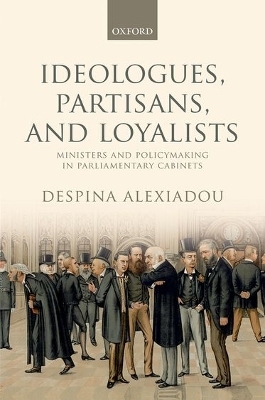
Ideologues, Partisans, and Loyalists
Ministers and Policymaking in Parliamentary Cabinets
Seiten
2016
Oxford University Press (Verlag)
978-0-19-875571-5 (ISBN)
Oxford University Press (Verlag)
978-0-19-875571-5 (ISBN)
This book challenges assumptions made in literature on representative democracy and argues that cabinet ministers can have very important policy role as policy agenda setters. The book answers questions about the role of the individual in the policy-making process, and shows that the process of ministerial selection is critical to policy-making.
For the past thirty years scholars have debated the role of political parties in fiscal, monetary, and social welfare policies. Some argue that Social Democratic parties are more committed to advancing and maintaining welfare protection, while others claim that party ideology has ceased to explain parties' policy choices due to the constraining forces of economic globalization, deindustrialization, and electoral volatility. Indeed, the empirical findings in support of partisan arguments are mixed. Much of this rich literature treats political parties as uniform and cohesive entities when it comes to forming government policy.
Ideologues, Partisans, and Loyalists challenges this assumption and advances the argument that ideology and partisan policy preferences play a major role in policy choices, yet they are not necessarily observable at the government or even at the party level. Instead, we often need to look at the individual level -- particularly at the cabinet minister who is in charge of the policy in question to predict policy outcomes.
Ideologues, Partisans, and Loyalists innovatively argues that cabinet ministers can have very important policy role as policy agenda setters. Yet, not all ministers are equally effective policy-makers. Some make a difference, while others do not. Loyalists are loyal to their party leader and prioritize office over policy; partisans are party heavyweights and aspiring leaders; and ideologues have fixed policy ideas and are unwilling to compromise for the perks of holding office. Only ideologues and partisans can effectively change social welfare and labour market policy, above and beyond what their government mandates.
For the past thirty years scholars have debated the role of political parties in fiscal, monetary, and social welfare policies. Some argue that Social Democratic parties are more committed to advancing and maintaining welfare protection, while others claim that party ideology has ceased to explain parties' policy choices due to the constraining forces of economic globalization, deindustrialization, and electoral volatility. Indeed, the empirical findings in support of partisan arguments are mixed. Much of this rich literature treats political parties as uniform and cohesive entities when it comes to forming government policy.
Ideologues, Partisans, and Loyalists challenges this assumption and advances the argument that ideology and partisan policy preferences play a major role in policy choices, yet they are not necessarily observable at the government or even at the party level. Instead, we often need to look at the individual level -- particularly at the cabinet minister who is in charge of the policy in question to predict policy outcomes.
Ideologues, Partisans, and Loyalists innovatively argues that cabinet ministers can have very important policy role as policy agenda setters. Yet, not all ministers are equally effective policy-makers. Some make a difference, while others do not. Loyalists are loyal to their party leader and prioritize office over policy; partisans are party heavyweights and aspiring leaders; and ideologues have fixed policy ideas and are unwilling to compromise for the perks of holding office. Only ideologues and partisans can effectively change social welfare and labour market policy, above and beyond what their government mandates.
Despina Alexiadou is an Assisant Professor at teh University of Pittsburgh. She received her PhD from the European University Institute in Florence, Italy and was an ESRC Postdoctoral Fellow at Warwick University.
1. Introduction ; 2. Theory ; 3. Who are the Ministers? ; 4. Appointing Ideologues, Partisans, and Loyalists ; 5. Social Welfare Policies ; 6. Employment Policies ; 7. Ireland ; 8. The Netherlands ; 9. Greece ; 10. Conclusions
| Verlagsort | Oxford |
|---|---|
| Sprache | englisch |
| Maße | 162 x 235 mm |
| Gewicht | 558 g |
| Themenwelt | Sozialwissenschaften ► Politik / Verwaltung ► Politische Systeme |
| Sozialwissenschaften ► Politik / Verwaltung ► Politische Theorie | |
| Sozialwissenschaften ► Politik / Verwaltung ► Staat / Verwaltung | |
| Sozialwissenschaften ► Politik / Verwaltung ► Vergleichende Politikwissenschaften | |
| Wirtschaft | |
| ISBN-10 | 0-19-875571-6 / 0198755716 |
| ISBN-13 | 978-0-19-875571-5 / 9780198755715 |
| Zustand | Neuware |
| Informationen gemäß Produktsicherheitsverordnung (GPSR) | |
| Haben Sie eine Frage zum Produkt? |
Mehr entdecken
aus dem Bereich


aus dem Bereich
Das politische System der USA und die Zukunft der Demokratie
Buch | Hardcover (2025)
C.H.Beck (Verlag)
CHF 39,20
Russland, Europa, Amerika
Buch | Softcover (2025)
C.H.Beck (Verlag)
CHF 25,20


