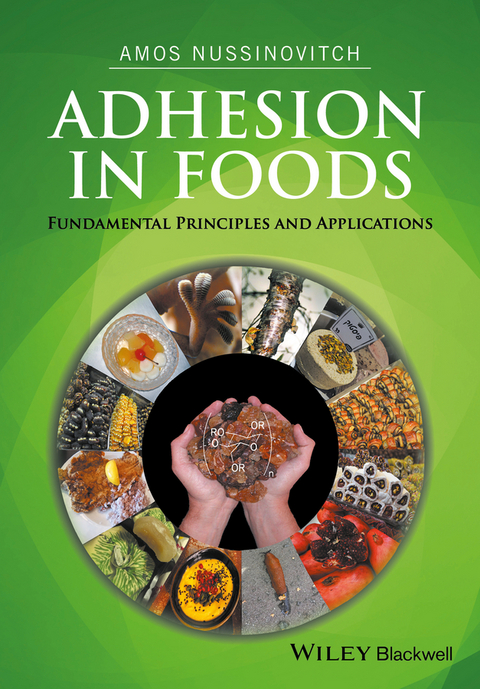
Adhesion in Foods (eBook)
John Wiley & Sons (Verlag)
978-1-118-85160-9 (ISBN)
To the layman, adhesion is a simple matter of how well two different materials stick together, and adhesion measurements provide some indication of the force required to separate them. However, a more detailed look at adhesion shows that it is a very important feature of food throughout its manufacturing, packaging and storage.
Chapters are fully devoted to the fascinating topic of adhesion in foods. Key features of the book include, but are not limited to: definition and nomenclature of adhesion; adhesion mechanisms and measurements; stickiness in various foods and its relation to technological processes; perception of stickiness; hydrocolloids as adhesive agents for foods; adhesion phenomena in coated, battered, breaded and fried foods; electrostatic adhesion in foods; multilayered adhered food products, and adhesion of substances to packaging and cookware.
Adhesion in Foods: Fundamental Principles and Applications is dedicated not only to the academic community but also to the broader population of industrialists and experimentalists who will find it to be not only a source of knowledge, but also a launching pad for novel ideas and inventions. In particular, this book is expected to be of interest to personnel involved in food formulation, food scientists, food technologists, industrial chemists and engineers, and those working in product development.
To the layman, adhesion is a simple matter of how well two different materials stick together, and adhesion measurements provide some indication of the force required to separate them. However, a more detailed look at adhesion shows that it is a very important feature of food throughout its manufacturing, packaging and storage. Chapters are fully devoted to the fascinating topic of adhesion in foods. Key features of the book include, but are not limited to: definition and nomenclature of adhesion; adhesion mechanisms and measurements; stickiness in various foods and its relation to technological processes; perception of stickiness; hydrocolloids as adhesive agents for foods; adhesion phenomena in coated, battered, breaded and fried foods; electrostatic adhesion in foods; multilayered adhered food products, and adhesion of substances to packaging and cookware. Adhesion in Foods: Fundamental Principles and Applications is dedicated not only to the academic community but also to the broader population of industrialists and experimentalists who will find it to be not only a source of knowledge, but also a launching pad for novel ideas and inventions. In particular, this book is expected to be of interest to personnel involved in food formulation, food scientists, food technologists, industrial chemists and engineers, and those working in product development.
Professor Amos Nussinovitch, Department of Biochemistry, Food Science and Nutrition, The Robert H. Smith Faculty of Agriculture, Food and Environment, The Hebrew University of Jerusalem, Rehovot, Israel.
About the Author ix
Acknowledgments xi
Outline xiii
1 Adhesion: Definition and Nomenclature 1
1.1 Introduction 1
1.2 Adhesives--a Brief Historical Viewpoint 1
1.3 Nomenclature and Definitions of Adhesion Terms 6
1.4 Concluding Remarks 11
References 12
2 Adhesion Mechanisms and Measurements 17
2.1 Introduction 17
2.2 The Phenomenon of Adhesion 17
2.3 Methods of Determining Adhesion of Food Materials 27
2.4 Adhesion Strength Measurements 29
2.5 Wettability 30
References 39
3 Stickiness of Foods and Its Relation to Technological Processes 47
3.1 Introduction 47
3.2 Dough Properties and Stickiness 47
3.3 Cookies, Breads, Cakes, and Pasta 49
3.4 Stickiness of Rice 54
3.5 Fruit Powders 57
3.6 Stickiness of Milk Powders 59
3.7 Cereal Products 60
3.8 Relations Between Technological Processes and Stickiness 61
References 65
4 Perception of Stickiness 75
4.1 Introduction 75
4.2 Collection and Classification of Words for Descriptions of Food Texture 75
4.3 Principles of Objective Measurements of Stickiness 77
4.4 The Problematic Nature of Instrumental Determinations 78
4.5 Perception of Stickiness in Oil?-in?-Water Dairy Emulsions 79
4.6 Stickiness of Dispersions, Semi?-solids, and Sugar?-rich Foods 80
4.7 Changes in Sensory Stickiness Perception with Age 84
References 88
5 Hydrocolloids as Adhesive Agents in Foods 93
5.1 Introduction 93
5.2 Food Uses and Applications of Adhesives 93
5.3 Hydrogel-Adherend Relationships and Structure-Function Issues 94
5.4 Hydrocolloid Adhesion Tests 96
5.5 Hydrocolloids as Wet Glues 98
5.6 Hydrocolloids as Adhesives in Foods 100
5.7 Hydrocolloid Adhesion: Future Prospects and Possible Developments 109
References 110
6 Adhesion Phenomena in Coated, Battered, Breaded, and Fried Foods 115
6.1 Introduction 115
6.2 A Few Definitions 115
6.3 Enrobing Processes 118
6.4 Types of Batter and Their Use in Different Products 119
6.5 Breaded Products 128
6.6 New Batters and Breadings 131
References 132
7 Electrostatic Adhesion in Foods 137
7.1 Introduction 137
7.2 Technology of Electrostatic Powder Spraying 137
7.3 Adhesion of Food Powders onto Food Products 140
7.4 Adhesion of Sodium Chloride and Its Effect on Coating 143
7.5 Other Food?-Related Uses of Electrostatic Adhesion 147
References 152
8 Multilayered Adhered Food Products 159
8.1 Introduction 159
8.2 Multilayered Hydrocolloid?-Based Foodstuffs 159
8.3 Stiffness and Compressive Deformabilities of Multilayered Texturized Fruits and Gels 160
8.4 Other Edible Multilayered Hydrocolloid Products 161
8.5 Layered Cellular Solids 164
8.6 Future Biotechnological Potential Uses of Multilayered Gels 165
8.7 Methods to Estimate Properties of Multilayered Products 167
8.8 Current Systems and Methods to Prepare Multilayered Products 168
8.9 Problems Related to Multilayered and Colored Products 169
References 174
9 Adhesion of Substances to Food Packages and Cookware 179
9.1 Wetting Properties of Food Packaging 179
9.2 Adhesion of Fermented Dairy Products to Packaging Materials 182
9.3 Active Food Packaging and Bacterial Adhesion 184
9.4 Antimicrobial Food Packaging 185
9.5 Protein Adsorption to Processing Surfaces 187
9.6 Adhesion of Edible Oils to Food?-Contact Surfaces 188
9.7 Microorganism Adhesion to and Oil Removal from Modified Surfaces 188
9.8 Aspects of Non?-stick Coatings for Cookware 190
References 192
Index 199
Outline
An adhesive is most simply described as a substance that causes one body to stick or adhere to another. The oldest adhesives were almost certainly fish or bone glues and these have been in use for many thousands of years. Due to the importance of glues and adhesion, the libraries are full of excellent books on the topic, covering: adhesion; adhesion molecules; adhesion of pathogens and bacteria; adhesion technology; fundamentals of adhesion; adhesion related to medicine and in health and disease; surface treatment and adhesion; adhesion of cells, viruses, and nanoparticles; adhesion and adhesives; adhesion promotion techniques; adhesion measurement methods; adhesion of dust and powder; adhesion and bonding in composites; and adhesion measurements of films and coatings, to name but a few.
Adhesion is a very important feature in food throughout its manufacturing, packaging, and storage. Nevertheless, to the best of our knowledge, there is not even one published manuscript that is fully devoted to food adhesion. During many years of research and development at the Hebrew University of Jerusalem and in the industry, I have been involved in studying hydrocolloid wet glues, adhesion related to edible coatings, adhesion in the manufacturing of multilayered food products, pressure‐sensitive adhesives, and tests to check adhesion in foods. Furthermore, I have written several chapters on adhesion related to hydrocolloids, foods, and specialized adhered textures in both my previous books and those of others. The following proposed manuscript outline consists of chapters that are all devoted to the fascinating topic of adhesion in foods.
Chapter 1: Adhesion: Definition and Nomenclature
To the layman, adhesion is a simple matter of how well two different materials stick together, and adhesion measurements provide some indication of the force required to separate them. This chapter will steer the reader to a more scientific definition of adhesion that can be useful for a variety of purposes. Also included are comments on nomenclature and usage and a short review of the history of adhesion.
Chapter 2: Adhesion Mechanisms and Measurements
Mechanisms involved in materials' adhesive processes are related to many fields, including mechanics, thermodynamics, and chemistry. Many theories have been developed to explain adhesion. These include mechanical interlocking, wetting and thermodynamic adsorption, electrostatic adhesion, diffusion, chemical adhesion, and weak boundary layers, and they are all briefly reviewed in this chapter. An overview of useful adhesion‐evaluation methods is also provided, among them weighing, UV absorbance measurements, and adhesive loss measurements. In addition, adhesion strength measurements are reviewed, as well as destructive and non‐destructive methods related to mechanical testing of adhesive joints by tensile test, shear test, and peel test. These tests can be regarded as static tests. Other adhesive tests are also described, including dynamic loading, creep, impact, and fatigue.
Chapter 3: Stickiness of Foods and its Relation to Technological Processes
Stickiness is a common characteristic of foods. This chapter gives examples of stickiness in different food types. These include, but are not limited to, stickiness of dough and rice, sticky sweets, stickiness in sugar‐rich foods—soft cookies, toffees, and dried fruit—and in some dishes, such as sticky toffee pudding, stickiness of pasta through cooking, stickiness of semi‐solid foods and food powders, stickiness of non‐fat processed cheeses, jams, food powders, and jaggery granules. This chapter also provides a general introduction to other chapters in which various types of food stickiness/adhesion are discussed in more depth. The relationships between technological processes and stickiness are also described, for example, in spray‐drying and freeze–thawing processes with food products, and in the milk industry.
Chapter 4: Perception of Stickiness
In word‐association tests with consumers, sticky was the fourth most frequent word used by a panel of 30 university students, and was strongly positively correlated with thick and viscous, and negatively correlated with thin and runny. Stickiness consequently appears to be a readily identifiable textural attribute in foods, but one that is not a major determinant of consumer appeal. It may have an important secondary effect as a negative hedonic factor under certain circumstances, if levels become excessive. This chapter will deal with the perception of stickiness, what affects sensory stickiness, and the correlation of consumer rating of stickiness with objective measurements.
Chapter 5: Hydrocolloids as Adhesive Agents in Foods
The adhesive properties of many hydrocolloids (gums) have been known for centuries. The word gum means a sticky substance, and has been defined as such. A large number of hydrocolloids have been mentioned in the literature as adhesive agents, and they are briefly mentioned throughout this chapter. Except for individual gums that can be used as is or in adhesives, mixtures of gums and their adhesive potential will also be described for their role in the food and other industries. Special emphasis will be placed on protein hydrocolloids and gum exudates as adhesive agents in foods.
Chapter 6: Adhesion Phenomena in Coated, Battered, Breaded, and Fried Foods
Battered and breaded foods represent a fast‐growing category in most high‐convenience consumer societies. As a result, the per capita consumption of battered and breaded foods is on the rise, as is the annual volume of formulated batters and breadings produced. Moreover, battered and breaded foods are becoming quite common in developing countries. This chapter deals with the effects of ingredients used in batters on the adhesion characteristics of deep‐fat‐fried products, adhesion in fried battered nuggets, performance of different hydrocolloids as pre‐dusts, effect of proteins in improving adhesion in deep‐fat‐fried products, new batters and breadings, the influence of freeze–thaw cycles and the presence of phosphate on the adhesion of commercially produced batter fry coatings to frozen products, and the effect of freezing on breading adhesion.
Chapter 7: Electrostatic Adhesion in Foods
Electrostatic adhesion is a significant force in the paint and other industries. Nevertheless, food coating involves powders and targets with properties that are far from ideal for electrostatic coating. In addition, the adhesion must be long‐lasting to be useful. This chapter explores the significance of electrostatic adhesion in food coating. The discussion includes descriptions of a range of food powders that have been coated on different kinds of foods electrostatically and non‐electrostatically, and the measured adhesion. In addition, the correlation between effectiveness of the process and resistivity or oil content of the target, resistivity of the powder, and particle size will be explained. Finally, the influence of low relative humidity on electrostatic adhesion will be described in detail.
Chapter 8: Multilayered Adhered Food Products
A simple way of achieving different textures and tastes in the same bite is to construct a food product made of different layers. The chapter starts by describing a few such multilayered products. It also describes how these layers are adhered together, and how some of the mechanical properties of the layered array can be estimated from the properties of the individual layers. The chapter will also focus on different adhesion techniques for multilayered gels and on the adhesion‐strength characteristics of double‐layered gels. A small part of the chapter will discuss these techniques as unique for future products in the food industry and for the development of novel foods and cooking.
Chapter 9: Adhesion of Substances to Food Packages and Cookware
The sticking of foods to their packaging is generally regarded as undesirable, resulting in possible damage to the packing material, product loss, and disfigurement of the product surface. It can be surmised that the extent to which this generates an adverse consumer reaction will depend on the extent of the sticking, on the type and cost of the product, and on the availability of alternative product packaging combinations. Adhesion of oils and fatty food products to packages is an important storage problem, because it increases product–package interactions that alter quality. Reducing such adhesion would reduce the costs of recycling and cleaning processes. The aim of this chapter is to demonstrate that some thermodynamic adhesion models are correlated to edible oils’ bulk adhesion as measured experimentally. Models of adhesion will be described for their ability to calculate a solid’s surface tension and the thermodynamic work of adhesion.
This book is designed to serve as a guide for those who want to introduce the fascinating world of food adhesives to the public. It is expected to serve as a useful addition to the traditional libraries of universities and research institutes where food science, food chemistry, life sciences, and other practical and theoretical industrial issues are taught and studied. In this sense, the book is unique, and I am confident that it will be a great success. My hope is that this book will assist all levels of readers. It is dedicated not only to the academic...
| Erscheint lt. Verlag | 3.11.2016 |
|---|---|
| Sprache | englisch |
| Themenwelt | Naturwissenschaften ► Biologie |
| Technik ► Lebensmitteltechnologie | |
| Weitere Fachgebiete ► Land- / Forstwirtschaft / Fischerei | |
| Schlagworte | Food adhesion, Adhesion mechanisms, Adhesion measurements, Stickiness in foods, Perception of stickiness, Hydrocolloids, Adhesive agents, Electrostatic adhesion, Multilayered foods, Food packages • Food chemistry • food engineering • Food Processing, Production & Manufacture • Food Science & Technology • Herstellung u. Verarbeitung von Lebensmitteln • Lebensmittelchemie • Lebensmittelforschung u. -technologie • Lebensmitteltechnik |
| ISBN-10 | 1-118-85160-9 / 1118851609 |
| ISBN-13 | 978-1-118-85160-9 / 9781118851609 |
| Informationen gemäß Produktsicherheitsverordnung (GPSR) | |
| Haben Sie eine Frage zum Produkt? |
 EPUB (Adobe DRM)
Kopierschutz: Adobe-DRM
Adobe-DRM ist ein Kopierschutz, der das eBook vor Mißbrauch schützen soll. Dabei wird das eBook bereits beim Download auf Ihre persönliche Adobe-ID autorisiert. Lesen können Sie das eBook dann nur auf den Geräten, welche ebenfalls auf Ihre Adobe-ID registriert sind.
Details zum Adobe-DRM
Dateiformat: EPUB (Electronic Publication)
EPUB ist ein offener Standard für eBooks und eignet sich besonders zur Darstellung von Belletristik und Sachbüchern. Der Fließtext wird dynamisch an die Display- und Schriftgröße angepasst. Auch für mobile Lesegeräte ist EPUB daher gut geeignet.
Systemvoraussetzungen:
PC/Mac: Mit einem PC oder Mac können Sie dieses eBook lesen. Sie benötigen eine
eReader: Dieses eBook kann mit (fast) allen eBook-Readern gelesen werden. Mit dem amazon-Kindle ist es aber nicht kompatibel.
Smartphone/Tablet: Egal ob Apple oder Android, dieses eBook können Sie lesen. Sie benötigen eine
Geräteliste und zusätzliche Hinweise
Buying eBooks from abroad
For tax law reasons we can sell eBooks just within Germany and Switzerland. Regrettably we cannot fulfill eBook-orders from other countries.
aus dem Bereich