


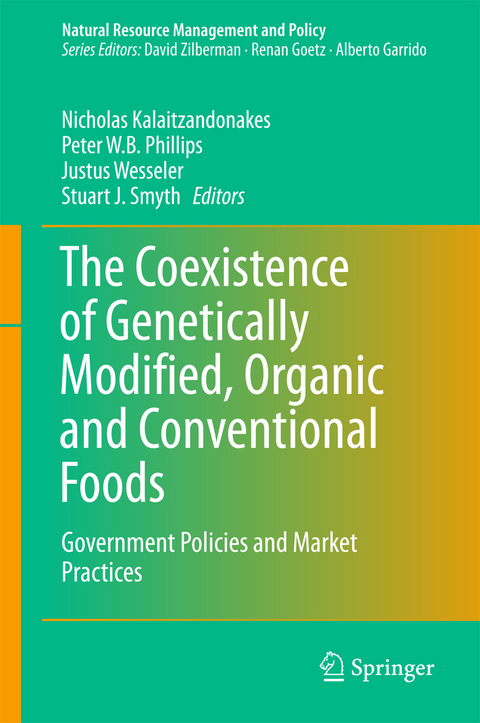
The Coexistence of Genetically Modified, Organic and Conventional Foods (eBook)
XII, 426 Seiten
Springer New York (Verlag)
978-1-4939-3727-1 (ISBN)
Nicholas Kalaitzandonakes is the MSMC Endowed Professor of Agribusiness Strategy and the Director of the Economics and Management of Agrobiotechnology Center (EMAC) at the University of Missouri. His research, teaching and outreach focus on the economics and policy of agrifood biotechnology and other agribusiness innovations.
Since their commercial introduction in 1996, genetically modified (GM) crops have been adopted by farmers around the world at impressive rates. In 2011, 180 million hectares of GM crops were cultivated by more than 15 million farmers in 29 countries. In the next decade, global adoption is expected to grow even faster as the research pipeline for new biotech traits and crops has increased almost fourfold in the last few years. The adoption of GM crops has led to increased productivity, while reducing pesticide use and the emissions of agricultural greenhouse gases, leading to broadly distributed economic benefits across the global food supply chain. Despite the rapid uptake of GM crops, the various social and economic benefits as well as the expanding rate innovation, the use of GM crops remains controversial in parts of the world. Despite the emergence of coexistence between GM, organic and conventional crops as a key policy and practical issue of global scale, there isno coherent literature that addresses it directly. Governments and market stakeholders in many countries are grappling with policy alternatives that settle conflicting property rights, minimize negative market externalities and associated liabilities, maximize the economic benefits of innovation and allow producer and consumer choice. This book intends to fill these needs with contributions from the top theoreticians, legal and economic analysts, policy makers and industry practitioners in the field. As the economics and policy of coexistence start to emerge as an separate subfield in agricultural, environmental and natural resource economics with an increasing number of scholars working on the topic, the book will also provide a comprehensive base in the literature for those entering the area, making it of interest to students, scholars and policy-makers alike.
Nicholas Kalaitzandonakes is the MSMC Endowed Professor of Agribusiness Strategy and the Director of the Economics and Management of Agrobiotechnology Center (EMAC) at the University of Missouri. His research, teaching and outreach focus on the economics and policy of agrifood biotechnology and other agribusiness innovations.Peter W.B. Phillips is Distinguished Professor of Public Policy in the Johnson-Shoyama Graduate School of Public Policy at the University of Saskatchewan, Canada. He undertakes research on governing transformative innovation, including regulation and trade policy.Justus Wesseler is Professor and Head of Group Agricultural Economics and Rural Policy in the Social Science Department at Wageningen University, The Netherlands. He undertakes research on the contribution of the bio-economy value chain to sustainable development.Stuart Smyth is an Assistant Professor and holds the Industry Chair in Agri-Food Innovation in the Department of Agricultural and Resource Economics at the University of Saskatchewan, Canada. His research focuses on the sustainability and farm level impacts of genetically modified crops.
1. Introduction.- 2. The Science of Gene Flow in Agriculture and Its Role in Coexistence.- 3. Developing Market Driven Standards for Coexistence: Tolerances, Thresholds, and Other Technical Standards Used by the Seed Industry.- 4. Economic and Legal Principles of Coexistence Policy in North America.- 5. Organic Label Rules And Market Tensions: The Challenge of Satisfying Buyers.- 6. Developing Solutions for Coexistence in the EU - Legal, Technical, and Economic Issues.- 7. The Principle(S) of Co-Existence in the Market for GMOs in Europe: Social, Economic And Legal Avenues.- 8. Coexistence In Brazil.- 9. What Can We Learn about Coexistence from Commercial Non-GM Programs in the US?.- 10. Lessons from the Legal Cases of GM Alfalfa And Sugar Beet Deregulation tn the United States.- 11.Organic Versus GM Agriculture in The Courtroom in Australia and the USA.- 12. Coexistence – Under-Explored Facets for a USDA Policy.- 13. The “Honey” Judgment Of Bablok and Others Vs. Freistaat Bayern in the Court Of Justice of the European Union: Implications For Coexistence.- 14.The Canadian And European Union Impacts From The Detection of GM Flax.- 15.Consequences Of Adventitious Presence Of Non-Approved GMOs In Seeds: The Case Of Maize Seeds in Germany.- 16. Commercialization Strategies And Market Opportunities for GM Canola.- 17. Regulatory Lags For Genetically Modified Crops: Legal and Political Perspectives.- 18.Regulatory Approval Asynchrony, LLP, and Implications for Biotech R&D And Innovation.- 19.The Economic Impacts of Regulatory Delays: The Case of HT Soybeans.- 20. Potential Economic Impacts of Low Level Presence (Ll) in the Global Wheat Market.- 21. Potential Economic Impacts of Asynchronous Approvals Of Biotech Crops on South Korea.- 22. Low Level Presence and Asynchronous Authorizations of Genetically Modified Products In China.- 23. Asynchronous Approvals And The Low Level Presence Of Unapproved GM Products In Imports: How “Tolerant” Should Small Countries Be?.- 24. Low Level Presence Under The WTO.- 25. Forging the Future of LLP: Building An International Coalition And Developing A National LLP Policy.- 26. Market Solutions To Coexistence And Regulatory Asynchrony.- 27. Coexistence Of Genetically Modified, Conventional, And Organic Food Products: A Framework And Analysis.- 28. The Cost of a GMO-Free Market Basket Of Food In The US.- 29. Lessons From Eu Voluntary Labeling Schemes for GM-Free Processed Food Products.- 30. Welfare And Co-Existence.- 31. GM Maize in Mexico: The Challenge of Coexistence in a Centre Of Origin.- 32. Conclusions and Synthesis.
| Erscheint lt. Verlag | 18.10.2016 |
|---|---|
| Reihe/Serie | Natural Resource Management and Policy | Natural Resource Management and Policy |
| Zusatzinfo | XII, 426 p. 46 illus., 38 illus. in color. |
| Verlagsort | New York |
| Sprache | englisch |
| Themenwelt | Sozialwissenschaften ► Politik / Verwaltung ► Staat / Verwaltung |
| Technik | |
| Wirtschaft ► Betriebswirtschaft / Management | |
| Wirtschaft ► Volkswirtschaftslehre | |
| Weitere Fachgebiete ► Land- / Forstwirtschaft / Fischerei | |
| Schlagworte | Coexistence • crops • farming • Food Supply Chain • genetically modified • organic |
| ISBN-10 | 1-4939-3727-8 / 1493937278 |
| ISBN-13 | 978-1-4939-3727-1 / 9781493937271 |
| Informationen gemäß Produktsicherheitsverordnung (GPSR) | |
| Haben Sie eine Frage zum Produkt? |
 PDF (Wasserzeichen)
DRM: Digitales Wasserzeichen
Dieses eBook enthält ein digitales Wasserzeichen und ist damit für Sie personalisiert. Bei einer missbräuchlichen Weitergabe des eBooks an Dritte ist eine Rückverfolgung an die Quelle möglich.
Dateiformat: PDF (Portable Document Format)
Mit einem festen Seitenlayout eignet sich die PDF besonders für Fachbücher mit Spalten, Tabellen und Abbildungen. Eine PDF kann auf fast allen Geräten angezeigt werden, ist aber für kleine Displays (Smartphone, eReader) nur eingeschränkt geeignet.
Systemvoraussetzungen:
PC/Mac: Mit einem PC oder Mac können Sie dieses eBook lesen. Sie benötigen dafür einen PDF-Viewer - z.B. den Adobe Reader oder Adobe Digital Editions.
eReader: Dieses eBook kann mit (fast) allen eBook-Readern gelesen werden. Mit dem amazon-Kindle ist es aber nicht kompatibel.
Smartphone/Tablet: Egal ob Apple oder Android, dieses eBook können Sie lesen. Sie benötigen dafür einen PDF-Viewer - z.B. die kostenlose Adobe Digital Editions-App.
Buying eBooks from abroad
For tax law reasons we can sell eBooks just within Germany and Switzerland. Regrettably we cannot fulfill eBook-orders from other countries.
aus dem Bereich


