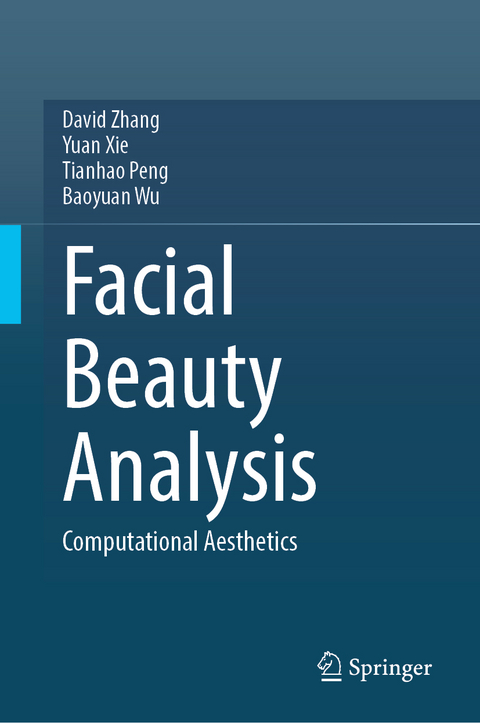
Facial Beauty Analysis
Springer Verlag, Singapore
978-981-95-6143-8 (ISBN)
- Titel nicht im Sortiment
- Artikel merken
By combining principles from computer vision, pattern recognition, machine learning, and deep learning, this book provides comprehensive insights into landmark detection, feature extraction, beauty prediction, and facial attractiveness enhancement. It introduces cutting-edge innovations such as geometric prior guided hybrid deep neural networks, GAN-based facial beautification, and 3D facial beauty analysis, ensuring readers are equipped with the latest advancements. The content is thoughtfully crafted to empower readers with both foundational concepts and the latest tools required to stay ahead in this rapidly evolving domain.
Targeted toward researchers, professionals, and graduate students, “Facial Beauty Analysis: Computational Aesthetics,” aims to systematically cover both 2D and 3D facial beauty analysis, providing comprehensive insights into feature extraction, beauty prediction, and facial enhancement. This book offers both foundational knowledge and cutting-edge methodologies to advance the field of facial beauty analysis. Whether you’re exploring the fundamentals or seeking to apply the latest technologies, this book is a valuable asset for anyone dedicated to advancing the field of facial beauty analysis.
David Zhang (Life Fellow, IEEE) graduated from Peking University, Beijing, China, in 1974 and received the M.S. and first Ph.D. degrees in computer science from the Harbin Institute of Technology, Harbin, China, in 1982 and 1985, respectively. He also got his second Ph.D. degree in electrical and computer engineering from the University of Waterloo, ON, Canada, in 1994. From 1986 to 1988, he was a postdoctoral fellow with Tsinghua University, Beijing, and then an associate professor with the Academia Sinica, Beijing. He has been a chair professor with the Hong Kong Polytechnic University, Hong Kong, where he is the Founding Director of Biometrics Research Centre (UGC/CRC) supported by the Hong Kong SAR Government since 1998. He is currently a distinguished presidential chair professor with the Chinese University of Hong Kong (Shenzhen), Shenzhen, China. Over the past 40 years, he has been working on pattern recognition, image processing, and biometrics, where many research results have been awarded and some created directions, including medical biometrics and computerized TCM, are famous in the world. He has published 20+ monographs, 500+ international journal papers, and 50+ patents from the USA, Japan, and China. He has been continuously eight years listed as a global highly cited researcher in engineering by Clarivate Analytics. He is also ranked 70th with H-Index 133 at top 1,000 scientists for International Computer Science in 2023. Prof. Zhang has been selected as a fellow of both Royal Society of Canada (RSC) and Canadian Academy of Engineering (CAE). He is also a Croucher senior research fellow, a distinguished speaker of the IEEE Computer Society, an IAPR, and an AAIA fellow. Yuan Xie received the B.S. degree in Math and Statistics from Xi’an Jiao Tong University, Xi’an, China, in 2022. He is a Ph.D student of Prof. David Zhang and is currently pursuing the Ph.D. degree in School of Data Science from The Chinese University of Hong Kong, Shenzhen, China, under the supervision of Prof. David Zhang. His research interests include pattern recognition, deep learning, computer vision and image processing. Tianhao Peng received the B.S. degree from Changchun Normal University, Changchun, China in 2005, the M.S. degree from Yunnan University, Kunming, China in 2012. He is currently pursuing the Ph.D. degree in computer science and technology from School of Computer Science and Technology, Guizhou University, Guiyang, China. He is also currently an associate professor with the department of automation, Moutai Institute, Renhuai, China. His current research interests include pattern recognition, computer vision, and machine learning. Baoyuan Wu is an associate professor of School of Data Science, the Chinese University of Hong Kong, Shenzhen (CUHKShenzhen). He is also the director of the Secure Computing Lab of Big Data, Shenzhen Research Institute of Big Data (SBRID). On June 2014, he received the PhD degree from the National Laboratory of Pattern Recognition, Institute of Automation, Chinese Academy of Sciences. From November 2016 to August 2020, he was a senior and principal researcher at Tencent AI lab. His research interests are AI security and privacy, machine learning, computer vision, and optimization. He has published 40+ top-tier conference and journal papers, including TPAMI, IJCV, NeurIPS, CVPR, ICCV, ECCV, ICLR, and AAAI, and one paper was selected as the Best Paper Finalist of CVPR 2019. He serves as an associate editor of Neurocomputing, area chair of ICLR 2022, AAAI 2022 and ICIG 2021, senior program committee member of AAAI 2021 and IJCAI 2020/2021, task force member of CCF and CAA. He is the principal investigator of General Program of National Natural Science Foundation of China, 2021 CCF-Tencent Rhino-Bird Young Faculty Open Research Fund, and 2021 Tencent Rhino-Bird Special Research Fund. Yuan Xie received the B.S. degree in Math and Statistics from Xi’an Jiao Tong University, Xi’an, China, in 2022. He is a Ph.D student of Prof. David Zhang and is currently pursuing the Ph.D. degree in School of Data Science from The Chinese University of Hong Kong, Shenzhen, China, under the supervision of Prof. David Zhang. His research interests include pattern recognition, deep learning, computer vision and image processing. Tianhao Peng received the B.S. degree from Changchun Normal University, Changchun, China in 2005, the M.S. degree from Yunnan University, Kunming, China in 2012. He is currently pursuing the Ph.D. degree in computer science and technology from School of Computer Science and Technology, Guizhou University, Guiyang, China. He is also currently an associate professor with the department of automation, Moutai Institute, Renhuai, China. His current research interests include pattern recognition, computer vision, and machine learning. Baoyuan Wu is an associate professor of School of Data Science, the Chinese University of Hong Kong, Shenzhen (CUHKShenzhen). He is also the director of the Secure Computing Lab of Big Data, Shenzhen Research Institute of Big Data (SBRID). On June 2014, he received the PhD degree from the National Laboratory of Pattern Recognition, Institute of Automation, Chinese Academy of Sciences. From November 2016 to August 2020, he was a senior and principal researcher at Tencent AI lab. His research interests are AI security and privacy, machine learning, computer vision, and optimization. He has published 40+ top-tier conference and journal papers, including TPAMI, IJCV, NeurIPS, CVPR, ICCV, ECCV, ICLR, and AAAI, and one paper was selected as the Best Paper Finalist of CVPR 2019. He serves as an associate editor of Neurocomputing, area chair of ICLR 2022, AAAI 2022 and ICIG 2021, senior program committee member of AAAI 2021 and IJCAI 2020/2021, task force member of CCF and CAA. He is the principal investigator of General Program of National Natural Science Foundation of China, 2021 CCF-Tencent Rhino-Bird Young Faculty Open Research Fund, and 2021 Tencent Rhino-Bird Special Research Fund.
Part I. Introduction.- Chapter 1. Overview.- Chapter 2. Current State of Facial Beauty Research.- Part II. 2D Facial Beauty Analysis.- Chapter 3. Features Extraction Methods in 2D Images.- Chapter 4. Efficient Facial Landmark Model Design.- Chapter 5. 2D Facial Beauty Prediction.- Chapter 6. 2D Facial Beauty Enhancement.- Part III. 3D Facial Beauty Analysis.- Chapter 7. Fundamentals of 3D Facial Beauty Analysis.- Chapter 8. Advanced Facial Reconstruction Techniques for 3D Beauty Analysis.- Chapter 9. Facial Attractiveness Prediction based on 3D Geometric.- Chapter 10. 3D Facial Beauty Computation and Enhancement Methods.- Part IV. Application and Future Work.- Chapter 11. A Facial Beauty Analysis System.- Chapter 12. Book Review and Future.
| Erscheint lt. Verlag | 13.5.2026 |
|---|---|
| Zusatzinfo | Approx. 250 p. |
| Verlagsort | Singapore |
| Sprache | englisch |
| Maße | 155 x 235 mm |
| Themenwelt | Informatik ► Theorie / Studium ► Künstliche Intelligenz / Robotik |
| Technik ► Elektrotechnik / Energietechnik | |
| Schlagworte | 3D Facial Reconstruction • Beauty Prediction Models • deep neural networks • Facial Attractiveness Centers • Facial Beautification Models • Facial beauty analysis • Facial Feature Extraction and Selection • facial landmark detection • generative adversarial networks • machine learning |
| ISBN-10 | 981-95-6143-4 / 9819561434 |
| ISBN-13 | 978-981-95-6143-8 / 9789819561438 |
| Zustand | Neuware |
| Informationen gemäß Produktsicherheitsverordnung (GPSR) | |
| Haben Sie eine Frage zum Produkt? |
aus dem Bereich