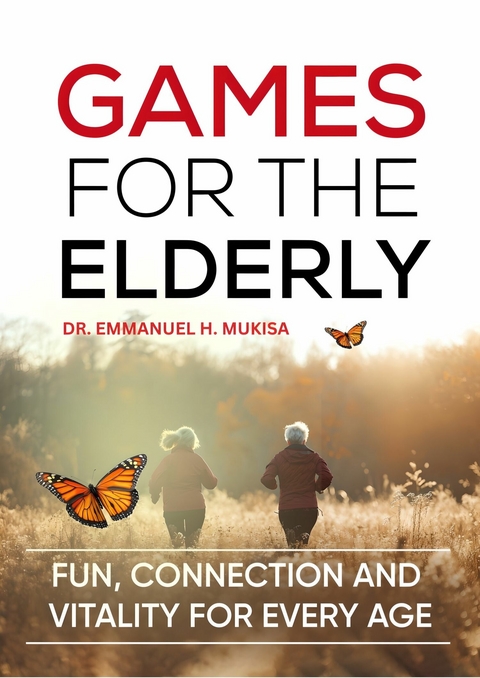
Games for The Elderly (eBook)
141 Seiten
Publishdrive (Verlag)
978-0-00-110348-1 (ISBN)
Bring joy, connection, and health to the lives of seniors with games for the elderly. This comprehensive guide offers brain-boosting puzzles, physical activities, and social games designed to improve mental clarity, mobility, and emotional well-being.
From classic card games to innovative intergenerational activities, this book emphasizes the healing power of play, the importance of social connection, and the benefits of engaging the mind and body. Rediscover the fun in aging with activities that entertain, engage, and promote longevity.
Growing older means you have to continue keeping your brain active to retain your thinking abilities and how to perform daily functions. Brain-boosting games are an exciting way to increase your mental clarity, concentration, and memory. These games strengthen neural connections and are, therefore, very crucial in keeping good brain health. From puzzles to card games, there are a plethora of strategy-based activities that one can engage in while challenging the mind. Brain games might also lower the risk of cognitive decline and dementia. One can, therefore include them in daily activities and have fun while ensuring that the brain health is sustainable.
Most common of all games for brain improvement is crosswords. The puzzle games enhance the memory because one is compelled to memorize words and phrases, which leads to a better retention in the memory. They further improve the vocabulary and problem solving skills which are essential in daily life. With age, language-based activities are essential as they tend to increase their demand on cognition. Solving the most difficult or even easy puzzles is a great activity that makes older people sharpen their brains and develops high mental flexibility. Crosswords are simple but excellent for using one's brain very often.
The best way to help the brain be healthy is through memory games. Mainly, they play the matching cards or sequences of information being recalled. They strengthen short-term memory. For more functionality, seniors challenge themselves by playing these games on a regular basis to retain and process information. The recurrence of action of these games helps the brain adapt to creating new pathways. Thus, memory games can improve recall and enhance the ability to remember everyday activities. Simple games like memory match and concentration can provide a fun, low-pressure way to keep the brain engaged.
Good mental function enhancement can be provided by strategy games involving chess, checkers, and many other such games. The player thinking a lot, while playing most of the strategic games, gets in planning and foresight. Building up logical reasoning and decision-making skills under strain, the necessity to strategize many moves in advance can be seen. Pattern recognition is one of the very necessary skills fostered by strategy games in people's everyday life. For seniors, playing these kinds of games can help enhance problem-solving skills and keep the brain agile. Of course, apart from these aspects, chess is an improvement on one's cognitive functions and generally a good mental exercise for any age of people.
Another commonly known brain exercise is the Sudoku: a number puzzle needing logic and patterns. Its problems to be solved need to be approached by a thinking mind through the use of deductive reasoning. Like everything, concentration and attention improve with practice and then start to decline with age. The different levels of difficulty provide a fun challenge for seniors who steadily build up their cognitive powers. The steady mental exercise keeps the brain fresh and assists in maintaining cognitive fitness as time goes by. At times the game is a great mental exercise, though done very efficiently.
Other games which are also used include bridge, solitaire and gin rummy. These involve a large part of the above cognitive abilities needed by the older adult to do well with remembering stuff that makes for the more general concept of mental sharpness. Also the nature of these card games and perhaps most significantly groups provide socialisation that reduces feelings of loneliness. The mental focus to play cards is an improvement for both decision-making skills and quick information processing. Card games are enjoyable when played with family or friends, and stimulating the mind has the added value of bonding with others. Thus, playing cards has cognitive benefits as well as social.
Word games can also be experimented to exercise the brain with games like Scrabble and Boggle. This brings creative thinking into play and even generates very lengthy vocabularies. Word games foster problem-solving and linguistic acuities that really come in handy for daily needs. Playing them every day as the elderly aged will maintain linguistic fluency. Both Scrabble and Boggle can be played solitaire, but they are more amenable to groups. This diversity makes them appealing for mental exercise. The competitiveness of these games will keep seniors active and motivated because they continue to play and learn.
Memory training apps and brain games can be played anywhere on a smartphone and tablet. Most of them are focused on challenging memory, focus, and reasoning in a non-boring but playful way. Such digital games will give feedback and track the progress that seniors are making so that they may see their progress over time. Such apps are portable, meaning anyone can do these mental exercises anywhere at any time. There are brain-exercising applications that will stimulate the brain, whether by using word puzzles, logic games, or simply through a trivia quiz. Digital brain games are an advanced and highly accessible method of keeping fit cognitively.
Classic games such as jigsaw puzzles work towards improving several different aspects of the brain's performance. This can be in concentration and spatial reasoning; however, a significant way of this process involves solving problems. Jigsaw puzzles can also usher in relaxation and alleviate stress by providing a mental break while involving the brain. The exercise of cognitive flexibility for the player is included because, when trying to piece, he needs to adjust several strategies. Seniors will improve their memory retention and attention from working on a puzzle. Satisfying accomplishment and well-being can be brought about by the completion of a puzzle.
Add a brain exercise to stir the brain further. Such activities as dance or tai chi force elderly persons to remember movements, sequences and steps. It also enhances the brain-body connection, and hence, exercises the body along with the mind. Thus, physical exercise and mental development reinforce one another. For instance, take the activity of dance. Memory of rhythm and timing indeed influences the scope of cognitive processing and coordination. Tai chi also calls for concentration and focus. These actions minimize the risk of cognitive impairment. Such exercises are fun and healthy for the brain.
Video trivia games or quizzes: Such are exciting exercises that challenge memory and knowledge through recall. Playing trivia is a form of workout for the brain because it forces players to recall information from long-term memory. Trivia games also encourage learning and curiosity, which can therefore enhance brain function over time. Several trivia games contain topics that span from history to geography and to pop culture or science. A range of knowledge is thus contested in trivia games. Seniors get well-engaged playing trivia games. They recall their previous experiences, knowledge, and facts. It keeps the mind active and engrossed. A game which can be played individually or in groups brings social aspects to the activity.
Other enjoyable ways to sharpen the brain from these word searches, these games sharpen brains, finding words through the matrix letters, thereby bringing about the improved ability to focus and cognitive plasticity. For those who may be interested to solve word search on a regular basis, improving visual processing would increase with memory recalls. Amusing with no stress by exercising one's brain. For seniors, word searches come in different difficulties, so a person can take it at his or her cognitive level. The sense of achievement when one solves a word search puzzle is beneficial to the general mental well-being.
Storytelling games or activities, like improvisation or creative writing, are also important for mental stimulation. These games enhance creative thinking, improve communication skills, and stimulate the imagination. Storytelling also exercised the brain in recalling one's previous experiences or even creating new ones, thus exercising memory and creativity. They would tell stories, interact with other people, and sometimes share their experiences and often discuss what used to be good old days. This would, in effect stimulate social interaction and help to keep oral communication skills in the pipeline. Storytelling games will also be healthy exercises to excite the brain in a jovial manner as it brings human beings closer to one another.
Mind-stimulating board games: This includes board games such as Clue, Risk, or Settlers of Catan. They require planning and problem-solving along with the usage of logical reasoning, thereby it is very efficient for brain stimulation. Most board games also include some luck to maintain things going and unpredictable and, therefore, keeping the brain engaged in a great deal. The playing of board games would improve concentration, memory, and a lot of decision-making. As aging is complex, so playing them frequently helps, these also bring perfect social contact elements that help elders to keep themselves cheerful for betterment in emotional aspects. Board games are just ideal to play which gives the effect of both enjoyable and mentally developed.
Special video games involving interaction designed primarily for older folks are another enjoyment activity for advancing cognitive abilities. These games usually have memory, attention, and processing speed exercises while being entertaining. Most video games have interactive elements, such as motion controls or touchscreens, to engage players physically and mentally. These games enhance hand-eye coordination,...
| Erscheint lt. Verlag | 26.3.2025 |
|---|---|
| Sprache | englisch |
| Themenwelt | Technik |
| ISBN-10 | 0-00-110348-2 / 0001103482 |
| ISBN-13 | 978-0-00-110348-1 / 9780001103481 |
| Informationen gemäß Produktsicherheitsverordnung (GPSR) | |
| Haben Sie eine Frage zum Produkt? |
 EPUB (Adobe DRM)
Größe: 241 KB
Kopierschutz: Adobe-DRM
Adobe-DRM ist ein Kopierschutz, der das eBook vor Mißbrauch schützen soll. Dabei wird das eBook bereits beim Download auf Ihre persönliche Adobe-ID autorisiert. Lesen können Sie das eBook dann nur auf den Geräten, welche ebenfalls auf Ihre Adobe-ID registriert sind.
Details zum Adobe-DRM
Dateiformat: EPUB (Electronic Publication)
EPUB ist ein offener Standard für eBooks und eignet sich besonders zur Darstellung von Belletristik und Sachbüchern. Der Fließtext wird dynamisch an die Display- und Schriftgröße angepasst. Auch für mobile Lesegeräte ist EPUB daher gut geeignet.
Systemvoraussetzungen:
PC/Mac: Mit einem PC oder Mac können Sie dieses eBook lesen. Sie benötigen eine
eReader: Dieses eBook kann mit (fast) allen eBook-Readern gelesen werden. Mit dem amazon-Kindle ist es aber nicht kompatibel.
Smartphone/Tablet: Egal ob Apple oder Android, dieses eBook können Sie lesen. Sie benötigen eine
Geräteliste und zusätzliche Hinweise
Buying eBooks from abroad
For tax law reasons we can sell eBooks just within Germany and Switzerland. Regrettably we cannot fulfill eBook-orders from other countries.
aus dem Bereich