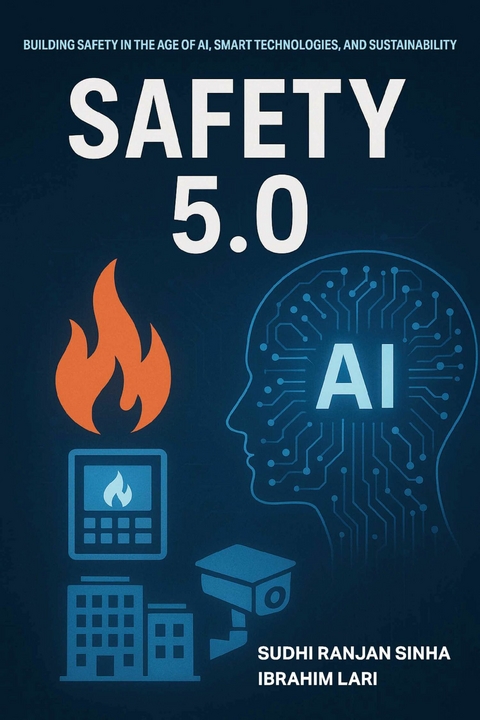
Safety 5.0 (eBook)
168 Seiten
Bookbaby (Verlag)
979-8-3178-1865-4 (ISBN)
IBRAHIM LARI is the Chairman and CEO of the SIBCA Group, a market leader for building technologies and solutions in the Middle East that is now expanding globally. He has extensive leadership experience in the technology and energy sectors. Previously, he has held executive leadership positions at Injazat Data Systems, Dolphin Energy, and Borouge. Ibrahim holds a Bachelor's degree in Electrical and Electronics Engineering, with an educational background in both the UAE and the USA. Recognized for leadership excellence, Ibrahim Lari has received accolades for contributions to the advancement of technology solutions in the UAE, reflecting a commitment to industry best practices and innovation.
The current improvements in the Internet of Things (IoT) technologies and Artificial Intelligence (AI) are redefining how building management is perceived and executed. This also spans very traditional safety and security systems that have long resisted change but are now poised to go through a significant transformation. But how can businesses and facilities reimagine safety in this new era? In the last few years, a lot of emphasis has been put on the topic of sustainability. Now, there is increasing realization globally that sustainable goals cannot be effectively achieved without the use of smart technologies and due improvements in safety. In this book, we will explore this emerging space. This book is intended to help business, facility, and technology leaders navigate the complex world of safety with its myriad dimensions in several ways:a) Understand the opportunity landscapeb) Develop a framework for understanding the influence of technological shifts on safetyc) Build the fundamentals, technology foundation, and the enabling ecosystems
Chapter 1
Introduction
Buildings have a long and rich history spanning over 5,000 years. Safety incidents in buildings, especially during the construction phase, have been present throughout this period. While there is a history of building codes dating back 4,000 years, safety-related codes were introduced in the 17th century. However, safety concerns gained greater significance and attention in the late 19th century, especially with the introduction of electricity and related fire and safety hazards on a mass scale. As modern and tall buildings started to become popular in the 20th century, safety standards and practices became more organized and slowly enforced. The 1927 International Conference of Building Officials’ adoption of the first Uniform Building Code was pivotal in this journey. Since then, in the past 100 years, the notion of safety, codes/practices to ensure safety, and technologies used in creating safe built environments have evolved a lot.
We live in an increasingly digital world in which we are inundated by IoT devices, connectivity, data, applications, and new experiences every moment. Our economy and our way of life are rapidly transforming into a digital one for most parts. This change is requiring businesses and institutions to rapidly reinvent themselves in this new world order, not only to thrive but sometimes just to survive. The noise and hype in this novel space are not unnoticed, with 75 percent of CEOs believing technology will reshape industry competition and 80 percent of CEOs thinking artificial intelligence (AI) will significantly change the way they do business, according to recent PwC studies.
As businesses and institutions go through this transformation, there is an increasing realization that their facilities play a pivotal role in this transformation journey. Organizations are defined by their mission, strategy, operating model, and people. Each business and each institution have a mission that is enabled, augmented, and executed by its workforce, operating in its workspaces, through its workflows. They all come together in a building. Therefore, the digital transformation of buildings becomes a critical component of the digital transformation agenda of any organization.
At an individual level, buildings matter as well. Our physical and psychological well-being, not to mention our productivity, are hugely influenced and in many ways determined by these environments. As our own needs and usages have become more nuanced and sophisticated, the demands and pressure on our built infrastructure have increased. Older buildings must be retrofitted to stay current, and new buildings are increasingly required to meet stringent evolving standards and accommodate a vast array of functions and activities. Not only that, they have to be malleable and adaptable to changing usages and conditions. Look no further than the pandemic, which forced a precipitous reckoning with ways in which buildings could be vectors of—and barriers against—an invisible menace.
Buildings behave like organisms, complex assemblages of materials, technology, and people. Early, century-old technologies like pneumatic controls and elevators have become vastly more sophisticated. And new technologies are added at a dizzying pace—modern buildings are rich ecosystems replete with sensors, systems, data, and protocols. We expect our environments to take on many of the functions that were previously entirely the domain of people. Factories in which production takes place with minimal human intervention, and hospitals in which the built environment itself is a key factor in facilitating positive outcomes for patients.
When we enter specialized environments such as data centers, the safety risk vectors from the industry’s rapid innovation cycles pose serious safety concerns. Some estimates suggest that in the next 3-5 years, the density of computing and electrical power will increase 80x in. The racks in the data centers of today are already a safety hazard for humans; imagine what the gigawatt AI factories of the future might pose a risk to!
As buildings become more complex, the associated risks multiply. How do we identify new risks? How do we mitigate against them? Dealing with these new scenarios is a worthy, sometimes gnarly, challenge for authorities and first responders. These risks often extend way beyond the buildings themselves.
Structure of the book
This book is organized into the following chapters:
- Introduction
This chapter sets the context of this work.
- New safety risks introduced by smart technology systems
This chapter explores the increasing and innovative use of technology in buildings and the new safety risk vectors they bring. We explore how AI, IoT, and other digital technologies introduce safety and closely associated cybersecurity risks. We then explore how sustainability and energy transition influenced technologies impact the domain of safety, and how to mitigate them.
- Using AI to enhance safety
AI has now emerged as one of the biggest transformative forces for the 21st century, reshaping entire industries altogether. It has started to impact the building industry by enabling new capabilities and efficiencies to address multiple challenges of increasing technology and operational complexity, adaptability, resource constraints, industry fragmentation, and other such macro factors. We see AI as a great enabler for helping improve the safety posture of the buildings. This chapter builds upon our thesis of digital buildings presented in the book Building 5.0 and focuses on the topic of safety.
- Safety and sustainability
While most of the sustainability conversations in the context of buildings are about energy efficiency and emissions, safety as a vector of sustainability is often ignored. The use of water and other fluids in suppression systems can have a considerable impact on water conservation and emission control. In the unfortunate event of a fire, dealing with waste is another sustainability issue one has to deal with. Sustainability and safety both require engagement from occupants and other stakeholders for driving results. This chapter digs deeper into the synergistic impact of these two topics.
- Assessing the safety posture of buildings
The safety posture of a building is the composite of materials, systems, policies, processes, and practices. Hundreds of vulnerability points could impact the safety posture of a built environment. The presence of fire detection and suppression systems, and the periodic minimally required inspections, are necessary but not sufficient to ensure a comprehensive safety posture of the building. This chapter will introduce a framework for comprehensively and objectively assessing the safety posture of a built environment, covering all the different dimensions of safety contributors—materials, systems, policies, processes, and practices. This framework will also help prioritize issues and map their resolution.
- Designing organization and building capabilities for
effective safety
Investment in systems is crucial for ensuring a safe environment. However, such investments cannot supplant the human capital required to address safety concerns. A well-designed cross-disciplined team, alignment of purpose and specific goals, shared understanding and operating practices, and a well-oiled performance is critical to ensure life and property safety. This chapter will address the organizational structure, roles and responsibilities, capabilities of the various functions and personnel, and overall readiness of an organization to deal with safety incidents. This chapter will also explore the incident response readiness of buildings and businesses.
- Maintenance and monitoring of safety-critical systems
Safety systems in an environment are the most critical of all building systems, as they are tied to life and property safety. Over time, as discussed previously in the book, their complexity and sophistication have increased. Today’s safety systems comprise a lot of electronic components, software elements, and inter-system connectivity. These require periodic and efficacious maintenance. Sometimes, building owners and operators have been known to make efforts to optimize the spending in such maintenance activities to the long-term detriment of the safety readiness of the facility. This chapter will highlight the right processes and best practices for maintaining the operating safety systems the right way.
- Safety in data centers
Data centers usually have fewer people working in them than most other types of facilities; however, they have high technology intensity, a mission-critical nature, a need to be operational 100% of the time, recover from any incident very rapidly, and consequently a need to have very early detection and quick response mechanisms. This chapter identifies the unique nuances of safety in...
| Erscheint lt. Verlag | 3.11.2025 |
|---|---|
| Sprache | englisch |
| Themenwelt | Technik |
| ISBN-13 | 979-8-3178-1865-4 / 9798317818654 |
| Informationen gemäß Produktsicherheitsverordnung (GPSR) | |
| Haben Sie eine Frage zum Produkt? |
 EPUB (Ohne DRM)
Größe: 2,3 MB
Digital Rights Management: ohne DRM
Dieses eBook enthält kein DRM oder Kopierschutz. Eine Weitergabe an Dritte ist jedoch rechtlich nicht zulässig, weil Sie beim Kauf nur die Rechte an der persönlichen Nutzung erwerben.
Dateiformat: EPUB (Electronic Publication)
EPUB ist ein offener Standard für eBooks und eignet sich besonders zur Darstellung von Belletristik und Sachbüchern. Der Fließtext wird dynamisch an die Display- und Schriftgröße angepasst. Auch für mobile Lesegeräte ist EPUB daher gut geeignet.
Systemvoraussetzungen:
PC/Mac: Mit einem PC oder Mac können Sie dieses eBook lesen. Sie benötigen dafür die kostenlose Software Adobe Digital Editions.
eReader: Dieses eBook kann mit (fast) allen eBook-Readern gelesen werden. Mit dem amazon-Kindle ist es aber nicht kompatibel.
Smartphone/Tablet: Egal ob Apple oder Android, dieses eBook können Sie lesen. Sie benötigen dafür eine kostenlose App.
Geräteliste und zusätzliche Hinweise
Buying eBooks from abroad
For tax law reasons we can sell eBooks just within Germany and Switzerland. Regrettably we cannot fulfill eBook-orders from other countries.
aus dem Bereich