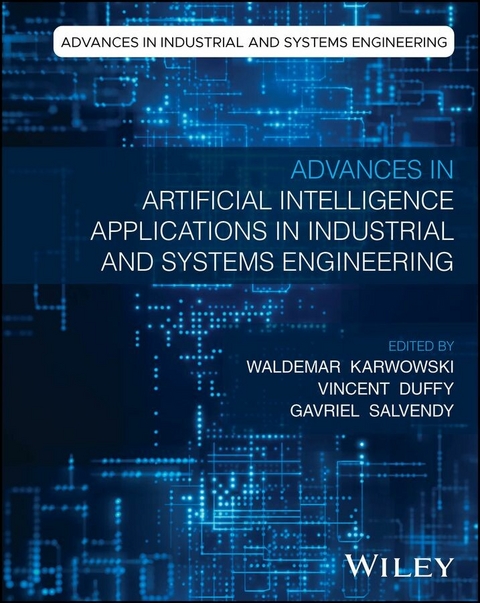
Advances in Artificial Intelligence Applications in Industrial and Systems Engineering (eBook)
787 Seiten
Wiley (Verlag)
978-1-394-25707-2 (ISBN)
Comprehensive guide offering actionable strategies for enhancing human-centered AI, efficiency, and productivity in industrial and systems engineering through the power of AI.
Advances in Artificial Intelligence Applications in Industrial and Systems Engineering is the first book in the Advances in Industrial and Systems Engineering series, offering insights into AI techniques, challenges, and applications across various industrial and systems engineering (ISE) domains. Not only does the book chart current AI trends and tools for effective integration, but it also raises pivotal ethical concerns and explores the latest methodologies, tools, and real-world examples relevant to today's dynamic ISE landscape.
Readers will gain a practical toolkit for effective integration and utilization of AI in system design and operation. The book also presents the current state of AI across big data analytics, machine learning, artificial intelligence tools, cloud-based AI applications, neural-based technologies, modeling and simulation in the metaverse, intelligent systems engineering, and more, and discusses future trends.
Written by renowned international contributors for an international audience, Advances in Artificial Intelligence Applications in Industrial and Systems Engineering includes information on:
- Reinforcement learning, computer vision and perception, and safety considerations for autonomous systems (AS)
- (NLP) topics including language understanding and generation, sentiment analysis and text classification, and machine translation
- AI in healthcare, covering medical imaging and diagnostics, drug discovery and personalized medicine, and patient monitoring and predictive analysis
- Cybersecurity, covering threat detection and intrusion prevention, fraud detection and risk management, and network security
- Social good applications including poverty alleviation and education, environmental sustainability, and disaster response and humanitarian aid.
Advances in Artificial Intelligence Applications in Industrial and Systems Engineering is a timely, essential reference for engineering, computer science, and business professionals worldwide.
WALDEMAR KARWOWSKI is a Pegasus Professor and Chair in the Department of Industrial Engineering and Management Systems at the University of Central Florida. He is an elected member of The Academy of Science, Engineering and Medicine of Florida (ASEMFL).
VINCENT DUFFY is a Professor of Industrial Engineering and Agricultural & Biological Engineering at Purdue University and a Fulbright Senior Scholar.
GAVRIEL SALVENDY is a University Distinguished Professor at the University of Central Florida, a member of the National Academy of Engineering, and founding Department Head of Industrial Engineering at Tsinghua University in China.
Comprehensive guide offering actionable strategies for enhancing human-centered AI, efficiency, and productivity in industrial and systems engineering through the power of AI. Advances in Artificial Intelligence Applications in Industrial and Systems Engineering is the first book in the Advances in Industrial and Systems Engineering series, offering insights into AI techniques, challenges, and applications across various industrial and systems engineering (ISE) domains. Not only does the book chart current AI trends and tools for effective integration, but it also raises pivotal ethical concerns and explores the latest methodologies, tools, and real-world examples relevant to today s dynamic ISE landscape. Readers will gain a practical toolkit for effective integration and utilization of AI in system design and operation. The book also presents the current state of AI across big data analytics, machine learning, artificial intelligence tools, cloud-based AI applications, neural-based technologies, modeling and simulation in the metaverse, intelligent systems engineering, and more, and discusses future trends. Written by renowned international contributors for an international audience, Advances in Artificial Intelligence Applications in Industrial and Systems Engineering includes information on: Reinforcement learning, computer vision and perception, and safety considerations for autonomous systems (AS)(NLP) topics including language understanding and generation, sentiment analysis and text classification, and machine translationAI in healthcare, covering medical imaging and diagnostics, drug discovery and personalized medicine, and patient monitoring and predictive analysisCybersecurity, covering threat detection and intrusion prevention, fraud detection and risk management, and network securitySocial good applications including poverty alleviation and education, environmental sustainability, and disaster response and humanitarian aid. Advances in Artificial Intelligence Applications in Industrial and Systems Engineering is a timely, essential reference for engineering, computer science, and business professionals worldwide.
Chapter 1
Introduction to Industrial Artificial Intelligence
Dai-Yan Ji, Hanqi Su, Takanobu Minami, and Jay Lee
Center for Industrial Artificial Intelligence, Department of Mechanical Engineering, University of Maryland, College Park, MD, USA
1.1 Fundamental Problems in Industry
Digital transformation is a journey to develop data-centric operations with great visibility and productivity. Through the fourth industrial revolution efforts, companies can generate substantial financial and operational advantages, improving productivity and increasing customer satisfaction. The fundamental problem is digital transformation is to address productivity issues on flexibility, quality, and speed. Flexibility is achieved through the collaboration of machines and humans, forming a responsive, on-demand production system capable of adapting in real time. Quality is enhanced through real-time plant monitoring and the application of just-in-time maintenance. The degradation of manufacturing equipment and tools affects product quality and reduces productivity by increasing the occurrence of unplanned downtime. Thus, intelligent prognostic and health management (PHM) tools are essential for timely maintenance, guaranteeing the provision of high-quality products, minimizing unplanned downtime, and enhancing customer satisfaction. Speed is attained by improving interconnectivity between different sectors within the manufacturing process, impacting the entire product lifecycle. The synchronization and integration of data across companies, both vertically and horizontally, promotes transparency and cohesion across departments and functions, greatly boosting manufacturing efficiency.
However, many production sites have found it difficult to quickly implement these technologies on a broad scale due to three major problems including:
- Discipline Problems: These problems include workforce competency, organizational culture, and managerial competencies. Japan is a perfect example of a trained workforce and effective mechanisms to transfer knowledge that can foster a strong company culture.
- System Problems: These problems refer to equipment, systems, and processes. Germany exhibits superior skill by employing precision-engineered equipment, rigorous process standards, and advanced design and manufacturing capabilities to facilitate knowledge transfer.
- Intrinsic Problems: These problems entail creating value for customers. The United States takes the lead in pioneering innovative business models and deploying technologies, employing collaborative innovation that leverages intellectual property, domain data, and ongoing service innovations for knowledge transfer.
Classical machine learning (ML) has created broad use cases to address these problems across manufacturing, such as predicting and preventing defects and failures. But generative AI is just beginning to be explored. Industrial AI emerges as a potent solution to these difficulties, providing substantial benefits for manufacturing improvements by enhancing the quality, structure, and vital aspects of manufacturing processes. The ability to train machines on large and unstructured datasets unlocks an entire suite of knowledge bases that can ultimately mimic human problem-solving capabilities using domain-based and data-rich sources in manufacturing processes. By standardizing workflows with data, industrial AI promotes the rapid accumulation of experience and aids in effective knowledge transfer. The strategic use of data not only uncovers latent problems in manufacturing systems but also supports transparent management of equipment health, stabilizes process parameters, and boosts overall efficiency. Furthermore, data serve as a medium for increasing user value, improving the functionality and reliability of products and equipment, enhancing operational efficiency, and bolstering the sustainable profitability of enterprises. Thus, incorporating industrial AI into manufacturing tackles these three critical problems through the application of data-driven insights and automation. It addresses discipline problems by boosting workforce competency and management skills with intelligent insights. System problems are alleviated by enhancing equipment design, manufacturing processes, and system integration, thereby making the entire manufacturing process more transparent and effective. Additionally, intrinsic problems associated with customer value creation are solved by evolving business models and technologies, which foster collaborative innovation and continuous service enhancement. In summary, the necessity for AI intervention in the industry is highlighted by these challenges, demonstrating industrial AI’s vital role in driving manufacturing excellence.
1.2 The Purpose of Industrial AI
The interpretation of industrial AI systems varies between academic and industrial sectors. Definitions of industrial AI as a unique technology or solution sometimes overlook critical questions such as the precise settings of intelligence required in industrial environments, the unsolved problems and challenges that current methods do not resolve, and the function of AI in overcoming these deficiencies. Furthermore, the role of industrial AI should not be limited to merely displaying the capabilities of data scientists in revolutionizing conventional industrial models. Instead, it should concentrate on uncovering and addressing the hidden problems within industrial ecosystems.
Industrial AI goes beyond merely adapting general AI technologies to industrial environment settings. The distinct characteristics of these settings – such as their fragmented nature, individualized challenges, and need for specialization – demand an integrated approach that merges computer science, AI, and domain-specific knowledge. Unlike conventional rule-based or mechanistic approaches, the true strength of data-driven industrial intelligence lies in its predictive analytics capabilities. These capabilities are founded on insights and evidence derived from data that facilitate the creation of intelligent management tools for tackling previously unknown challenges. Additionally, it assists in revealing complex interdependencies, thereby fostering the generation of new knowledge and supporting the evolution of a system that intelligently adapts and improves over time.
Challenges of industrial systems (Lee et al. 2019) can be generally divided into two main areas as depicted in Figure 1.1. Visible problems include issues such as machine failures, reduced production yield, and deteriorating product quality. On the other hand, invisible challenges encompass aspects like machine wear, component deterioration, and inadequate lubrication. Commonly identifiable problems such as equipment malfunctions, quality defects, and productivity declines are typically managed through continuous improvements and standardized practices, reflecting the conventional approach to manufacturing (located in the lower left quadrant). Modern manufacturers are increasingly adopting AI algorithms to gain a competitive advantage. This approach is directly toward designing, producing, and delivering high-quality products more rapidly than competitors, thereby focusing on problem-solving (located in the upper left quadrant). Recent efforts by various companies have led to the development of new methods and techniques aimed specifically at addressing invisible challenges (positioned in the lower right quadrant). The adoption of an industrial AI-driven approach offers the potential to open up new opportunities for value creation in smart manufacturing, especially in environments that are dynamic and unpredictable (found in the upper right quadrant). Extensive implementation of industrial AI’s fundamental components not only aids in addressing visible problems but also in avoiding invisible ones.
Figure 1.1 Visible and invisible problems in industrial systems and opportunities for industrial AI.
Industrial AI also plays a critical role in achieving the 3W’s of smart manufacturing, namely work reduction, waste reduction, and worry-free manufacturing. The idea of “worry” in modern manufacturing systems is frequently derived from invisible difficulties such as machine degradation, process variation, and operation uncertainties. To address these difficulties, it is critical to implement industrial AI technologies in a systematic approach. Furthermore, the aim of reducing workloads and waste may be achieved by identifying the visible aspects of these difficulties and proactively resolving their possible future consequences using adaptive AI modules.
1.3 Difference Between AI and Industrial AI
There are clear differences (Lee 2020) between AI in general and industrial AI. These differences extend beyond the domain of application and include differences in functional requirements and algorithmic techniques. Before diving into these differences, it is necessary to define both terms. AI is a field of cognitive science that includes considerable study in image analysis and machine vision, natural language processing (NLP), robotics, and ML, among other topics. Despite its intense perspective, AI is usually veiled in mystery, with critics citing a lack of verifiable proof to back up its usefulness, repeatability, and financial return on investment in an industrial environment.
Conversely, industrial AI is described as a systematic discipline for the creation, validation, and rapid deployment of ML algorithms customized for industrial use cases, resulting in sustained performance. This domain focuses on developing intelligent systems for...
| Erscheint lt. Verlag | 15.8.2025 |
|---|---|
| Reihe/Serie | Advances in Industrial and Systems Engineering |
| Sprache | englisch |
| Themenwelt | Technik ► Bauwesen |
| Technik ► Maschinenbau | |
| Schlagworte | Artificial Intelligence (AI) • Continuous Improvement • Engineering Economics • Industrial Engineering • Industry 4.0 • intelligent manufacturing • Lean Manufacturing • Operations Management • Smart Systems • Systems Engineering |
| ISBN-10 | 1-394-25707-4 / 1394257074 |
| ISBN-13 | 978-1-394-25707-2 / 9781394257072 |
| Informationen gemäß Produktsicherheitsverordnung (GPSR) | |
| Haben Sie eine Frage zum Produkt? |
 EPUB (Adobe DRM)
Kopierschutz: Adobe-DRM
Adobe-DRM ist ein Kopierschutz, der das eBook vor Mißbrauch schützen soll. Dabei wird das eBook bereits beim Download auf Ihre persönliche Adobe-ID autorisiert. Lesen können Sie das eBook dann nur auf den Geräten, welche ebenfalls auf Ihre Adobe-ID registriert sind.
Details zum Adobe-DRM
Dateiformat: EPUB (Electronic Publication)
EPUB ist ein offener Standard für eBooks und eignet sich besonders zur Darstellung von Belletristik und Sachbüchern. Der Fließtext wird dynamisch an die Display- und Schriftgröße angepasst. Auch für mobile Lesegeräte ist EPUB daher gut geeignet.
Systemvoraussetzungen:
PC/Mac: Mit einem PC oder Mac können Sie dieses eBook lesen. Sie benötigen eine
eReader: Dieses eBook kann mit (fast) allen eBook-Readern gelesen werden. Mit dem amazon-Kindle ist es aber nicht kompatibel.
Smartphone/Tablet: Egal ob Apple oder Android, dieses eBook können Sie lesen. Sie benötigen eine
Geräteliste und zusätzliche Hinweise
Buying eBooks from abroad
For tax law reasons we can sell eBooks just within Germany and Switzerland. Regrettably we cannot fulfill eBook-orders from other countries.
aus dem Bereich