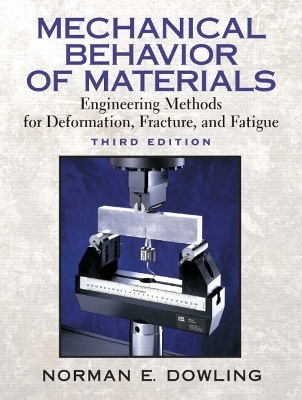
Mechanical Behavior of Materials
Pearson (Verlag)
978-0-13-186312-5 (ISBN)
- Titel erscheint in neuer Auflage
- Artikel merken

This respected text introduces the spectrum of mechanical behavior of materials, emphasizing practical engineering methods for testing structural materials to obtain their properties, and predicting their strength and life when used for machines, vehicles, and structures. With its logical treatment and ready-to-use format, it is ideal for upper-level undergraduate students who have completed elementary mechanics of materials courses.
Preface, xi
Acknowledgements, xvii
1 Introduction, 1
1.1 Introduction, 1
1.2 Types of Material Failure, 2
1.3 Design and Materials Selection, 11
1.4 Technological Challenge, 16
1.5 Economy Importance of Fracture, 16
1.6 Summary, 19
References, 20
Problems and Questions, 21
2 Structure and Deformation in Materials, 23
2.1 Introduction, 23
2.2 Bonding in Solids, 25
2.3 Structure in Crystalline Materials, 29
2.4 Elastic Deformation and Theoretical Strength, 33
2.5 Inelastic Deformation, 38
2.6 Summary, 44
References, 45
Problems and Questions, 46
3 A Survey of Engineering Materials, 48
3.1 Introduction, 48
3.2 Alloying and Processing of Metals, 49
3.3 Irons and Steels, 55
3.4 Nonferrous Metals, 63
3.5 Polymers, 67
3.6 Ceramics and Glasses, 77
3.7 Composite Materials, 84
3.8 Materials Selection for Engineering Components, 89
3.9 Summary, 94
References, 97
Problems and Questions, 98
4 Mechanical Testing: Tension Test and Other Basic Tests, 102
4.1 Introduction, 102
4.2 Introduction to Tension Test, 108
4.3 Engineering Stress-Strain Properties, 109
4.4 Trends in Tensile Behavior, 119
4.5 True Stress-Strain Interpretation of Tension Test, 125
4.6 Compression Test, 135
4.7 Hardness Tests, 139
4.8 Notch-Impact Tests, 148
4.9 Bending and Torsion Tests, 152
4.10 Summary, 155
References, 157
Problems and Questions, 158
5 Stress-Strain Relationships and Behavior, 166
5.1 Introduction, 166
5.2 Models for Deformation Behavior, 167
5.3 Elastic Deformation, 177
5.4 Anisotropic Materials, 188
5.5 Summary, 196
References, 199
Problems and Questions, 199
6 Review of Complex and PrincipalStatesand Strain, 205
6.1 Introduction, 205
6.2 Plane Stress, 206
6.3 Principal Stresses and the Maximum Shear Stress, 222
6.4 Three-Dimensional States of Stress, 214
6.5 Stresses on the Octahedral Planes, 228
6.6 Complex States of Strain, 229
6.7 Summary, 233
References, 235
Problems and Questions, 235
7 Yielding and Fracture under Combined Stresses, 239
7.1 Introduction, 239
7.2 General Form of Failure Criteria, 241
7.3 Maximum Normal Stress Fracture Criterion, 243
7.4 Maximum Shear Stress Yield Criterion, 245
7.5 Octahedral Shear Stress Yield Criterion, 251
7.6 Discussion of the Basic Failure criteria, 256
7.7 Coulomb-Mohr Fracture Criterion, 262
7.8 Modified Mohr Fracture Criterion, 268
7.9 Additional Comments on Failure Criteria, 273
7.10 Summary, 278
References, 280
Problems and Questions, 281
8 Fracture of Cracked Members, 286
8.1 Introduction, 286
8.2 Preliminary Discussion, 288
8.3 Mathematical Concepts, 295
8.4 Application of K to Design and Analysis, 300
8.5 Additional Topics on Application of K, 307
8.6 Fracture Toughness Values and Trends, 317
8.7 Plastic Zone Size, and Plasticity Limitations on LEFM, 327
8.8 Discussion of Fracture Toughness Testing, 335
8.9 Extensions of Fracture Mechanics Beyond Linear Elasticity, 337
8.10 Summary, 344
References, 347
Problems and Questions, 349
9 Fatigue of Materials: Introduction and Stress-Based Approach, 357
9.1 Introduction, 357
9.2 Definitions and Concepts, 358
9.3 Sources of Cyclic Loading, 368
9.4 Fatigue Testing, 371
9.5 The Physical Nature of Fatigue Damage, 375
9.6 Trends in S-N Curves, 380
9.7 Mean Stresses, 388
9.8 Multiaxial Stresses, 396
9.9 Variable Amplitude Loading, 401
9.10 Summary, 410
References, 412
Problems and Questions, 413
10 Stress-Based Approach to Fatigue: Notched Members, 420
10.1 Introduction, 420
10.2 Notch Effects, 421
10.3 Notch Sensitivity and Empirical Estimates of kf, 426
10.4 Estimating Long-Life Fatigue Strengths (Fatigue Limits), 441
10.5 Notch Effects at Intermediate and Short Lives, 431
10.6 Combined Effects of Notches and Mean Stress, 434
10.7 Estimating S-N Curves, 444
10.8 Use of Component S-N Data, 451
10.9 Designing to Avoid Fatigue Failure, 461
10.10 Discussion, 472
10.11 Summary, 474
References, 476
Problems and Questions, 477
11 Fatigue Crack Growth, 488
11.1 Introduction, 488
11.2 Preliminary Discussion, 489
11.3 Fatigue Crack Growth Rate Testing, 497
11.4 Effects of R = Smin /Smax on Fatigue Crack Growth, 501
11.5 Trends in Fatigue Crack Growth Behavior, 512
11.6 Life Estimates for Constant Amplitude Loading, 516
11.7 Life Estimates for Variable Amplitude Loading, 527
11.8 Design Considerations, 533
11.9 Plasticity Aspects and Limitations of LEFM for Fatigue Crack Growth, 535
11.10 Environmental Crack Growth, 542
11.11 Summary, 547
References, 549
Problems and Questions, 550
12 Plastic Deformation Behavior and Models for Materials, 559
12.1 Introduction, 559
12.2 Stress-Strain Curves, 562
12.3 Three-Dimensional Stress-Strain Relationships, 570
12.4 Unloading and Cyclic Loading Behavior from Rheological Models, 578
12.5 Cyclic Loading Behavior of Real Materials, 585
12.6 Summary, 595
References, 598
Problems and Questions, 598
13 Stress-Strain Analysis of Plastically Deforming Members, 603
13.1 Introduction, 603
13.2 Plasticity in Bending, 604
13.3 Residual Stresses and Strains for Bending, 613
13.4 Plasticity of Circular Shafts in Torsion, 618
13.5 Notched Members, 622
13.6 Cyclic Loading, 633
13.7 Summary, 641
References, 643
Problems and Questions, 644
14 Strain-Based Approach to Fatigue, 649
14.1 Introduction, 649
14.2 Strain-Versus-Life Curves, 651
14.3 Mean Stress Effects, 662
14.4 Multiaxial Stress Effects, 669
14.5 Life Estimates for Structural Components, 673
14.6 Discussion, 686
14.7 Summary, 693
References, 695
Problems and Questions, 697
15 Time-Dependent Behavior: Creep and Damping, 706
15.1 Introduction, 706
15.2 Creep Testing, 708
15.3 Physical Mechanisms of Creep, 714
15.4 Time-Temperature Parameters and Life Estimates, 724
15.5 Creep Failure under Varying Stress, 734
15.6 Stress-Strain-Time Relationships, 735
15.7 Creep Deformation under Varying Stress, 742
15.8 Creep under Multiaxial Stress, 749
15.9 Component Stress-Strain Analysis, 752
15.10 Energy Dissipation (Damping) in Materials, 757
15.11 Summary, 766
References, 769
Problems and Questions, 770
App. A Review of Selected Topics from Mechanics of Materials, 779
A.1 Introduction, 779
A.2 Basic Formulas for Stresses and Deflections, 779
A.3 Properties of Areas, 780
A.4 Shears, Moments, and Deflections in Beams, 783
A.5 Stresses in Pressure Vessels, Tubes, and Discs, 785
A.6 Elastic Stress Concentration Factors for Notches, 787
A.7 Fully Yielding Loads, 787
References, 797
App. B Statistical Variation in Materials Properties, 798
B.1 Introduction, 798
B.2 Mean and Standard Deviation, 799
B.3 Normal or Gaussian Distribution, 800
B.4 Typical Variation in Materials Properties, 803
B.5 One-Sided Tolerance Limits, 804
B.6 Discussion, 806
References, 806
Bibliography, 807
Index, 819
| Erscheint lt. Verlag | 4.5.2006 |
|---|---|
| Sprache | englisch |
| Maße | 241 x 181 mm |
| Gewicht | 1516 g |
| Themenwelt | Technik ► Maschinenbau |
| ISBN-10 | 0-13-186312-6 / 0131863126 |
| ISBN-13 | 978-0-13-186312-5 / 9780131863125 |
| Zustand | Neuware |
| Informationen gemäß Produktsicherheitsverordnung (GPSR) | |
| Haben Sie eine Frage zum Produkt? |
aus dem Bereich