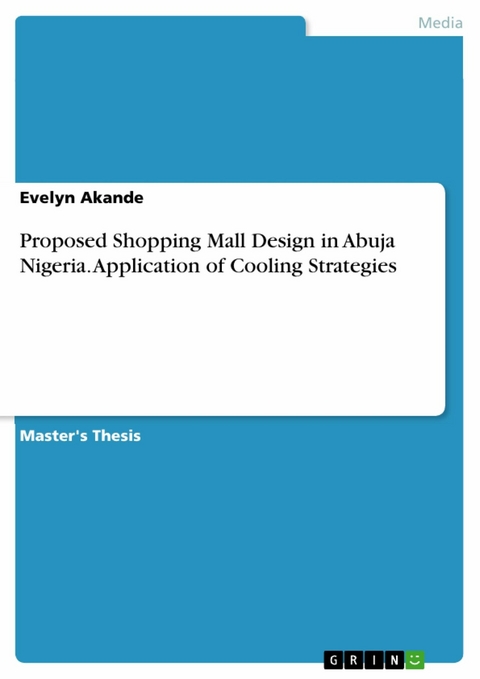
Proposed Shopping Mall Design in Abuja Nigeria. Application of Cooling Strategies (eBook)
124 Seiten
GRIN Verlag
978-3-346-77855-0 (ISBN)
Shopping malls are now far more complex in terms of both space and interior operations, dispelling the notion that they exist solely for retail sales. The mall serves as a significant urban development hub and provides customers with shopping, entertainment, leisure, and recreation. Shopping malls have evolved to a closed building envelope as a result of this scale increase, necessitating the deployment of additional machinery to handle the mall’s interior heat. Numerous malls in Nigeria only employ mechanical cooling systems, which raises their operational costs in terms of purchase, installation, and maintenance. Therefore, the goal of this project was to create a shopping center that used passive cooling techniques in its architecture.
The objectives assessed the characteristic of shopping mall design, the cooling strategies used in shopping malls and the architectural design considerations for cooling. Thirteen case studies were selected using the random sampling techniques. Utilizing an observation checklist and the variable for each objective, data from the chosen case studies were collected. The statistical tool SPSS was used to evaluate the data that was gathered. To ascertain the percentages of various variables for the characteristics of shopping mall architecture and the cooling strategies utilized in the chosen samples, a descriptive survey method of analysis was used with an observation schedule.
Findings revealed the frequency of the variables used throughout the study, and it was concluded from the chosen case studies that shopping malls in Nigeria rely more on active cooling systems than passive cooling strategies, with mechanical cooling being used in 76.9% of the malls examined and mechanical and passive cooling being used in 23.1% of the malls. Additionally, the results showed that 7.7% of the areas featured lakes, pools, and fountains, respectively. However, 76.9% of the malls lacked evaporative cooling systems.
| Erscheint lt. Verlag | 13.12.2022 |
|---|---|
| Verlagsort | München |
| Sprache | englisch |
| Themenwelt | Technik ► Architektur |
| Schlagworte | Cooling • Design • Shopping mall |
| ISBN-10 | 3-346-77855-X / 334677855X |
| ISBN-13 | 978-3-346-77855-0 / 9783346778550 |
| Informationen gemäß Produktsicherheitsverordnung (GPSR) | |
| Haben Sie eine Frage zum Produkt? |
 PDF (Ohne DRM)
Digital Rights Management: ohne DRM
Dieses eBook enthält kein DRM oder Kopierschutz. Eine Weitergabe an Dritte ist jedoch rechtlich nicht zulässig, weil Sie beim Kauf nur die Rechte an der persönlichen Nutzung erwerben.
Dateiformat: PDF (Portable Document Format)
Mit einem festen Seitenlayout eignet sich die PDF besonders für Fachbücher mit Spalten, Tabellen und Abbildungen. Eine PDF kann auf fast allen Geräten angezeigt werden, ist aber für kleine Displays (Smartphone, eReader) nur eingeschränkt geeignet.
Systemvoraussetzungen:
PC/Mac: Mit einem PC oder Mac können Sie dieses eBook lesen. Sie benötigen dafür einen PDF-Viewer - z.B. den Adobe Reader oder Adobe Digital Editions.
eReader: Dieses eBook kann mit (fast) allen eBook-Readern gelesen werden. Mit dem amazon-Kindle ist es aber nicht kompatibel.
Smartphone/Tablet: Egal ob Apple oder Android, dieses eBook können Sie lesen. Sie benötigen dafür einen PDF-Viewer - z.B. die kostenlose Adobe Digital Editions-App.
Buying eBooks from abroad
For tax law reasons we can sell eBooks just within Germany and Switzerland. Regrettably we cannot fulfill eBook-orders from other countries.
aus dem Bereich