The Battle for Isurava
Big Sky Publishing (Verlag)
978-1-922615-67-1 (ISBN)
- Titel ist leider vergriffen;
keine Neuauflage - Artikel merken
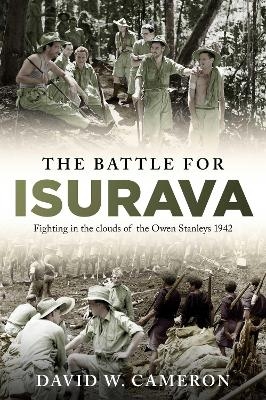
At Isurava, this small militia force of the 39th Battalion now numbering around 300 men was determined to make a stand against a crack Japanese force of the 144th Regiment and supporting elements, numbering at least 1500. Then on the day the Japanese launched their attack, to the great relief of these militiamen, reinforcements from the 2nd AIF who had fought with great distinction in the Middle East began to arrive in the afternoon having spent days struggling up the track from Port Moresby. Even so, the Australians were still outnumbered, as the Japanese also received reinforcements, and unlike the Japanese, the Australians had no supporting artillery or medium machineguns.
The battle for Isurava would be the defining battle of the Kokoda Campaign and has rightfully been described as Australia’s Thermopylae. It was here that Australia’s first Victoria Cross in the Pacific war was awarded when the Japanese conducted several ferocious attacks against the Australian perimetre. Private Bruce Kingsbury led an Australian counterattack, rushing forward sweeping the Japanese positions with his Bren gun, saving he situation when all seemed lost — he was killed leading the charge. Another two men were also nominated for the VC during the fighting at Isurava.
The outnumbered and poorly equipped Australians managed to hold back the Japanese advance for almost a week; only then did these battle scared and weary men begin a month long fighting withdraw towards Ioribaiwa Ridge just north of Port Morsby. However, their sacrifice provided time for the Australian 25th Brigade to be brought forward — finally forcing the Japanese to withdrawal just as they glimpsed the lights of Port Morseby.
David W. Cameron is a Canberra-based author specializing in Australian military and convict history, as well as human and primate evolution. He has published over 60 internationally peer-reviewed papers and book chapters. David received First Class Honours in Prehistoric Archaeology from the University of Sydney and completed his Ph.D. in Palaeoanthropology at the Australian National University. He has held prestigious research fellowships, including an Australian Research Council (ARC) Postdoctoral Fellowship at ANU’s School of Archaeology and an ARC QEII Fellowship at the University of Sydney’s Department of Anatomy and Histology. David has led and participated in numerous international fieldwork projects across Australia, the Middle East (Turkey, Jordan, Israel, UAE), Europe (Hungary), and Asia (Japan, Vietnam, India), and has contributed to conferences and museum studies worldwide.
| Erscheinungsdatum | 21.03.2022 |
|---|---|
| Zusatzinfo | B&W images throughout |
| Verlagsort | Newport, NSW |
| Sprache | englisch |
| Maße | 153 x 230 mm |
| Themenwelt | Geschichte ► Allgemeine Geschichte ► 1918 bis 1945 |
| Geschichte ► Teilgebiete der Geschichte ► Militärgeschichte | |
| Sozialwissenschaften ► Politik / Verwaltung | |
| Technik ► Fahrzeugbau / Schiffbau | |
| Technik ► Luft- / Raumfahrttechnik | |
| ISBN-10 | 1-922615-67-6 / 1922615676 |
| ISBN-13 | 978-1-922615-67-1 / 9781922615671 |
| Zustand | Neuware |
| Informationen gemäß Produktsicherheitsverordnung (GPSR) | |
| Haben Sie eine Frage zum Produkt? |
aus dem Bereich